



惯性聚合 高效追踪和阅读你感兴趣的博客、新闻、科技资讯
阅读原文 在惯性聚合中打开

推荐订阅源

有赞技术团队
有赞技术团队
Exploit-DB.com RSS Feed
aimingoo的专栏
aimingoo的专栏
IT之家
IT之家
G
Google Developers Blog
爱范儿
爱范儿
博客园 - 司徒正美
Recent Announcements
The Register - Security
J
Java Code Geeks
The Cloudflare Blog
M
MIT News - Artificial intelligence
Apple Machine Learning Research
Microsoft Security Blog
博客园 - Franky
雷峰网
雷峰网
酷 壳 – CoolShell
酷 壳 – CoolShell
Blog — PlanetScale
Blog — PlanetScale
Vercel News
Vercel News
宝玉的分享
宝玉的分享
CTFtime.org: upcoming CTF events
B
Blog
小众软件
小众软件
Microsoft Azure Blog
让小产品的独立变现更简单 - ezindie.com
WordPress大学
WordPress大学
T
Troy Hunt's Blog
Application and Cybersecurity Blog
H
Hacker News: Front Page
H
Help Net Security
S
Security @ Cisco Blogs
V
V2EX
Security Archives - TechRepublic
Stack Overflow Blog
Stack Overflow Blog
O
OpenAI News
L
LINUX DO - 最新话题
Cyber Security Advisories - MS-ISAC
S
Secure Thoughts
Help Net Security
Help Net Security
F
Full Disclosure
博客园 - 叶小钗
The Hacker News
The Hacker News
Spread Privacy
Spread Privacy
Threat Intelligence Blog | Flashpoint
Jina AI
Jina AI
K
Kaspersky official blog
www.infosecurity-magazine.com
V
Vulnerabilities – Threatpost
P
Privacy International News Feed
Scott Helme
Scott Helme

NETSCOUT

Resilience Is the Foundation of Modern Security Strategy | NETSCOUT How Machines Are Taking Over Network Traffic | NETSCOUT Why AI Moves Faster Than the Controls Built to Manage It | NETSCOUT NETSCOUT Named a SPARK Matrix™ Leader in Network Observability for the Third Consecutive Year | NETSCOUT Why CDNs Alone Are Not Sufficient for Modern DDoS Protection | NETSCOUT All That Glitters Isn’t Gold: Why AI Needs Better Data | NETSCOUT From Horseback to Real-Time Observability | NETSCOUT Why Digital Twins Are Now Mission-Critical for Scaling 5G with Confidence | NETSCOUT NETSCOUT Earns Six Leader Badges in the G2 Summer 2026 Grid Reports | NETSCOUT When Too Much Data Becomes Too Big an AI Problem | NETSCOUT Game-Changing AI in the RAN Plays by Its Own Rules | NETSCOUT What Is NETSCOUT Smart Data and Why Is It So Important? | NETSCOUT Understanding Network Traffic for Threat Hunting | NETSCOUT Black Box Versus Glass Box DDoS Protection Intellyx Names NETSCOUT to Prestigious 2026 Digital Innovator Award List How to Operationalize Threat Hunting with NETSCOUT, SIEM, XDR, EDR, and SOAR Solving Network Blind Spots Created by Massive Data Silos The Self-Healing Network: Why Your AI Strategy Needs a Neutral Lens Does It Feel Like a Stormy Season in Your Cloud? Four AI Trends Transforming Network Operations The 1 A.M. Cloud Migration Meltdown Communication Service Provider Supports Banking Application Success Across International Borders Defending Against DDoS Attacks at Scale AI-Driven Workflow Automation Is the New North Star for Communication Service Providers Key Takeaways from the EMA Network Management Megatrends 2026 The Digital Foundation of Public Trust Is More Than Skin Deep Unlocking the Full Value of 5G with Network Slicing NETSCOUT to Have a Strong Presence at Cisco Live Why Airlines and Airports Must Embrace Observability Ahead of the Summer Travel Surge Beyond “Best Effort”: Why Carrier Grade 5G Slicing Matters More Than Ever | NETSCOUT The Shrinking Lifespan of SSL/TLS Certificates | NETSCOUT From Packets to Insight: How Curated Network Data Powers AI | NETSCOUT Data Centers Are Feeling the Heat, and That’s OK | NETSCOUT If You Can’t See the Slice, You Can’t Sell the SLA | NETSCOUT Insights from the GigaOm Radar for Network Observability v6 Report | NETSCOUT How Shadow AI Creates Zombie Infrastructure NETSCOUT Earns Eight Leader Badges in the G2 Spring 2026 Grid Reports Your Modern Manufacturing Network Deserves a Modern Observability Strategy How Botnet-Driven DDoS Attacks Evolved in 2H 2025 The Hidden Cost of Poor Network Observability Insurance Systems Look Simple, but the Infrastructure Isn’t How AI is Transforming the RAN With the Right Data When Cloud SaaS DDoS Mitigation Offerings Aren’t Enough Frictionless Banking Experiences Start with Observability Colocation Growth Demands Scalable End-to-End Observability Bringing Shadow AI Into the Light AIOps Outcomes Depend on Data Quality, Not Algorithms Why AI, Zero Trust, and Modern Security Require Deep Visibility How Service Behavior Changes in Remote Locations The 10-Hour Problem: How Visibility Gaps Are Burning Out the SOC From Insight to Impact: Observability Fuels AI-Driven Innovation How Orphaned Applications Are Quietly Fueling Your Shadow IT Problem Why Today’s Security Tools Can’t See the Network Anymore How NETSCOUT Addresses Modern Network Observability Challenges Helping IT Organizations Prevent Disruptions Before They Impact Business How Hidden Blind Spots Quietly Became Cybersecurity’s Biggest Vulnerability The Blame Game! Is it the Network or Gaps in Observability? Six Winter 2026 G2 Leader Badges Prove This DDoS Protection Stands Out The Value of Combining Modern Observability Solutions for Actionable Insights AI Failure Is the Norm Because Most Initiatives Are Flying Blind NETSCOUT Distinguished by Frost & Sullivan with the 2025 Company of the Year Recognition 5 Emerging AI Data Trends Enterprise IT Teams Cannot Ignore What is Network Slicing NETSCOUT’s Omnis Cyber Intelligence Earns Security Today’s 2025 CyberSecured Award Turning a Flood of 5G Data into Rocket Fuel for AIOps NETSCOUT Recognized by Comparably as a Top Workplace for Q4 2025 How to deliver consistent ultra-low latency, high-throughput, and total reliability across complex networks Smart Data: The Super Fuel Driving Next-Gen Observability NETSCOUT Recognized for Leadership in Network Detection and Response Integrating Deep Packet Inspection in 5G Networks Removing Barriers to Digital Transformation Gain Real-time Visibility to Future Proof Your Network for Autonomous Operations Why Is Cloud Performance Still Foggy? Smarter DDoS Security at Scale How DPI Is Transforming Observability and Operational Resilience 10 Key Challenges to Optimizing Radio Access Networks in the 5G Era Why Arbor Edge Defense and CDN-Based DDoS Protection Are Better Together NETSCOUT’s Holiday Playlist for IT Teams and Leaders More Data Does Not Always Equate to Better Business Visibility Seeing Clearly with Deep Packet Inspection at Scale How to Ensure High Availability for FWA Services System Integrators and the Future of Enterprise IT The Transformative Power of ‘Thinking’ AI and the Implications for Business How Fast Can Your Organization Identify and Resolve IT Outages? Observability for the “Always On” Power Industry
75,000 DDoS-for-Hire Actors Targeted by Law Enforcement | NETSCOUT
mike.wetherbee · 2026-06-23 · via NETSCOUT

Distributed denial-of-service (DDoS) attacks have become increasingly accessible, commercialized, and disruptive. As reported by Yahoo News, European law enforcement agencies recently identified more than 75,000 individuals suspected of purchasing or using DDoS-for-hire services capable of overwhelming websites, servers, and online services with malicious traffic. These services enable users—often with minimal technical expertise—to disrupt digital operations at scale.

The investigation described coordinated law enforcement action by Europol and international partners to dismantle DDoS-for-hire platforms. Authorities seized domains, databases, and infrastructure that had been used to support attacks across schools, government agencies, businesses, gaming platforms, and critical infrastructure. The scope and scale of the crackdown highlighted how widespread and persistent the DDoS threat has become, particularly against organizations that depend on always-on digital services.

Cost or Consequences

The growing availability of DDoS-for-hire services has clear consequences. According to the article, these attacks are not limited to nuisance disruptions such as gaming outages. Law enforcement agencies and the U.S. Department of Justice confirmed that DDoS attacks have been used to extort organizations, disrupt public services, and cause significant financial loss, particularly through downtime, operational disruption, and increased infrastructure and hosting costs.

Beyond immediate financial impact, organizations face reputational damage, loss of customer trust, and regulatory or public accountability challenges following service outages. The fact that law enforcement felt compelled to issue mass warning emails rather than pursue only individual prosecutions underscores the sheer volume of attacks and the difficulty of relying on legal deterrence alone to protect service availability.

How NETSCOUT Can Help

NETSCOUT’s DDoS attack protection solution is designed specifically to address the realities of modern DDoS threats. The NETSCOUT Arbor DDoS protection portfolio combines always-on, on‑path local defense, in‑cloud DDoS mitigation, and global threat intelligence derived from visibility into a significant portion of worldwide internet traffic.
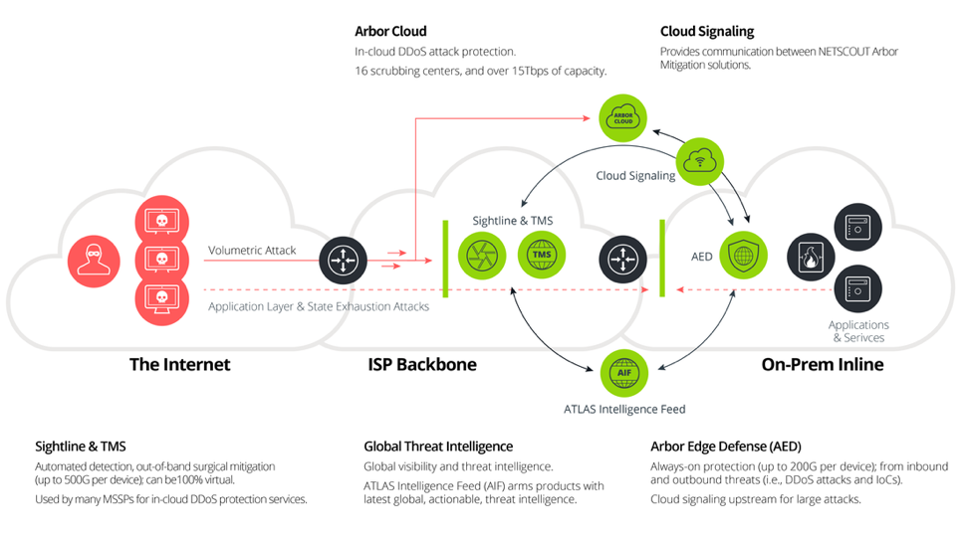
Cloud Signaling and Arbor Cloud Chart

Key elements of the solution include continuous detection of volumetric, state-exhaustion, application-layer, and encrypted DDoS attacks, backed by intelligence from NETSCOUT’s ATLAS Intelligence Feed. This intelligence enables automated, explainable mitigation decisions that can be applied locally or upstream without routing all traffic through a single external dependency. The architecture is designed to preserve service availability while adapting to new and evolving attack techniques as they emerge globally.

Potential Results

By adopting a purpose-built DDoS protection architecture, organizations gain the ability to defend critical services against both large-scale attacks and smaller, targeted disruptions that often evade basic upstream or generic protections. The NETSCOUT Arbor approach enables faster detection, automated response, and operational visibility into why traffic is allowed or blocked—capabilities that are essential when facing frequent, low-barrier DDoS attacks such as those described in law enforcement investigations.

Most importantly, the solution shifts the focus from reacting to outages to maintaining service continuity, even as DDoS activity continues to grow in volume and accessibility. In an environment where tens of thousands of attackers can be identified in a single enforcement action, resilient, intelligence-driven DDoS protection becomes a foundational requirement for digital operations rather than an optional security layer.

For more information click here: