






For more than two decades, enterprise storage operated under a comfortable assumption: hardware would get cheaper, denser, and faster every refresh cycle. Organizations could plan a three- to five-year replacement window, negotiate a new array, migrate data, and expect better economics each time. That assumption no longer holds.
In 2026, infrastructure leaders are facing a different reality. Component costs—particularly memory and flash—are rising again after years of relative stability. AI-driven demand is absorbing capacity across the semiconductor supply chain. Lead times are lengthening.
Vendors are prioritizing high-margin segments. And enterprise buyers are discovering that the “next refresh” is neither cheaper nor simpler.
This is not a temporary fluctuation. It is a structural shift. And it exposes the fragility of the traditional storage refresh model.
Storage Is Now Tied to Global Supply Dynamics
DRAM and NAND flash pricing cycles have always existed, but the current pressure is different. Hyperscale and AI infrastructure are consuming enormous volumes of high-performance memory and storage. Manufacturers are rationalizing production lines. Capacity allocation is strategic.
The ripple effect reaches enterprise IT:
- Higher bill-of-materials costs for arrays and servers
- Less negotiating leverage at refresh time
- Greater pricing volatility
- Extended procurement cycles
When supply tightens and demand concentrates at the top of the market, mid-sized and even large enterprises lose leverage. You are no longer buying in a buyer’s market.
For years, storage refresh cycles relied on declining cost curves to justify wholesale replacement. When that curve flattens—or reverses—the economics break.
The Hidden Risk in the Traditional Refresh Model
The classic model looks simple:
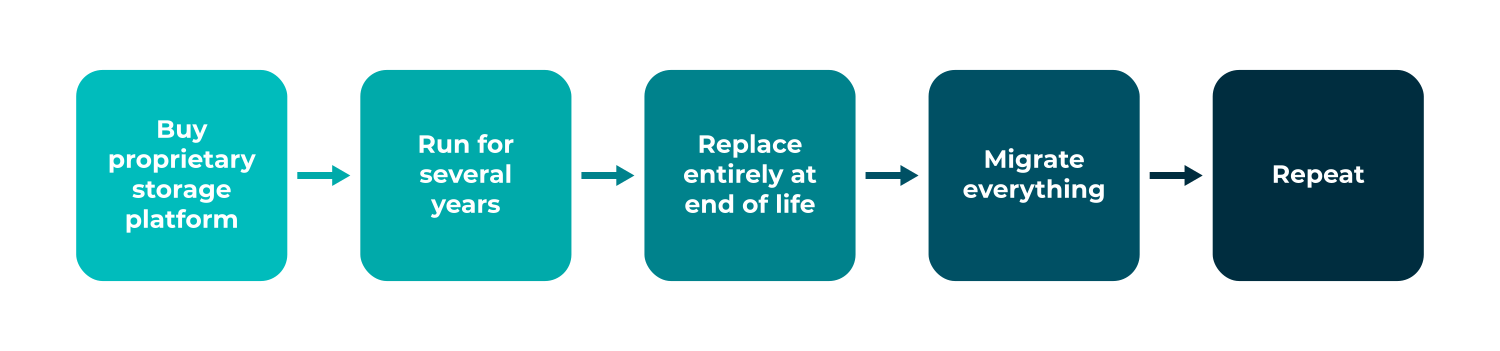
That model assumes three things:
- Pricing improves over time
- Vendor terms remain competitive
- Migration is manageable
In 2026, none of those are guaranteed.
When you are locked into a single vendor’s hardware and data services stack, you are forced to buy on their timetable, at their pricing, under their licensing model. If component costs rise, your replacement cost rises. If supply tightens, your project timeline slips. If budgets shrink, you still face a binary choice: refresh or risk support exposure.
That is not operational agility. That is structural dependency. And dependency is expensive when markets tighten.
Vendor Lock-In Is No Longer Just an IT Concern, It’s a Financial Risk
Historically, vendor lock-in was framed as an operational nuisance. Harder migrations. Licensing constraints. Limited flexibility. In today’s climate, it becomes something else entirely: balance-sheet exposure. When your data services, replication, snapshots, and performance layers are inseparable from proprietary hardware:
- You cannot arbitrage hardware suppliers
- You cannot phase hardware refresh on your terms
- You cannot extend asset life without vendor approval
- You cannot negotiate from a position of strength
In stable markets, that dependency feels tolerable. In volatile markets, it becomes a liability. CFOs increasingly scrutinize infrastructure spend not just for cost efficiency, but for flexibility under uncertainty. A storage architecture that mandates periodic, capital-intensive refresh cycles is fundamentally misaligned with that expectation.

The Strategic Shift: From Refresh Cycles to Architectural Resilience
The conversation should no longer be about when to refresh. It should be about whether your architecture requires disruptive refresh at all. Forward-thinking IT decision-makers are asking different questions:
- Can hardware be upgraded incrementally rather than wholesale?
- Can data services persist independently of specific arrays?
- Can multiple hardware vendors coexist behind a common control layer?
- Can we extend asset life without compromising support or performance?
This is not about chasing the latest hardware innovation. It is about decoupling infrastructure strategy from vendor-imposed cycles.
When software-defined approaches separate control planes from physical devices, organizations gain optionality. Hardware becomes replaceable. Capacity can be added or retired in stages. Supply-chain disruptions become manageable events, not existential crises. That freedom and flexibility are strategic leverage.
The Cost of Inaction
Consider the alternative. An organization tied to rigid refresh cycles in a rising-cost environment will face:
- Higher capital spikes every few years
- Increased project risk during migrations
- Reduced negotiation leverage
- Budget unpredictability
- Deferred modernization elsewhere to fund infrastructure replacement
Over time, infrastructure becomes a drag on innovation rather than an enabler of it. And in an era where digital initiatives compete directly for capital, that trade-off becomes painful.
What IT Leaders Should Do Now
This is not a call for panic. It is a call for architectural introspection. IT leaders should:
- Map where true dependency exists in their storage stack.
- Model total lifecycle cost over 10 years, not just purchase price.
- Assess how much of their spend is dictated by vendor timelines.
- Evaluate whether data services can survive hardware transitions.
- Build negotiation leverage through architectural flexibility.
The goal is not to eliminate vendors. It is to prevent any single vendor from dictating your economic future. In a tightening market, flexibility equals power.
A New Mindset for 2026 and Beyond
 The era of automatic cost decline in enterprise storage is over, at least for now. Demand from AI infrastructure, supply-chain prioritization, and pricing volatility have altered the landscape. IT organizations that cling to legacy refresh thinking will experience higher cost, higher risk, and lower leverage. Those that redesign around architectural independence will gain something more valuable than marginal performance gains: control. And in uncertain markets, control is the ultimate competitive advantage.
At DataCore, we believe organizations shouldn’t have to trade flexibility for performance or accept vendor lock-in as the price of stability. Our software-defined solutions help IT teams build freedom of choice across block, file, object, and container-focused environments—deployed where it matters most, from the core data center to the edge and into hybrid and cloud architectures.
The outcome is practical control: extending asset life, reducing disruption and risk during change, improving cost predictability, and strengthening negotiating leverage by avoiding vendor-driven refresh cycles. If you’re reassessing storage strategy in today’s volatile market, connect with DataCore to discuss how architectural independence can help you stay in control.