惯性聚合 高效追踪和阅读你感兴趣的博客、新闻、科技资讯
阅读原文 在惯性聚合中打开

推荐订阅源

Apple Machine Learning Research
Exploit-DB.com RSS Feed
S
Security @ Cisco Blogs
cs.CV updates on arXiv.org
Cisco Talos Blog
Cisco Talos Blog
Cyberwarzone
Cyberwarzone
SecWiki News
SecWiki News
Webroot Blog
Webroot Blog
L
LINUX DO - 最新话题
V
Vulnerabilities – Threatpost
T
Troy Hunt's Blog
Cloudbric
Cloudbric
L
LINUX DO - 热门话题
Google DeepMind News
H
Heimdal Security Blog
S
Schneier on Security
NISL@THU
NISL@THU
The Hacker News
The Hacker News
Attack and Defense Labs
A
Arctic Wolf
V2EX - 技术
V2EX - 技术
Security Latest
Security Latest
AWS News Blog
AWS News Blog
Scott Helme
Scott Helme
W
WeLiveSecurity
S
Secure Thoughts
Y
Y Combinator Blog
GbyAI
GbyAI
H
Hackread – Cybersecurity News, Data Breaches, AI and More
博客园 - Franky
量子位
人人都是产品经理
人人都是产品经理
雷峰网
雷峰网
K
Kaspersky official blog
P
Privacy & Cybersecurity Law Blog
T
Tenable Blog
The GitHub Blog
The GitHub Blog
cs.CL updates on arXiv.org
J
Java Code Geeks
Vercel News
Vercel News
Recent Commits to openclaw:main
Schneier on Security
云风的 BLOG
云风的 BLOG
小众软件
小众软件
Engineering at Meta
Engineering at Meta
宝玉的分享
宝玉的分享
C
CERT Recently Published Vulnerability Notes
Security Archives - TechRepublic
C
CXSECURITY Database RSS Feed - CXSecurity.com
P
Palo Alto Networks Blog

Apptio

How IBM Apptio Delivers Data Center Value in the Age of AI - Apptio Managing K8s Agent Updates at Scale with Helm and Terraform - Apptio GitOps with IBM Kubecost: API-Driven Rightsizing - Apptio It’s Here: Meet the New IBM Apptio Report Studio – A Faster, More Intuitive Approach to Reporting - Apptio New Tech, Same Rules: Cloud Lessons for an AI Advantage - Apptio IBM Cloudability Advanced Containers for Kubernetes FinOps - Apptio The Next Era of IT Financial Management Reporting with the New IBM Apptio Report Studio - Apptio From Guesswork to Confidence: Introducing Intelligent Forecasting for Tech Spend Planning - Apptio Smarter Technology Spend with AI-Driven Financial Intelligence - Apptio Budgets Are Up, Confidence Isn't: 2026 Global Tech Investment Insights - Apptio IBM Kubecost 3.1: Kubernetes Resource Quota Rightsizing - Apptio Driving FinOps Forward in 2025 and Beyond - Apptio ITFM Maturity: The Next CIO Imperative in the Age of Innovation - Apptio How Banks Can Optimize IT Spend Without Sacrificing Impact - Apptio Introducing IBM Apptio Product TCO: Turn Product Spend into Strategic Investments with Clear, End-to-End Total Cost of Ownership and Unit Costs: Creating a Strategic Lens for IT Investment Decisions - Apptio Workforce Management: The Engine of Strategic Portfolio Management - Apptio FinOps for AI: Enabling the Next Wave of Cloud Innovation - Apptio IBM Kubecost 3.0: Faster, Smarter, and Built for Scale - Apptio Introducing IBM Apptio Mainframe TCO: Complete Visibility into Mainframe Costs and Usage - Apptio Essential K8s Cost Metrics for Reducing Spend - Apptio The New Standard for Strategic Portfolio Management: Financial Visibility at Every Level - Apptio K8s Cost Ownership: Who’s Responsible and How to Make It Work - Apptio Kubecost 2.8: Centralized Custom Pricing and a Big Performance Leap with ClickHouse - Apptio Unlock the Power of IT Financial Management with IBM Apptio Essentials - Apptio Full Transparency for Smart AI Investments with IBM Apptio’s AI Total Cost of Ownership & Usage - Apptio What’s New in IBM Apptio Planning - Apptio Labeling in Kubernetes: From Metadata to Money-Saving Insights - Apptio Innovative Approaches to Drive Tech Spend Management with AI, Analytics, and Automation - Apptio Discover Kubecost on Apptio’s Website: Enhancing FinOps with Kubernetes Insights - Apptio How Kubecost Collections Works: From the Engineers Who Built It - Apptio Kubecost 2.7 Release Highlights - Apptio Introducing Hybrid IT TCO Impact: IBM Apptio’s Newest Solution to Manage Your Evolving Hybrid Environment - Apptio FinOps Essentials: Best Practices for Finance Teams - Apptio Upgrading Your Kubecost Experience - Apptio Kubecost 2.6 Release Highlights - Apptio Kubernetes Efficiency: Cut Waste, Not Performance - Apptio FinOps Essentials: Best Practices for Product Teams - Apptio Optimizing GPU Monitoring for AI Efficiency - Apptio Kubecost 2.5 Release Highlights - Apptio FinOps Essentials: Strategies for Smarter Cloud Spending - Apptio Achieving Cost-Effective Scaling in Kubernetes - Apptio Celebrating OpenCost’s Journey to CNCF Incubation - Apptio Unlocking Technology Value: The Essential Role of TBM in Modern IT Management - Apptio The Complex Costs of AI: Investments, Funding, and ROI Tracking - Apptio Addressing Carbon Emissions in IT: The New Business Imperative - Apptio Kubecost Brings NVIDIA GPU cost monitoring for AI workloads in 2.4 - Apptio Kubecost Launches Support for Oracle Cloud - Apptio Kubecost 2.4 Release Highlights - Apptio Evolving Container Cost Visibility with IBM Cloudability - Apptio Transforming the Way You Manage Your Digital Portfolios: IBM Apptio and ServiceNow - Apptio Maximizing Kubernetes Cost Efficiency with Kubecost and Amazon EKS - Apptio FinOps Foundations: Strategies for Cross-Team Alignment - Apptio Managing Kubernetes Costs in a Multi-Cloud Environment - Apptio Unlock Kubernetes Savings with Kubecost’s Automated Actions - Apptio Celebrating a Milestone: Kubecost Surpasses 10 Million Installs - Apptio Kubernetes Pricing: On-Premises Versus Cloud Environments - Apptio Maximizing Multi-Cloud Efficiency with Kubecost APIs - Apptio Aligning Tech Financials and Labor Resources - Apptio Kubecost 2.3 Release Highlights - Apptio IBM Cloudability Introduces New Innovations for FinOps Practitioners - Apptio Kubecost Launches the First Kubecost Certification - Apptio Enhancing Cloud Reporting: Attributing Costs to Kubernetes Applications - Apptio Building a FinOps Solution for All - Apptio Navigating the Growing Complexities of Technology Spend Management - Apptio Apptio Introduces New Products to Elevate Technology Value - Apptio Developing a Strategy for Kubernetes Cost Monitoring - Apptio Visualize your Kubernetes Network Costs - Apptio Getting Highly Accurate and Granular Cost Metrics with Kubecost - Apptio 8 Steps to Achieve Enterprise Agile Planning Success - Apptio FinOps and TBM at Public Sector Summit - Apptio Introducing Kubecost Collections - Apptio Apptio & ServiceNow launch new Application Portfolio Management capabilities - Apptio Beyond the Hype: A Balanced View of AI Adoption - Apptio 2.1 Release Highlights - Apptio Starting your Technology Business Management Journey: A Guide for Smart Technology Investments with Apptio Cost Management - Apptio IBM Cloudability: 2023 Innovation in Review - Apptio Kubecost 2.0 Packaging - Apptio Kubernetes Readiness Probe: Tutorial & Examples - Apptio Kubernetes Health Check - How-To and Best Practices - Apptio Introducing Kubecost 2.0 - Apptio Kubernetes Liveness Probe: Tutorial & Examples - Apptio Kubernetes Cluster Size: Your Guide to Optimization - Apptio EKS Cost Monitoring: The Kubecost and AWS Solution - Apptio Kubernetes Deployment Strategies: Tutorial & Examples - Apptio Guide to Kubernetes Management Tools - Apptio Automate Your Rightsizing Workflows with IBM Cloudability and ServiceNow - Apptio Kyverno and Kubecost: Real-time Kubernetes Cost Management - Apptio Making Smarter IT Decisions With Apptio Plus ServiceNow Breaking Down Silos Between Finance and Agile Teams With Lean Budgeting - Apptio Maximize Cloud Savings Without Running Afoul of AWS RI Marketplace Enforcements - Apptio Cost-Effective Deployment Policies With Kyverno - Apptio Tracking Waste on Kubernetes Clusters - Apptio Blending FinOps With Observability - Apptio 3 Key Opportunities for Finance Teams in SAFe 6.0 - Apptio Kubecost Predict Part 2: Introducing the Admission Controller - Apptio The CEO as the Chief Transformation Officer - Apptio Client Challenge Client Challenge Client Challenge
GitOps with IBM Kubecost: Preventing Argo CD Rollbacks - Apptio
Mohammad Azharuddin · 2026-05-08 · via Apptio

Introduction

Over-provisioned containers are one of the quietest budget leaks in Kubernetes. Pods requesting 512Mi of RAM but using 20Mi. CPU requests of 500m with actual consumption around 10m. Multiply that across dozens of deployments and the waste adds up fast.

In our previous post, GitOps with IBM Kubecost: API-Driven Rightsizing, we showed how to apply IBM Kubecost recommendations through Git so Argo CD can reconcile those changes as part of a standard GitOps workflow. This post builds on that foundation by covering a second approach: using IBM Kubecost Actions to apply rightsizing changes on a recurring schedule, and configuring Argo CD to keep those changes in place instead of reverting them.

The problem: Argo CD self-heal vs. rightsizing patches

Argo CD’s selfHeal: true automatically reconciles drift in managed fields back to the Git-defined desired state. That’s great for stability, but it directly conflicts with any tool that mutates resource specs in-cluster without a Git commit.

When Kubecost Actions updates resources.requests, Argo CD detects the divergence and reconciles the Git-defined state back on the next sync cycle unless those fields are ignored.

The fix: tell Argo CD to ignore differences in resource requests and limits using ignoreDifferences, while letting it continue managing everything else.

Step 1: Configure Argo CD to ignore resource diffs

Add the ignoreDifferences block below to your Argo CD Application manifest. This tells Argo CD to ignore requests and limits differences from reconciliation at both the Pod and Deployment levels.

project: default 
source: 
repoURL: <$REPO_URL> 
path: <$PATH> 
targetRevision: HEAD 
destination: 
server: <$SERVER> 
namespace: argocd-prod-apps 
syncPolicy: 
automated: 
prune: true 
selfHeal: true 
syncOptions: 
- CreateNamespace=true 
- RespectIgnoreDifferences=true # ← required 
ignoreDifferences: 
- kind: Pod 
jqPathExpressions: 
- .spec.containers[].resources.requests 
- .spec.containers[].resources.limits 
- group: apps 
kind: Deployment 
jqPathExpressions: 
- .spec.template.spec.containers[].resources.requests 
- .spec.template.spec.containers[].resources.limits

Don’t skip RespectIgnoreDifferences=true. Without it, Argo CD respects the ignored fields during health checks but overwrites them on the next sync.

Step 2: Check your recommendations in Kubecost

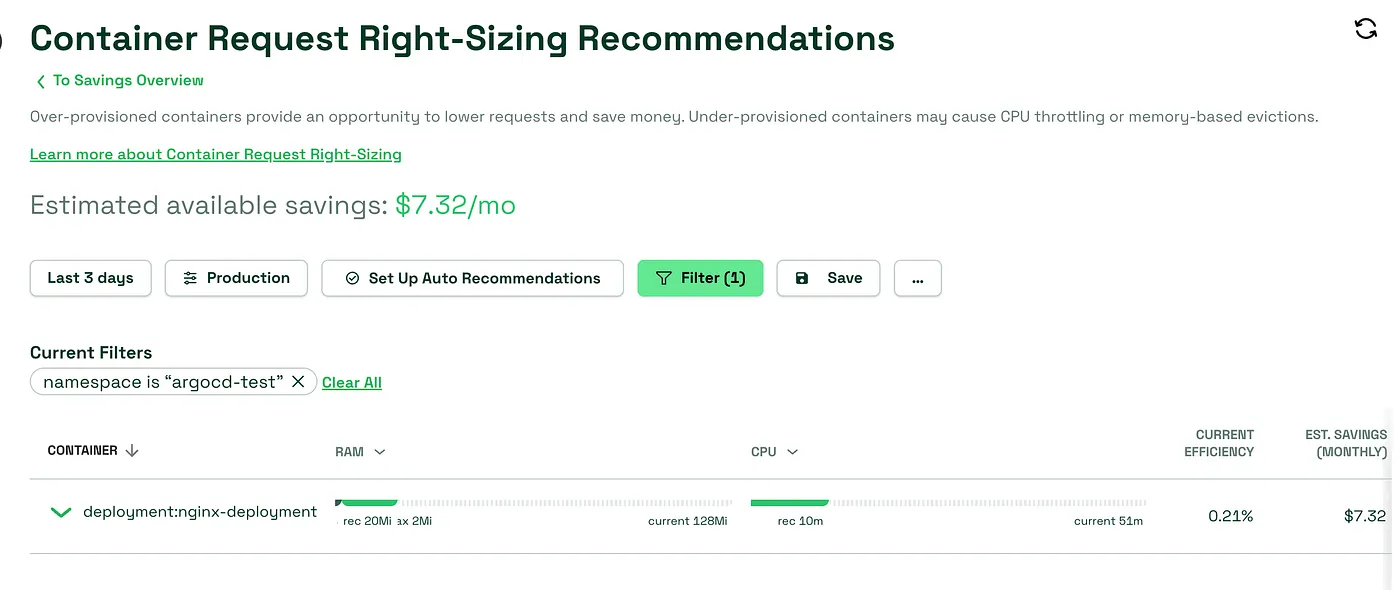
Go to Savings → Container Request Right-Sizing and confirm Kubecost has enough usage data to make meaningful recommendations. Filter by namespace to scope the view to the workloads you want to automate.

Kubecost GitOps 1 - GitOps with IBM Kubecost: Preventing Argo CD Rollbacks - Apptio

Figure A: In this example, nginx-deployment requests 128Mi RAM and 51m CPU but actually uses 20Mi and 10m—a 0.21% efficiency rating, worth $7.32/month in recoverable waste.

Step 3: Create a Kubecost Action

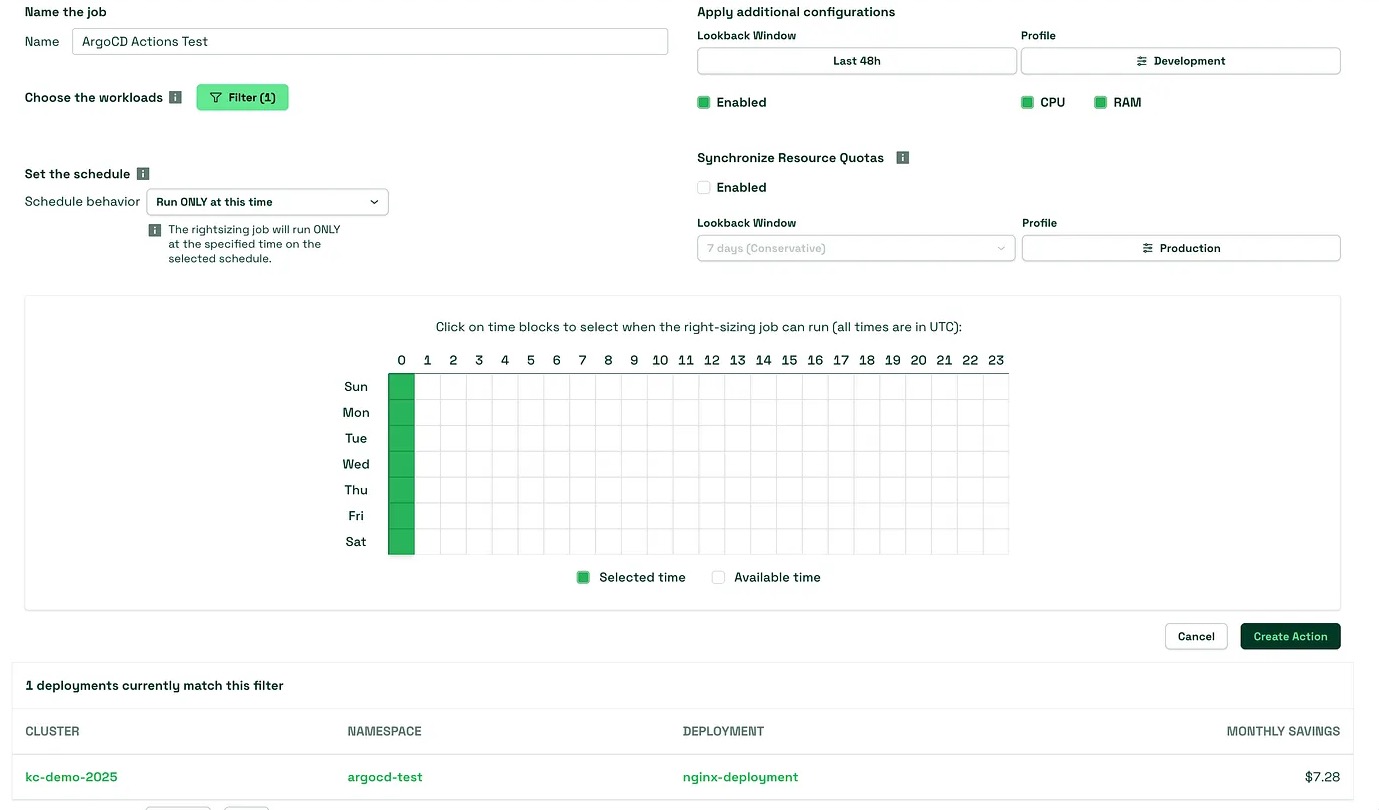
Go to Actions → Create Action and configure:

  • Name: something identifiable in logs, e.g. ArgoCD Actions Test
  • Workloads: filter to the target namespace or deployment
  • Schedule: use the time-block grid to pick low-traffic UTC hours for when patches should apply
  • Profile: Development for aggressive savings (P95 usage), Production for conservative headroom. Match your lookback window to the same risk tolerance.

Click Create Action when done.

Kubecost GitOps 2 - GitOps with IBM Kubecost: Preventing Argo CD Rollbacks - Apptio

Figure B: Screenshot showing “Create Action” in IBM Kubecost.

How it works end-to-end

  1. Kubecost patches the live Deployment’s resource requests on schedule.
  2. Argo CD detects a diff but ignores the resources fields per your configuration.
  3. The updated rightsized values persist, while Argo CD continues reconciling the rest of the Application as usual.

On Git drift: Your committed manifests will diverge from the live cluster state for the ignored resource fields. This is an acceptable tradeoff for most teams. If strict manifest purity is required, use Kubecost’s recommendations to drive automated PRs instead.

Conclusion

The ignoreDifferences block is the handshake between Argo CD and IBM Kubecost—Argo CD owns desired state, IBM Kubecost owns resource sizing. A few dollars saved per deployment per month becomes significant at scale, with no ongoing manual effort after setup.

To see this in action, check out our Monthly Kubechat webinar, Closing the Kubernetes Cost Loop with GitOps.