







Reading Time: 7 minutes
Whether you’re a veteran podcaster or you’re just starting out, one sure way to improve your show’s content is by planning podcast episodes. Make sure you have a solid plan before you turn the mic on. It pays to know the structure of the episode, what you’re going to discuss, and to have your research, facts and stats to hand – the less stress when you hit play, the better.
Keeping your episodes within a fairly uniform time is super important for listener retention. It’s quite difficult to do that, though, without a plan: if you need to touch on three or four ideas within 25 minutes, you’ll need to keep an eye on your notes and the clock to ensure you can fit everything in!
Your episodes don’t all have to be identical down to the second, but keeping them in the same ballpark is super important. That said, there’s no issue with you having additional or bonus episodes that are either longer or shorter than the usual format. Make sure your listeners are aware that it is a special episode, and that’s why it’s different from the usual.
Whether you’re interviewing a guest or discussing a topic or concept on your own, it pays to be informed. Having all your research in front of you ensures that you have any necessary facts and figures to hand to help back up what you’re saying, it also reduces mistakes and time spent on editing. Aside from that, it’s also good practice for any kind of public speaking, recorded or otherwise.
Proper planning leads to organized recording, which leads to easier editing. If you know roughly where you need to insert jingles between segments or any other post-production goodness, either you or your editor will have a far easier time.
With each episode, the likelihood is that there’ll be a few key points that you absolutely need to hit in order to cover the topic successfully. With a good, solid plan, there’s absolutely no danger of you missing one of these and having to go back and edit or re-record. You could have the best memory in the world, but if you don’t have a plan there’s a good chance that you could forget something or have to cram it in at the end, ruining the flow of your episode.
If only there was some kind of tool to plan your podcast episodes integrated directly into your podcast hosting service…
Captivate podcasters, plan episodes from within the platform with Research and Planning, including episode titles, private host (and guest) notes, details about the episode, guest information and links to your research.
Turn episode ideas directly into podcast episodes with the click of a button. Episode Details become your show notes, and Production Notes stay private for you as a host and your guests, without becoming publicly visible to your listeners.
Assign guests to episode ideas, who have booked using the guest booking tool, and their details are dynamically pulled into your Production Notes and episode show notes when you’re ready to hit publish. When guests book, they fill in their details such as their biography and social media links, meaning you don’t have to, saving you, so much time.
Once you’ve created your episode idea, all you have to do is click on Convert to Episode and the episode idea will become a draft episode, with your show notes, research links and guest booking details already populated, ready for you to attach an mp3 file.
For more, read our Captivate Research and Planning full guide.
The structure of your episode will depend pretty heavily on the format of your show – if it’s an interview-based podcast, you’ll be pulling from a different set of genre conventions than a news podcast or a narrative one. There are, however, some important points that apply to all podcasts, regardless of the genre.
Think of each episode as a conventionally structured story – if you’re introducing a concept or a person, explain what it is or who they are. It’s important for your listeners to be able to follow your ideas, so if you’re discussing something which needs background information to be understood, make sure to give that background information.
A good example of this is in one of my favourite podcasts, Philosophize This. As the name suggests, this podcast discusses the work of philosophers and philosophical concepts. Episodes tend to deal with just one philosopher’s work, though usually the work of a given philosopher is built off or in opposition to the work of other philosophers. Therefore, in order to talk about the topic properly the host, Stephen West, has to acknowledge other concepts.
What Stephen does is briefly summarise the tangential concept and directs listeners to an episode covering that concept. They don’t assume knowledge on the listeners part, and is careful to make sure that listening to an episode doesn’t require you to have listened to all of their other content, which would make the podcast virtually inaccessible to new listeners.
Calls to Action (or CTAs) are requests for your listeners to do something for you, for example, “follow me on Twitter” or “leave me a review on Podchaser”. You also have CTAs that are accompanied by a lead magnet to further incentivize listeners, for example, “sign up to my email list to receive an exclusive episode for free” or “sign up to my email list to receive this free downloadable resource”.
There are three places to include a CTA:
Savvy podcast listeners will skip past the introduction, or stop listening when they know the episode is coming to an end. Not all, but some will, especially those who are familiar with your podcast and format. That’s why having a mid-roll CTA works great, as no one knows when the midpoint of your podcast episode will be, meaning they won’t skip and miss it.
Pre, mid and post-roll CTAs can be easily managed with Captivate AMIE, our dynamic content insertion tool.
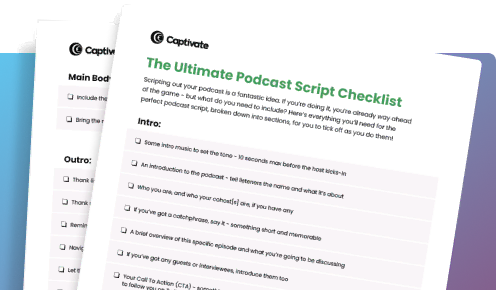
"*" indicates required fields
100% secure. We never share your email
Our article on whether there is an ideal podcast episode length, goes into detail and answers this very question, including how integral your knowledge of your target audience and their listening habits is in deciding how long to make your show.
For the purposes of now, though, you should be considering two things in particular when deciding your show length.
Consistency is extremely important with your show length – it allows your listeners to build your show into their routine. If they know the show is 25 minutes, they can listen on their commute or in the bath after a long day.
You want to keep the show at a similar length throughout its run, so it’s important to make sure you’re being realistic about how much time you can spend on your show per week. Do you have time to record, edit and promote an hour long show? If so, great! If not, consider shorter-form content – reliability will lead to growth, so just be honest with yourself.
To effectively market anything, you need to know your target audience inside and out. The trick is to distil your ideal listener down to one person, a person who we’ll call your podcast avatar.
Reading Time: 6 minutes Everything you need to create a strong podcast brand that will help you to grow! Find out what it is, how to build one and its benefits today.
You want to know everything about your avatar – how old are they, do they have disposable income, do they commute to work, what are their interests? These characteristics inform your show: if your avatar is in their 30s and commutes to work, you should be shaping your show to fit this. A 25 minute show is perfect for a commute, and we know someone in their 30s would generally be easier to connect with on Instagram or Twitter than Tik Tok.
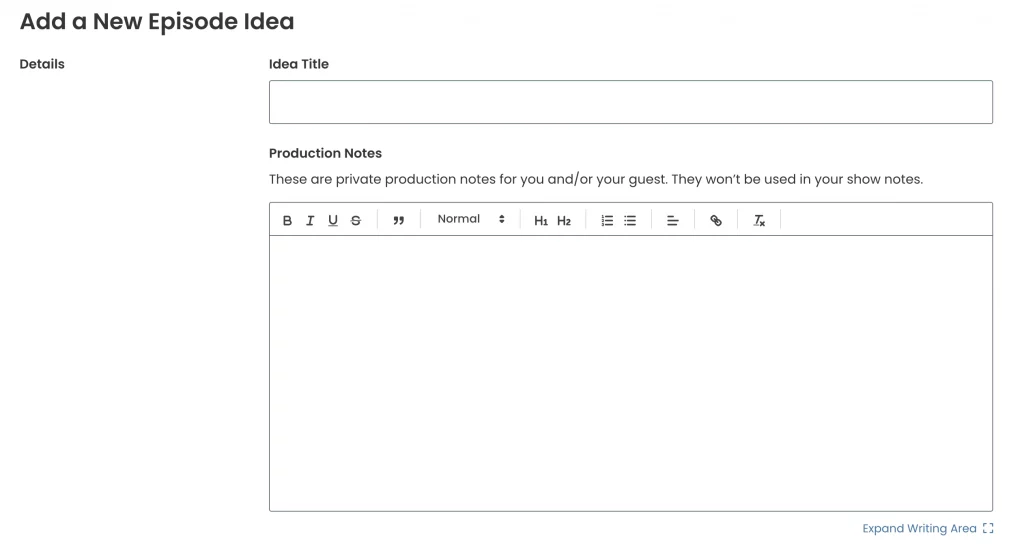
If you use Captivate, you have this template already in Research and Planning in the dashboard. Go to Episode Planning which you can use when recording, and remember due to Captivate’s integrated nature, when you’re ready for your episode to go live simply hit Convert Episode Idea and your show notes will be populated with the below information (apart from the private Production Notes for hosts and guests).
Something short and snappy, and includes a keyword e.g. what query will your audience be using in Google to find your podcast episode?
These are private production notes for you and/or your guest. They won’t be used in your show notes. Put in questions or any prompts or reminders that will help you when recording, such as key concepts, facts/stats, CTAs etc.
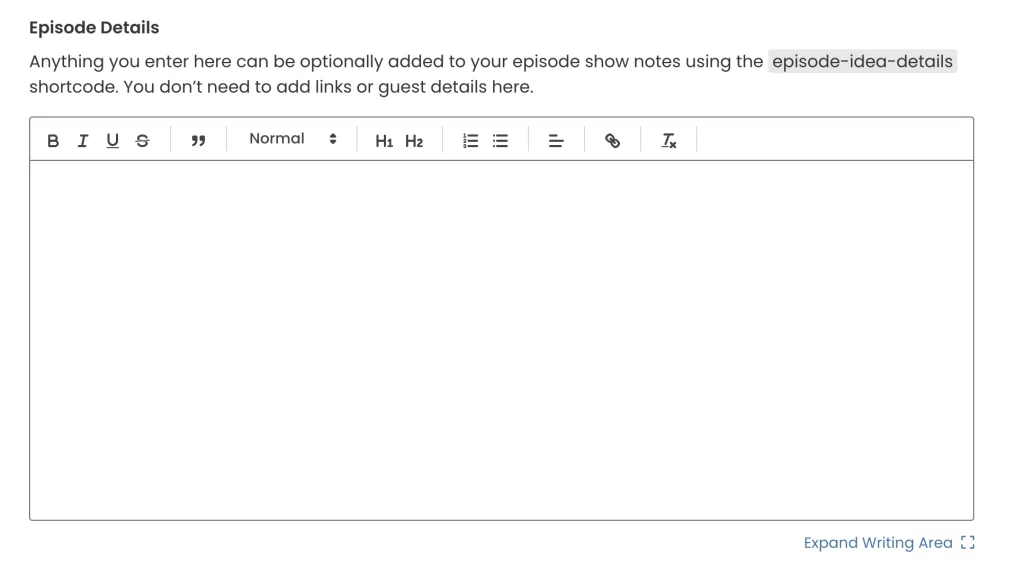
Details about what this podcast episode will cover and what your listeners can expect. Anything you enter here can be optionally added to your show notes using the episode-idea-details shortcode in Captivate.
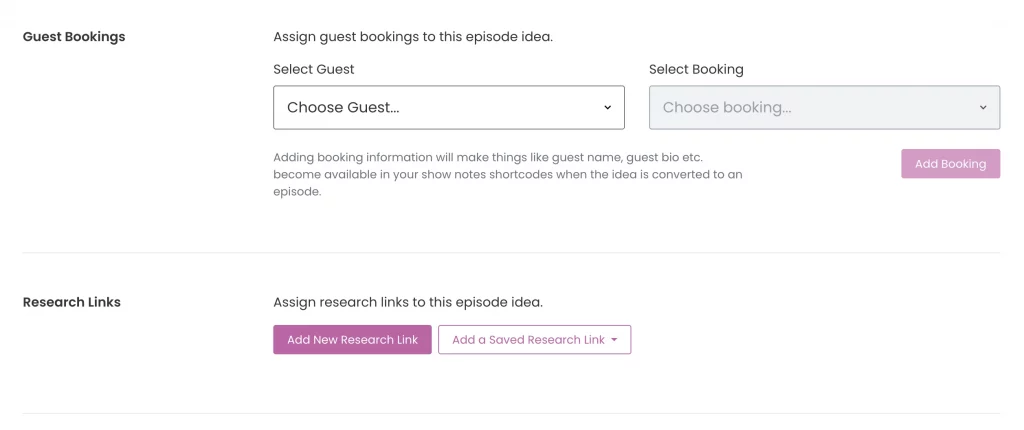
If you have a guest, make sure you have their details on hand, as this will make it easier when you’re introducing them. With Captivate, booking guests is easy with our guest management tool. Send guests a link to book a time, and fill in their details. Once in the system, and assigned to an Episode Idea, you have their details to hand when recording. Also when the Episode Idea is converted to an episode in Captivate, the below guest information can be dynamically pulled into your show notes using shortcodes:
Add research links, so that you can reference them when recording episodes. Captivate podcasters, these will also be dynamically pulled through to your show notes when converted into an episode.
Podcast planning is important. You’ll find what works best for you, but the main aim is to make sure you have a solid plan before you turn the mic on, making it easier for yourself when you hit record – that way, you can focus on your delivery and the quality of content.
Proper planning allows you to stay on track with your episodes, and keep your episodes uniform in length, which is super important for audience building, as it allows listeners to build your show into their routine and look forward to your next episode.
Planning also makes sure you cover all the key concepts in your episodes, and have research and guest information on hand when recording. It will also help you to remain a well-informed, unflappable host at all times.
Use our templates above and see how much easier a good plan makes podcasting for you!
"*" indicates required fields
100% secure. We never share your email
Ben is a content writer and podcast support expert for Captivate, and has been with the team since 2021. He has a first-class degree in Journalism, and uses these skills to help new and veteran podcasters alike level up their content: reviewing tech, crafting product guides and sharing cutting edge podcasting news. Ben is always on hand to help Captivate podcasters with anything they run into, from when they first import their show to advanced questions like how to grow your audience or where to start with monetization. He loves what he does, and is committed to helping podcasters grow their show using Captivate. He’s always been a podcast fan - current favourites include Steven West’s ‘Philosophize This’ and Bob Mortimer’s ‘Athletico Mince’.
此内容由惯性聚合(RSS阅读器)自动聚合整理,仅供阅读参考。 原文来自 — 版权归原作者所有。
