

惯性聚合 高效追踪和阅读你感兴趣的博客、新闻、科技资讯
阅读原文 在惯性聚合中打开

推荐订阅源

D
Docker
B
Blog RSS Feed
Microsoft Security Blog
Y
Y Combinator Blog
N
Netflix TechBlog - Medium
M
MIT News - Artificial intelligence
奇客Solidot–传递最新科技情报
奇客Solidot–传递最新科技情报
B
Blog
钛媒体:引领未来商业与生活新知
钛媒体:引领未来商业与生活新知
C
Check Point Blog
The GitHub Blog
The GitHub Blog
让小产品的独立变现更简单 - ezindie.com
P
Proofpoint News Feed
Martin Fowler
Martin Fowler
大猫的无限游戏
大猫的无限游戏
GbyAI
GbyAI
博客园_首页
A
About on SuperTechFans
Blog — PlanetScale
Blog — PlanetScale
人人都是产品经理
人人都是产品经理
T
Tailwind CSS Blog
aimingoo的专栏
aimingoo的专栏
T
The Blog of Author Tim Ferriss
The Cloudflare Blog

Superuser

OpenDev’s Quiet 15-Year Marathon – Superuser From GitLab SaaS to Full Sovereignty: Hosting GitLab in an OpenStack Cloud – Superuser We Made an OpenStack Cloud Tell Its Own Story – Superuser Do the invisible security work, too – Superuser ALASCA/SCS Sovereign Cloud for International Telecommunication Union (ITU) – Superuser How the University at Buffalo Modernized Its Research Cloud with OpenStack – Superuser A Hybrid Private Cloud as an AI Factory – Superuser How India’s Payment Backbone Runs on Open Source – Superuser What AI Builders Can Learn From a Decade of Open Source CI – Superuser How Pinaka ZTi Builds Sovereign Clouds Governments Can Actually Trust – Superuser KDDI’s Private Cloud Supporting Communications – Superuser When Vietnam’s Cloud Infrastructure Is No Longer the Bottleneck – Superuser Sovereign AI Cloud – Superuser How France’s National Railway Runs on Open Source – Superuser Why Digital Sovereignty Depends on Invisible Labor – Superuser Why AI Agents Need Stronger Sandboxing and What the Kata Containers Community Is Doing About It – Superuser A Guide to Manila Security and Terraform Integration – Superuser A Strategic Growth Opportunity for Open Infrastructure – Superuser NTT DOCOMO’s Tacker Activity – Superuser NTT DOCOMO’s Journey of Virtualization for Mobile Networks – Superuser How Rapifuzz CyberKshetra Built a Scalable Cyber Range on OpenStack (and Cut Costs by 60%) Integration of the Octavia module (Load Balancer as a Service) in an OpenStack Cloud Environment – Part 2 – Superuser OpenStack Case Study: CloudVPS – Superuser The 10th China Open Source Hackathon Recap: Projects, Talks, and More – Superuser Inside CERN’s Open Data portal – Superuser Taking the OpenStack ops manuals to the next level – Superuser Making your first contact with OpenStack – Superuser How tech giant Tencent uses OpenStack – Superuser Managing port level security in OpenStack – Superuser Using Ansible 2.0 to launch a server on OpenStack – Superuser
Ongoing Development and Next Steps for DOCOMO and Tacker ...
Yuya KunoYasafumi Ogawa · 2026-04-07 · via Superuser

DOCOMO is now developing and deploying container-based VNF as vRAN and 5GC. This activity evolves operational way significantly by cloud-native technology and the evolution extends NFV merits. The fundamental benefits of NFV are economic cost, telecom level quality and automation operation. Minimizing cost, power, and on-site maintenance is important for cost reduction and extending RAN domain will get more merit. Intelligent, autonomous and highly efficient resource management are also important for automation and quality such as long term and stable NFV platform and end to end orchestration.
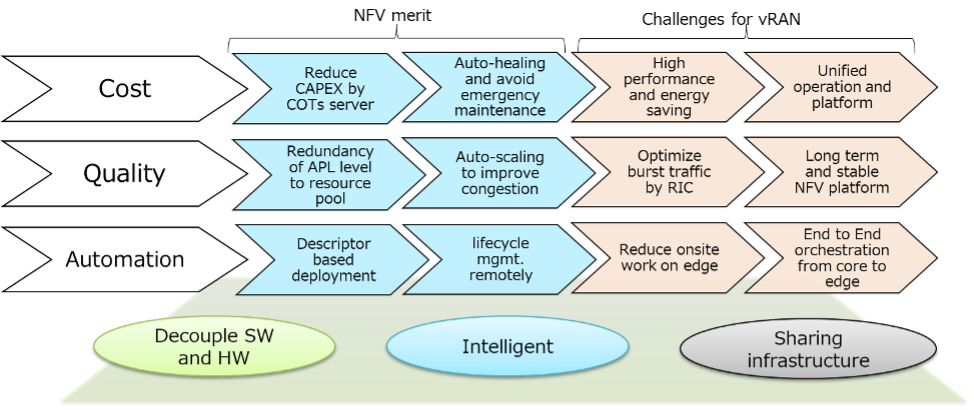
Motivation of virtualization in RAN

New technology of container also enhances more NFV merits. Construction time, healing time and renewal periods have been shorten significantly.
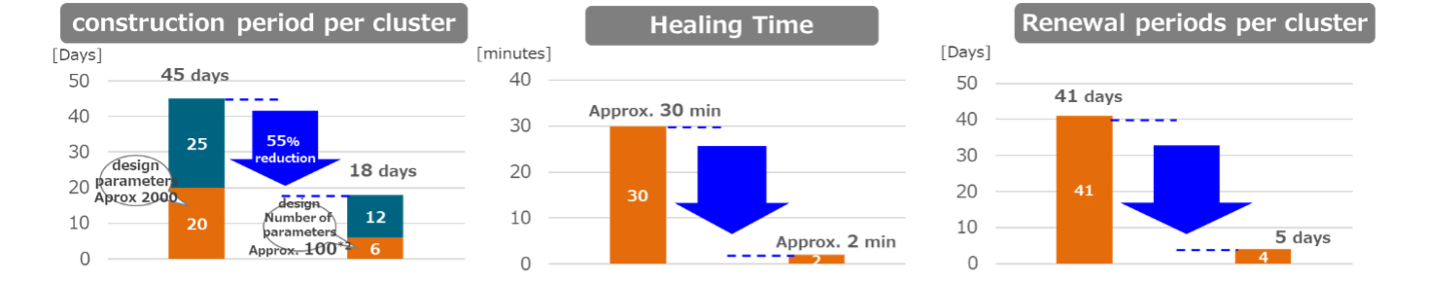
Comparison of VM technology and container technology

2. Next steps

The next step of DOCOMO is evolution of platform with new operational way for more dynamically and dramatically. Although original concept of DOCOMO NFV is to keep maintenance way as legacy operation, DOCOMO is trying to evolve its operational way more dynamic topology of cloud-native, unified data lake and AI technology as figure 10. Operator has 4 big items for operations, design, construction, maintenance and quality management.
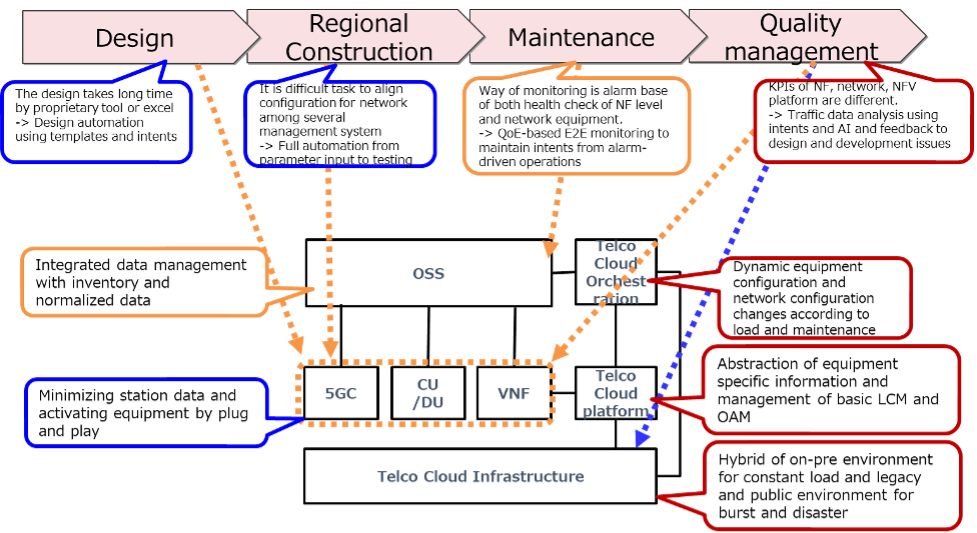
  • Operator wants to shorten design periods by intent or template base deployment.
  • Construction still requires many manual operation, such as configuration among different system, testing, so full automation from parameter input to testing is necessary.
  • Current maintenance work is alarm driven approach that detects and repairs failure triggered by alarm, but QoE-based End to End monitoring to maintain intent is important for user experience.
  • Quality management is difficult and analyze KPI for long term due to different KPIs, but realtime analysis to detect sign of failure by AI is necessary
Next step of DOCOMO operation

In order to new steps, evolution of NFV to Telco Cloud is important. DOCOMO will contribute Telco Cloud architecture and align among standards and open source.
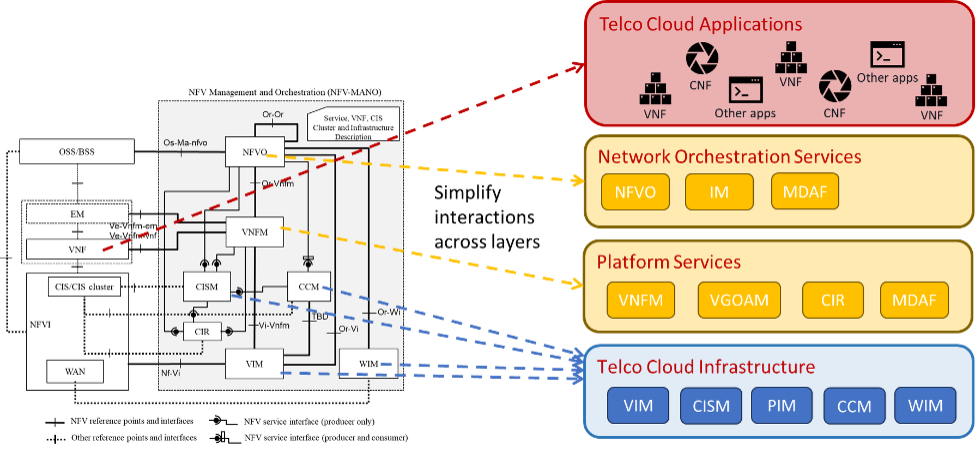
Evolution of NFV-MANO towards Telco Cloud

3. Tacker activity

Tacker team and DOCOMO are also discussing migrating to a Telco Cloud architecture while incorporating new requirements like those mentioned above to keep pace with the evolution of NFV standards.

Current Tacker implementations, like other OpenStack projects, achieve complex NFV specifications by modularizing functionality and ensuring extensibility. However, many key functions—such as lifecycle management and fault recovery—are concentrated within the VNF Manager. Telco Cloud, on the other hand, aims to cover a broader range of use cases, e.g. various type of applications, and enable a smooth transition to 6G by modularizing these functions into separate components and combining them appropriately to meet necessary requirements. The new design of Tacker will be finalized going forward, taking into account the maintenance of the current implementation and the migration timeline, while keeping an eye on the ETSI NFV standard discussions.

Tags: , , , ,

  • Author
  • Recent Posts