









A validated OpenStack distribution from India is quietly solving a problem every government IT team faces — and the lessons apply everywhere.
OpenStack is one of the most impressive pieces of open-source software ever built. Its community, now stewarded by the OpenInfra Foundation, has spent over a decade building a full cloud platform [compute, storage, networking, identity, orchestration] that any organisation can use without paying a licensing fee to any vendor.
That is genuinely remarkable. And the Pinaka ZTi team is grateful for every line of it. When it comes to primary requirement from Governments and Enterprises, someone has to harden it, validate it, package it for offline use, give it a tested upgrade path, and back it with a support team that answers at 2 AM when a critical vulnerability lands. Pinakastra Computing provides Pinaka ZTi that converts the upstream code into an enterprise/defence grade openstack distribution, that makes life easier with Day-0/1/2 cloud operations.
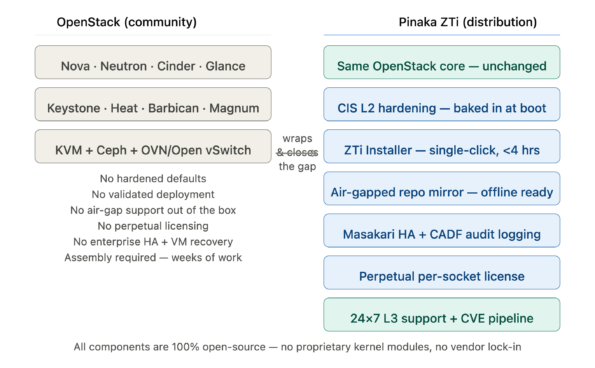
OpenStack gives you everything you need in principle: Nova for virtual machines, Ceph for storage, Neutron/OVN for networking, Keystone for identity, Barbican for secrets. World-class, Apache-licensed, vendor-neutral.
What it does not give you out of the box:
These are not criticisms of OpenStack, they are the natural boundary between a community project and an enterprise distribution. The Linux kernel is also not something you run on a server without a distribution around it. The OpenInfra community knows this, which is why distributions like Pinaka ZTi exist.
Governments have a unique set of requirements that commercial cloud cannot satisfy. Data must stay within the country’s borders, in some cases, within a specific building. The infrastructure must run with no connection to outside networks. There must be a complete, auditable record of every action taken by every user. Licensing cannot depend on annual renewal from an overseas company. And when something goes wrong, the support must come from engineers within reach, not a support portal.
These are not edge cases. They are the baseline requirements for the kinds of workloads governments run: military planning systems, national records, internal intelligence analysis, citizen data at scale.
For years, the only products that claimed to meet these requirements were proprietary hypervisor platforms from large Western technology companies. Then the licensing landscape shifted dramatically and governments that had built their infrastructure on those platforms found themselves facing price increases that their procurement systems could not absorb, and subscription models that violated the spirit (and sometimes the letter) of their procurement rules.
OpenStack was the obvious alternative. But “obvious alternative” and “production-ready, government-grade cloud platform” are not the same thing. Enter Pinaka ZTi.
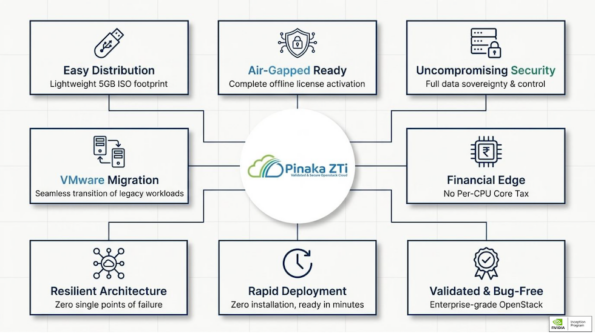
Pinaka ZTi is a validated, hardened OpenStack distribution. Every component underneath is open-source, there are no proprietary kernel modules, no hidden APIs, nothing that cannot be independently inspected and audited.
What Pinaka ZTi adds on top is the work that turns “powerful open-source software” into “something a defence auditor will sign off on”:
Security hardening at installation time. CIS Benchmark Level 2 controls are applied when the operating system is first provisioned before any OpenStack service starts. TLS is enabled on every internal endpoint. Legacy cryptography is disabled. Admin access requires multi-factor authentication. Every API call is logged in CADF audit format. Encryption keys are managed through Barbican, not stored in config files.
A fully offline deployment model. The ZTi Installer ships with a complete, mirrored package repository. A cluster can be deployed, patched, and upgraded with zero internet access, ever. For organisations where connecting infrastructure to an outside network is a security violation, this is not a nice-to-have — it is the minimum viable requirement.
A single-click installer that takes hours, not weeks. From racked hardware to a running, high-availability OpenStack cloud typically takes under four hours. The Pinaka Command Center handles node discovery, BIOS validation, OS provisioning, OpenStack role assignment, Ceph storage configuration, and HA orchestration automatically.
High availability that actually works. Masakari handles automatic VM recovery when a node fails. Galera clusters the database. Pacemaker/Corosync manages the control plane. These are not optional add-ons, they are configured correctly and tested as part of every deployment.
A perpetual licence. You pay once per CPU socket. You own it permanently. No annual renewal, no per-core counting, no risk that a future price change forces a budget crisis. Government procurement frameworks in most countries are designed for capital expenditure on owned assets Pinaka ZTi’s licensing model fits that framework cleanly.
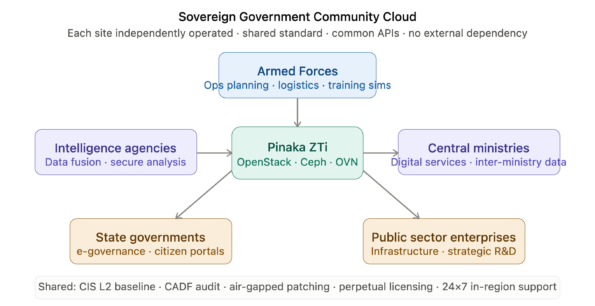
Pinaka ZTi comes in three deployment configurations, called Blueprints, that cover the full range of government deployments:
Blueprint 1 is as compact as it gets: three nodes, each doing compute, storage, and management simultaneously, with a small deployment orchestrator. It fits in a 9U cabinet. It runs about 30 production virtual machines. It is what you deploy at a remote facility, a border post, or a field operations centre anywhere that needs a real cloud with no outside connectivity and minimal physical footprint.
Blueprint 2 separates the management functions onto dedicated servers, with the remaining nodes handling compute and storage. This handles hundreds of virtual machines at a 99.99% uptime target. It is suited to government department data centres and mid-size state government installations.
Blueprint 3 separates compute and storage into fully independent tiers. Compute servers carry no storage overhead, every core and every gigabyte of RAM goes to running virtual machines. This is the configuration for large-scale government portal hosting, AI inference infrastructure, and national data centres running thousands of virtual machines at 99.999% uptime. It scales to hundreds of nodes.
All three blueprints use exactly the same installer, the same security baseline, and the same management interface. An operator trained on Blueprint 1 can run Blueprint 3.
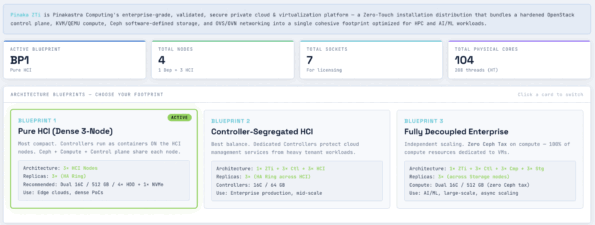
Across South Asia, Pinaka ZTi is in production at paying customers spanning every layer of government:
Armed services use it to run planning and operational support systems entirely air-gapped from any external network. Intelligence-related organisations use it for data analysis workloads where project-level isolation must be technically enforced, not administratively trusted. Central government ministries use it as the backbone for citizen-facing digital services. State government IT departments use it to run land records, public distribution systems, and health information management, applications that touch the lives of tens of millions of people daily. Strategic public sector enterprises use it as the foundation for internal research and infrastructure systems.
None of these organisations are named here, because they have not asked to be named. What they collectively represent, though, is something genuinely new: a sovereign government community cloud that has formed organically. Each site is independently operated. But every site runs the same platform, uses the same APIs, follows the same security baseline, and receives the same vulnerability patches on the same timeline. When one organisation’s team learns something, that knowledge transfers across the ecosystem.
That is how government community clouds should work. And it happened because OpenStack makes it possible, the same APIs everywhere, no proprietary lock-in, no reason any two government organisations cannot share knowledge freely.
The story being told here is set in South Asia, but the problem it solves is universal. Every government on every continent, that handles sensitive national data faces the same basic challenge: they need cloud infrastructure they can fully control, that runs without external dependencies, that meets their audit requirements, and that does not depend on a foreign company’s pricing decisions or licensing changes to remain operational.
OpenStack, with the right distribution around it, is the right answer to that challenge. Pinakastra has built that distribution for one of the world’s most complex government environments. The same platform, same installer, same APIs, same security architecture. is ready for any government anywhere that needs to own its infrastructure rather than rent it.
The Pinaka ZTi team sees deployments in multiple regions as the logical next step. The technology is geography-agnostic. The sovereignty requirement is universal.
There are a few practical lessons here worth sharing with the broader OpenInfra community:
Hardening must ship, not be documented. A security guide telling operators how to harden OpenStack is useful. A distribution that applies that hardening automatically at install time is what government customers actually need. The gap between the two is where deployments go wrong.
Offline-first is not a niche requirement. Air-gapped deployment is mandatory for a large fraction of the world’s most critical infrastructure. Any OpenStack distribution that cannot update itself without an internet connection is, for those customers, not a distribution at all.
Licensing that fits procurement law is a feature. The technical merits of open-source cloud software will not overcome a procurement framework that has no pathway for subscription-only licensing. Perpetual per-socket licensing is not a concession — it is what makes the technology accessible to the customers who need it most.
A sovereign cloud is a community cloud. The most powerful outcome of standardising on OpenStack across multiple government organisations is not cost savings, it is the knowledge-sharing network that forms automatically. Same platform, same APIs, same security baseline, shared expertise. That is the real value of open infrastructure in the public sector.
About Pinakastra Computing Pinakastra Computing is a Bengaluru-based deep-tech company building Pinaka ZTi, a validated, sovereign-grade OpenStack distribution for government and enterprise customers. Website: pinakastra.com · Email: [email protected]
Tags: containers, Data Sovereignty, digital sovereignty, edge computing, HPC, NFV, OpenDev, OpenInfra, OpenStack, OpenStack community, OpenStack Foundation, Private Cloud, public cloud, sovereign cloud, Superuser Award

此内容由惯性聚合(RSS阅读器)自动聚合整理,仅供阅读参考。 原文来自 — 版权归原作者所有。