



惯性聚合 高效追踪和阅读你感兴趣的博客、新闻、科技资讯
阅读原文 在惯性聚合中打开

推荐订阅源

The Cloudflare Blog
让小产品的独立变现更简单 - ezindie.com
人人都是产品经理
人人都是产品经理
C
Check Point Blog
有赞技术团队
有赞技术团队
H
Help Net Security
V
Vulnerabilities – Threatpost
N
News | PayPal Newsroom
Hacker News - Newest:
Hacker News - Newest: "LLM"
L
LINUX DO - 最新话题
Apple Machine Learning Research
博客园 - 【当耐特】
爱范儿
爱范儿
I
InfoQ
V
Visual Studio Blog
O
OpenAI News
Google DeepMind News
S
Security Affairs
T
Troy Hunt's Blog
P
Palo Alto Networks Blog
Spread Privacy
Spread Privacy
Engineering at Meta
Engineering at Meta
雷峰网
雷峰网
N
Netflix TechBlog - Medium
Latest news
Latest news
H
Hackread – Cybersecurity News, Data Breaches, AI and More
Webroot Blog
Webroot Blog
S
Schneier on Security
MongoDB | Blog
MongoDB | Blog
T
Tor Project blog
V2EX - 技术
V2EX - 技术
Security Latest
Security Latest
Cloudbric
Cloudbric
The GitHub Blog
The GitHub Blog
酷 壳 – CoolShell
酷 壳 – CoolShell
B
Blog RSS Feed
C
CERT Recently Published Vulnerability Notes
T
The Exploit Database - CXSecurity.com
P
Privacy International News Feed
S
Securelist
C
Cisco Blogs
博客园_首页
TaoSecurity Blog
TaoSecurity Blog
奇客Solidot–传递最新科技情报
奇客Solidot–传递最新科技情报
Security Archives - TechRepublic
P
Proofpoint News Feed
K
KPMG report finds enterprise disconnect between AI and its ROI | CIO
T
Threat Research - Cisco Blogs
阮一峰的网络日志
阮一峰的网络日志
S
Secure Thoughts

Tenable Blog

SharePoint CVEs FAQ: CVE-2026-56164, CVE-2026-32201, CVE-2026-45659 | Tenable® Build agentic AI security at Tenable Swarm, Black Hat 2026 SonicWall CVE-2026-15409 and CVE-2026-15410 zero-day exploited | Tenable® Understanding Anthropic’s new AI agent Claude Tag’s access model in Slack 5 reasons to integrate AppSec data with your exposure management platform July 2026 Patch Tuesday: Largest Patch Tuesday 569 CVEs FedRAMP High, IL5, and zero trust: How federal agencies can secure cloud environments OMB M-26-14: Why federal agencies must fix asset visibility first CISO’s guide to CISA BOD 26-04 and risk-based security metrics for vulnerability management How much cyber risk does AI create for organizations? 457 million security issues. Here’s what you can do about it. The Developer Credential Economy: An inside look at the Miasma worm campaign Oracle Critical Security Patch Update June 2026 | Tenable® How Tenable helps federal agencies comply with CISA BOD 26-04 Get critical cyber risk context: Understanding control validation, CTEM & Tenable One CISA BOD 26-04: Frequently asked questions about the new risk-based patching directive Microsoft’s June 2026 Patch Tuesday Addresses 198 CVEs ( CVE-2026-49160, CVE-2026-50507) The June 2026 AI Executive Order: What federal agencies need to know and how Tenable can help Tenable joins Anthropic’s Project Glasswing to advance AI-era cyber defense Tenable CTO Vlad Korsunsky Q&A: Countering AI threat multipliers with AI-powered exposure management | Tenable CTO Q&A: C-suite views AI as massive threat, as cyber teams adopt exposure management to counter AI attacks Oracle May 2026 Critical Security Patch Update Addresses 35 CVEs Download pumping: New npm deception technique for supply chain attacks Inside the customer environment: Where threat actors, vulnerabilities, and exposed assets intersect EXPOSURE 2026 prepares cybersecurity professionals for the AI era Mini Shai-Hulud: Frequently asked questions about the TeamPCP npm and PyPI supply chain campaign CVE-2026-9082: Highly Critical SQL Injection Vulnerability in Drupal Core (SA-CORE-2026-004) Tenable One deepens third-party integrations with new Open Connector for unified risk visibility Implement agentic AI in cybersecurity with Tenable Hexa AI: Reduce cyber risk at machine speed Key findings from the Verizon DBIR 2026: Slower vulnerability remediation meets faster exploitation Frequently asked questions about the continued exploitation of Cisco Catalyst SD-WAN vulnerabilities (CVE-2026-20182) Bring out your dead: How agentic AI for cybersecurity helps you rid your cloud of forgotten, risky assets Fragnesia (CVE-2026-46300): Frequently asked questions about new Linux Kernel XFRM ESP-in-TCP privilege escalation Securing data centers in the agentic AI era Microsoft’s May 2026 Patch Tuesday Addresses 118 CVEs (CVE-2026-41103) Dirty Frag (CVE-2026-43284, CVE-2026-43500): Frequently asked questions about this Linux kernel privilege escalation vulnerability chain Why the approaching flood of vulnerabilities changes everything — and what to do about it The AI-vs-AI battle is already happening. Watch it live at EXPOSURE 2026. Anthropic’s CEO warns the “moment of danger” is real. But most are looking in the wrong place. Security for AI: A strategic framework for closing the AI exposure gap Vulnerability remediation: Match CVEs to asset owners in seconds with Tenable Hexa AI Bridging the gap: How to integrate Claude Security into the Tenable One Exposure Management Platform Copy Fail (CVE-2026-31431): Frequently asked questions about Linux kernel privilege escalation vulnerability Mastering agentic AI security through exposure management As the NVD scales back CVE enrichment, here’s what Tenable customers need to know Five steps to become Mythos ready Oracle April 2026 Critical Patch Update Addresses 241 CVEs Beating the Mythos clock: Using Tenable Hexa AI custom agents for automated patching Unlocking foundational visibility for cyber-physical systems with OT vulnerability management Claude Mythos: Prepare for your board’s cybersecurity questions about the latest AI model from Anthropic Microsoft’s April 2026 Patch Tuesday Addresses 163 CVEs (CVE-2026-32201) What to Know About CyberAv3ngers: The IRGC-Linked Group Targeting Critical Infrastructure CVE-2026-35616: Fortinet FortiClientEMS improper access control vulnerability exploited in the wild The developer credential economy: Why exposure data is the new front line in the supply chain war Frequently Asked Questions About the Axios npm Supply Chain Attack by North Korea-Nexus Threat Actor UNC1069 Supply chain attack on Axios npm package: Scope, impact, and remediations What’s new in Tenable Cloud Security: Custom policies, AWS ABAC, and research-driven protection Uncover prompt injection, insider threats with the Tenable One Model Refusal Detection Security for AI: A guide to managing the risks of vibe coding and AI in software development Meet Tenable Hexa AI: Agentic AI for exposure management
Crushing the Axios supply chain threat with Tenable Hexa AI: Use cases for agentic AI
2026-04-10 · via Tenable Blog

See how you can use Tenable Hexa AI to determine in minutes if you’re impacted by the Axios npm supply chain attack. Learn how easy it is to automate configuration of scans, identify impacted assets, prioritize remediation, and more using agentic AI from Tenable.

Key takeaways: 

  1. Tenable Hexa AI, the agentic engine of the Tenable One Exposure Management Platform, can tell you in minutes if your organization is running compromised versions of the Axios npm package following a recent discovery of a supply chain attack.
     
  2. Tenable Hexa AI configures and launches scans; tags affected assets by severity, owner, or business unit to scope the blast radius of the threat; and automates remediation scans to verify remediation effectiveness.
     
  3. The workflow that Tenable Hexa AI automates (targeted scan, tag, remediate, verify) applies to any emerging threat, whether the discovery of a new CVE, zero-day vulnerability, or supply chain compromise.
     

When a highly utilized code package like the Axios npm package is compromised in a supply chain attack, news of the compromise often sets off a mad scramble for security teams. Responding to the discovery can take days, and typically involves manually configuring different assessments to identify if vulnerable versions of the software are present in your environment, and if so, which assets are affected by them. Then, of course, you have to implement recommended remediations, which in the case of the Axios npm supply chain attack include:

  • Downgrade to safe versions: [email protected] or [email protected]
  • Remove the phantom dependency: node_modules/plain-crypto-js/
  • Block C2 traffic to sfrclak[.]com and 142.11.206.73
  • Treat affected systems as fully compromised: rotate all secrets and credentials, rebuild from clean snapshots
  • Audit CI/CD pipelines: ephemeral runners require secret rotation; self-hosted runners are treated as fully compromised
  • Search for file artifacts: /Library/Caches/com.apple.act.mond (macOS), %PROGRAMDATA%\wt.exe (Windows), /tmp/ld.py (Linux).

Even if you can respond and remediate within hours, it’s still not fast enough for AI-assisted threat actors. These days, we need to answer three critical questions in minutes: 

  • Are we exposed?
  • Where are we exposed?
  • How quickly can we mitigate the threat? 

In the first of a series of blogs on use cases for the Tenable Hexa AI agentic engine, we show you how Tenable Hexa AI accelerates this exact workflow to reduce your window of risk.
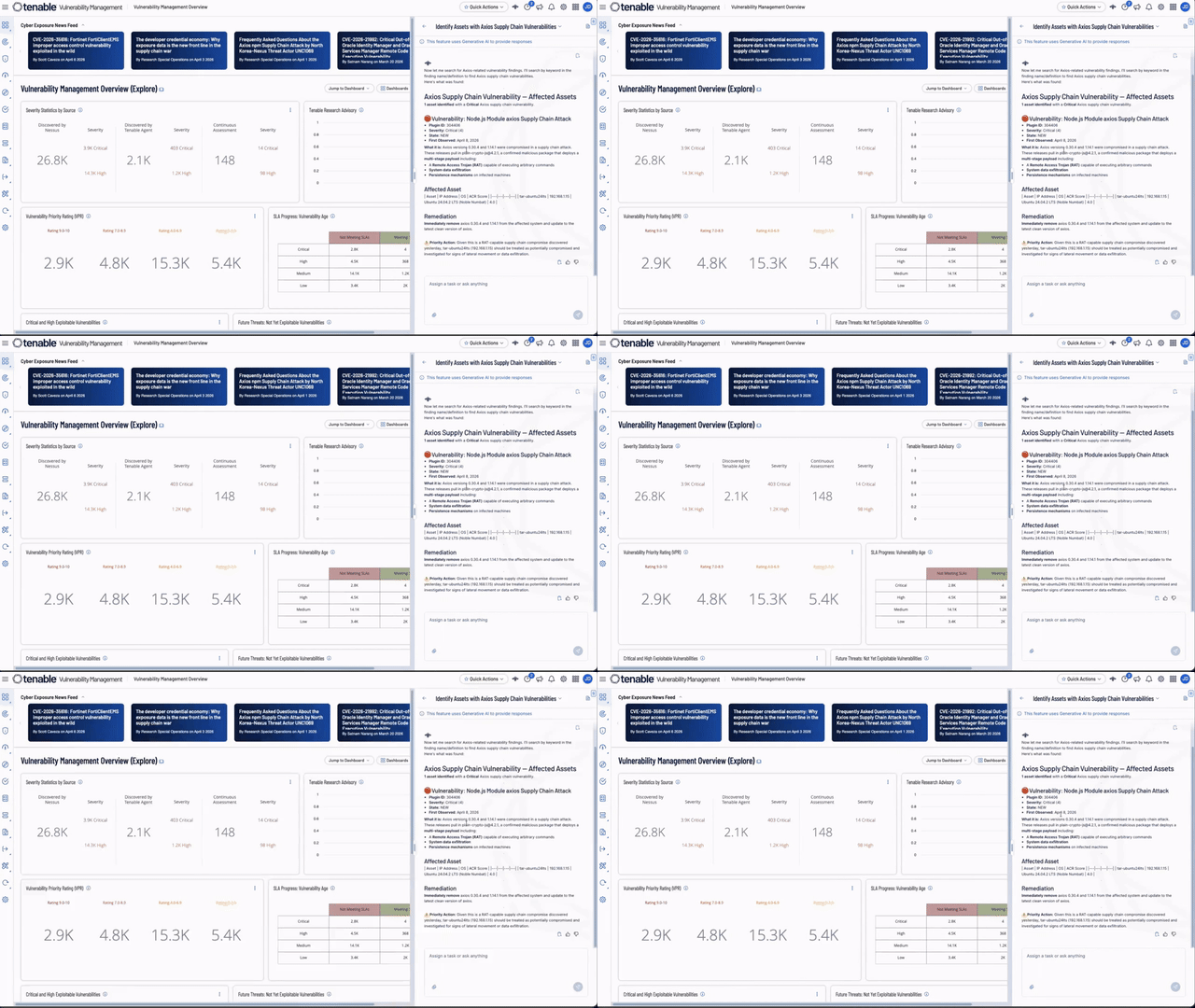
Using Tenable Hexa AI to discover the Axios threat and answer “Are we exposed?”


Using Tenable Hexa AI agentic AI to determine if malicious versions of Axios npm package compromised in supply chain attack are in your environment

When researchers discover a new zero-day or supply chain compromise, the first question on security teams’ minds isn’t “How do we fix it?” It’s “Are we affected?” Answering that question shouldn’t be difficult, and with Tenable Hexa AI, it couldn’t be simpler. 

Open Tenable Hexa AI and type something like, “Show me all assets in my environment vulnerable to the Axios Supply Chain vulnerability.”

Tenable Hexa AI then queries the Tenable One Exposure Data Fabric, the data already collected from your existing scans, agents, and integrations. Within seconds, Tenable Hexa AI produces a clear picture of which assets are running the compromised Axios versions, where they sit in your network, and how critical they are to your business. 

No query language. No console-hopping. No waiting for a new scan to finish. Just ask the question and get the answer. 
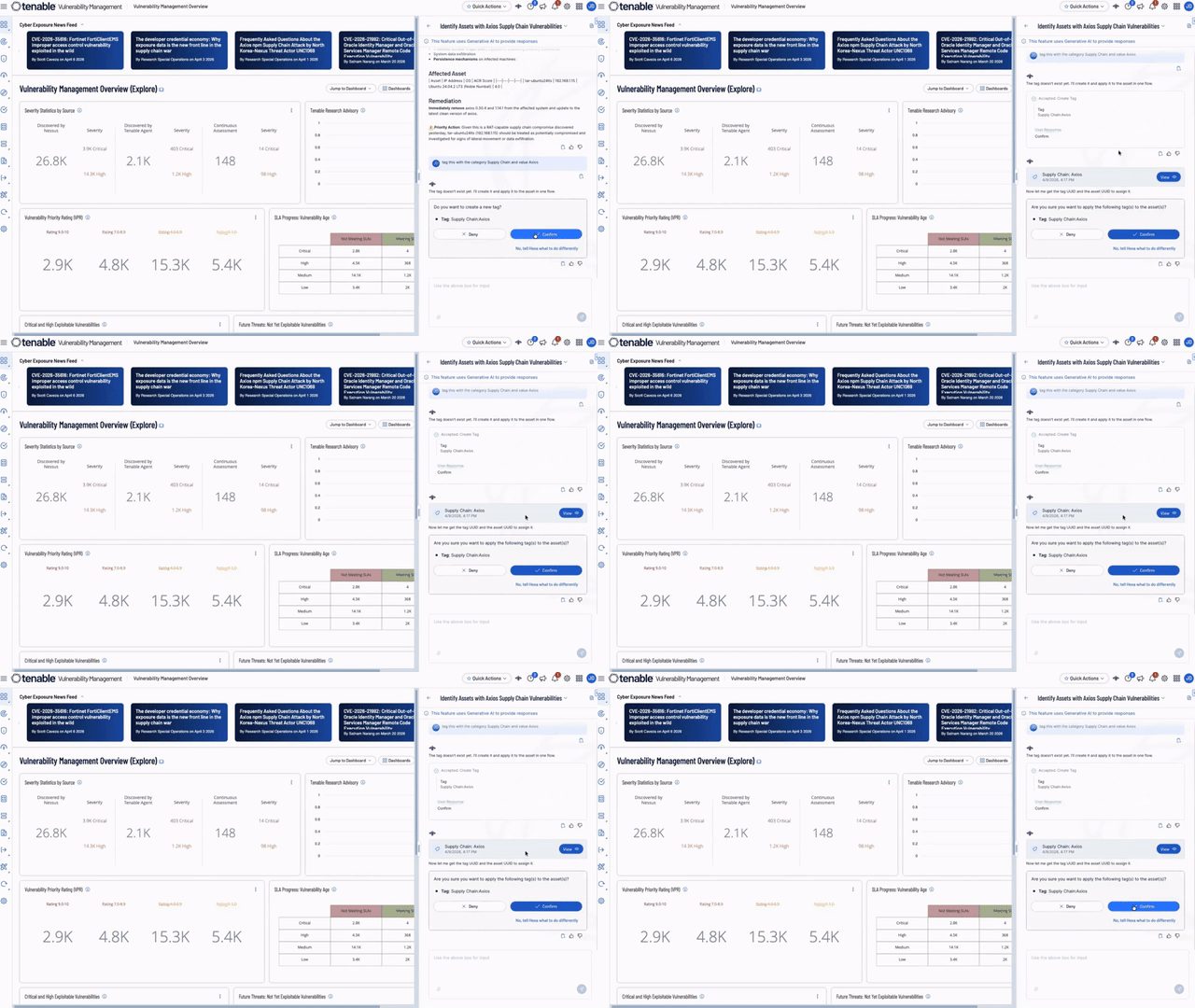
Using Tenable Hexa AI to scope the blast radius with asset tagging


Using Tenable Hexa AI agentic AI to identify malicious versions of Axios compromised in supply chain attack in your environment

Now you know which assets are affected, but a flat list isn’t a response plan; it’s a starting point. The next step is to scope the blast radius and organize it for action. With Tenable Hexa AI, this is as simple as telling Tenable Hexa AI to “Tag this with the category Supply Chain and value Axios.” 

Tenable Hexa AI then bulk-applies the tag across every asset in one action. And just like that, you’ve turned a raw discovery into a structured, queryable incident surface. 

This matters because tagging is the bridge between exposure discovery and remediation by the right team. Once assets are tagged, you can slice them by business unit or owner to route remediation work. You can feed tagged assets into dashboards for executive visibility, and critically, the tag preserves a snapshot of the blast radius as the environment changes. 

Why this capability matters beyond Axios

Supply chain attacks have seen a staggering increase in recent years, with the Sonatype 2024 State of the Software Supply Chain report showing a 156% year-over-year surge in attacks targeting upstream repositories like npm and PyPI. So the question isn’t if another package will be poisoned, but how much of your weekend it will consume when it happens.

What we’ve shown here with the Axios response (i.e., scope, discover, prioritize) is more than just a fix for one npm package. It represents a fundamental shift in how security teams handle emergency response. 

By using Tenable Hexa AI, you are building agentic and operational muscle memory. You can deploy the exact same conversational workflow you used to hunt for malicious versions of Axios the moment the next Log4j, XZ Utils, or MoveIt-style vulnerability hits the news.

Tenable Hexa AI transforms high-pressure fire drills like the discovery of the Axios npm supply chain attack into a structured, repeatable, and sane workflow. Instead of writing custom scripts or manually configuring policies under duress, you simply tell Tenable Hexa AI what to do, and the agentic engine handles the grunt work for you. 

Use cases for agentic AI: Additional ways to use Tenable Hexa AI 

Stay tuned for more use cases demonstrating the agentic power of Tenable Hexa AI. Here’s what’s coming next: 

  • Using Tenable Hexa AI to target remediation scans at tagged assets, schedule post-patch verification, and compare before/after results to confirm the threat is neutralized
  • Using Tenable Hexa AI to automate the creation of risk dashboards and report on security KPIs
  • Using Tenable Hexa AI to map vulnerabilities to asset owners (via Okta, CMDB, or custom mappings) and automatically notify the right teams.
  • Using Tenable Hexa AI to trigger patching workflows and network isolation for compromised assets

Tenable Hexa AI is currently in private preview for select Tenable One customers. Contact your Tenable Account Team to join the private preview program.

Want to learn more? Download the Tenable Hexa AI data sheet to get the full technical breakdown of our agentic capabilities.

James Davies

James Davies

Principal Security Engineer, Tenable

James Davies has over a decade of experience in cybersecurity, specializing in roles such as Enterprise Senior Sales Engineer, Senior Security Engineer, and Associate Sales Engineer at Tenable. He has a proven track record of deploying advanced security solutions, managing extensive lab environments, and collaborating with senior executives and product management teams. He has also held roles in software engineering, QA, customer support, and teaching, all of which showcase his diverse skill set and commitment to excellence in the tech industry. In his spare time, he’s passionate about new tech, automation, home theater, and video games.