


惯性聚合 高效追踪和阅读你感兴趣的博客、新闻、科技资讯
阅读原文 在惯性聚合中打开

推荐订阅源

N
Netflix TechBlog - Medium
CTFtime.org: upcoming CTF events
NISL@THU
NISL@THU
MongoDB | Blog
MongoDB | Blog
Microsoft Security Blog
Cyber Security Advisories - MS-ISAC
L
LangChain Blog
C
CXSECURITY Database RSS Feed - CXSecurity.com
C
CERT Recently Published Vulnerability Notes
aimingoo的专栏
aimingoo的专栏
B
Blog RSS Feed
WordPress大学
WordPress大学
Know Your Adversary
Know Your Adversary
The Register - Security
Jina AI
Jina AI
Spread Privacy
Spread Privacy
Recent Commits to openclaw:main
T
The Blog of Author Tim Ferriss
GbyAI
GbyAI
J
Java Code Geeks
S
Securelist
Y
Y Combinator Blog
T
Threat Research - Cisco Blogs
酷 壳 – CoolShell
酷 壳 – CoolShell
Vercel News
Vercel News
W
WeLiveSecurity
Hugging Face - Blog
Hugging Face - Blog
小众软件
小众软件
Martin Fowler
Martin Fowler
TaoSecurity Blog
TaoSecurity Blog
S
Schneier on Security
cs.CL updates on arXiv.org
D
DataBreaches.Net
L
LINUX DO - 热门话题
T
Tailwind CSS Blog
T
Tor Project blog
博客园 - 叶小钗
Blog — PlanetScale
Blog — PlanetScale
I
Intezer
V
V2EX
cs.CV updates on arXiv.org
C
Cyber Attacks, Cyber Crime and Cyber Security
雷峰网
雷峰网
The GitHub Blog
The GitHub Blog
量子位
AI
AI
Cyberwarzone
Cyberwarzone
T
Troy Hunt's Blog
N
News | PayPal Newsroom
H
Help Net Security

Tenable Blog

SharePoint CVEs FAQ: CVE-2026-56164, CVE-2026-32201, CVE-2026-45659 | Tenable® Build agentic AI security at Tenable Swarm, Black Hat 2026 SonicWall CVE-2026-15409 and CVE-2026-15410 zero-day exploited | Tenable® Understanding Anthropic’s new AI agent Claude Tag’s access model in Slack 5 reasons to integrate AppSec data with your exposure management platform July 2026 Patch Tuesday: Largest Patch Tuesday 569 CVEs FedRAMP High, IL5, and zero trust: How federal agencies can secure cloud environments OMB M-26-14: Why federal agencies must fix asset visibility first CISO’s guide to CISA BOD 26-04 and risk-based security metrics for vulnerability management How much cyber risk does AI create for organizations? 457 million security issues. Here’s what you can do about it. The Developer Credential Economy: An inside look at the Miasma worm campaign Oracle Critical Security Patch Update June 2026 | Tenable® How Tenable helps federal agencies comply with CISA BOD 26-04 Get critical cyber risk context: Understanding control validation, CTEM & Tenable One CISA BOD 26-04: Frequently asked questions about the new risk-based patching directive Microsoft’s June 2026 Patch Tuesday Addresses 198 CVEs ( CVE-2026-49160, CVE-2026-50507) The June 2026 AI Executive Order: What federal agencies need to know and how Tenable can help Tenable joins Anthropic’s Project Glasswing to advance AI-era cyber defense Tenable CTO Vlad Korsunsky Q&A: Countering AI threat multipliers with AI-powered exposure management | Tenable CTO Q&A: C-suite views AI as massive threat, as cyber teams adopt exposure management to counter AI attacks Oracle May 2026 Critical Security Patch Update Addresses 35 CVEs Download pumping: New npm deception technique for supply chain attacks Inside the customer environment: Where threat actors, vulnerabilities, and exposed assets intersect EXPOSURE 2026 prepares cybersecurity professionals for the AI era Mini Shai-Hulud: Frequently asked questions about the TeamPCP npm and PyPI supply chain campaign CVE-2026-9082: Highly Critical SQL Injection Vulnerability in Drupal Core (SA-CORE-2026-004) Tenable One deepens third-party integrations with new Open Connector for unified risk visibility Implement agentic AI in cybersecurity with Tenable Hexa AI: Reduce cyber risk at machine speed Key findings from the Verizon DBIR 2026: Slower vulnerability remediation meets faster exploitation Bring out your dead: How agentic AI for cybersecurity helps you rid your cloud of forgotten, risky assets Fragnesia (CVE-2026-46300): Frequently asked questions about new Linux Kernel XFRM ESP-in-TCP privilege escalation Securing data centers in the agentic AI era Microsoft’s May 2026 Patch Tuesday Addresses 118 CVEs (CVE-2026-41103) Dirty Frag (CVE-2026-43284, CVE-2026-43500): Frequently asked questions about this Linux kernel privilege escalation vulnerability chain Why the approaching flood of vulnerabilities changes everything — and what to do about it The AI-vs-AI battle is already happening. Watch it live at EXPOSURE 2026. Anthropic’s CEO warns the “moment of danger” is real. But most are looking in the wrong place. Security for AI: A strategic framework for closing the AI exposure gap Vulnerability remediation: Match CVEs to asset owners in seconds with Tenable Hexa AI Bridging the gap: How to integrate Claude Security into the Tenable One Exposure Management Platform Copy Fail (CVE-2026-31431): Frequently asked questions about Linux kernel privilege escalation vulnerability Mastering agentic AI security through exposure management As the NVD scales back CVE enrichment, here’s what Tenable customers need to know Five steps to become Mythos ready Oracle April 2026 Critical Patch Update Addresses 241 CVEs Beating the Mythos clock: Using Tenable Hexa AI custom agents for automated patching Unlocking foundational visibility for cyber-physical systems with OT vulnerability management Claude Mythos: Prepare for your board’s cybersecurity questions about the latest AI model from Anthropic Microsoft’s April 2026 Patch Tuesday Addresses 163 CVEs (CVE-2026-32201) Crushing the Axios supply chain threat with Tenable Hexa AI: Use cases for agentic AI What to Know About CyberAv3ngers: The IRGC-Linked Group Targeting Critical Infrastructure CVE-2026-35616: Fortinet FortiClientEMS improper access control vulnerability exploited in the wild The developer credential economy: Why exposure data is the new front line in the supply chain war Frequently Asked Questions About the Axios npm Supply Chain Attack by North Korea-Nexus Threat Actor UNC1069 Supply chain attack on Axios npm package: Scope, impact, and remediations What’s new in Tenable Cloud Security: Custom policies, AWS ABAC, and research-driven protection Uncover prompt injection, insider threats with the Tenable One Model Refusal Detection Security for AI: A guide to managing the risks of vibe coding and AI in software development Meet Tenable Hexa AI: Agentic AI for exposure management
Frequently asked questions about the continued exploitation of Cisco Catalyst SD-WAN vulnerabilities (CVE-2026-20182)
Research Special Operations · 2026-05-15 · via Tenable Blog

Multiple critical authentication bypass vulnerabilities in Cisco Catalyst SD-WAN Controller and Manager are under active exploitation by multiple threat clusters, including CVE-2026-20182, which has been exploited as a zero-day by a sophisticated threat actor.

Key Takeaways

  1. CVE-2026-20182 is a critical (CVSSv3 10.0) authentication bypass in Cisco Catalyst SD-WAN Controller and Manager disclosed on May 14 with confirmed active exploitation.
  2. A sophisticated threat actor designated UAT-8616 has exploited Cisco SD-WAN vulnerabilities since at least 2023, and 10 additional threat clusters began exploitation of multiple vulnerabilities in SD-WAN after public proof-of-concept code became available.
  3. Patches are available for all supported Cisco Catalyst SD-WAN releases and CISA has mandated remediation by May 17 under Emergency Directive 26-03.

Background

Tenable's Research Special Operations (RSO) team has compiled this blog to answer Frequently Asked Questions (FAQ) regarding the ongoing exploitation of multiple vulnerabilities in Cisco Catalyst SD-WAN Controller and Manager.

FAQ

When were these Cisco SD-WAN vulnerabilities first disclosed?

On February 25, 2026, Cisco published an advisory for CVE-2026-20127, a critical authentication bypass vulnerability in Cisco Catalyst SD-WAN Controller and Manager that was already being exploited in the wild at the time of disclosure. Alongside that advisory, Cisco also released patches for three additional vulnerabilities in SD-WAN Manager: CVE-2026-20133, CVE-2026-20128, and CVE-2026-20122. The security advisory for these CVEs (cisco-sa-sdwan-authbp-qwCX8D4v) was updated in March to confirm exploitation of CVE-2026-20128 and CVE-2026-20122 and then again in April to confirm that CVE-2026-20133 had also been exploited.

On May 14, 2026, Cisco published a new advisory (cisco-sa-sdwan-rpa2-v69WY2SW) for CVE-2026-20182, a separate critical authentication bypass vulnerability that was discovered during the investigation into the earlier exploitation. This vulnerability is also under active exploitation.

What are the vulnerabilities associated with the Cisco SD-WAN exploitation?

There are five CVEs associated with this ongoing campaign, plus one older vulnerability used for post-compromise privilege escalation:

Both CVE-2026-20182 and CVE-2026-20127 are critical-severity flaws that enable remote, unauthenticated access to administrative functions due to broken peering authentication logic. CVE-2026-20133, CVE-2026-20128, and CVE-2026-20122, when chained together, allow a remote unauthenticated attacker to gain access to the SD-WAN Manager.

What products are affected?

The following table lists the CVEs and affected devices. None of these vulnerabilities require specific device configurations to be exploitable, and all deployment models are affected:

CVEAffected Device(s)
CVE-2026-20182Cisco Catalyst SD-WAN Controller and Cisco Catalyst SD-WAN Manager
CVE-2026-20127Cisco Catalyst SD-WAN Controller and Cisco Catalyst SD-WAN Manager
CVE-2026-20133Cisco Catalyst SD-WAN Manager
CVE-2026-20128Cisco Catalyst SD-WAN Manager
CVE-2026-20122Cisco Catalyst SD-WAN Manager
CVE-2022-20775Cisco SD-WAN Software:
- SD-WAN vBond Orchestrator Software
- SD-WAN vEdge Cloud Routers
- SD-WAN vEdge Routers
- SD-WAN vManage Software
- SD-WAN vSmart Controller Software

How severe is the exploitation?

Successful exploitation of CVE-2026-20182 or CVE-2026-20127 provides access to a privileged (but non-root) internal account on the SD-WAN Controller. That access opens NETCONF, giving the attacker the ability to alter network configuration across the entire SD-WAN fabric. In observed attacks, the threat actor UAT-8616 then leveraged CVE-2022-20775 via a software version downgrade technique to escalate privileges to root.

Post-compromise activities observed by Cisco Talos include SSH key injection, NETCONF configuration manipulation, malicious account creation, and extensive log clearing to cover tracks.

Who is UAT-8616?

UAT-8616 is a designation assigned by Cisco Talos to a “highly sophisticated cyber threat actor” that has been exploiting Cisco SD-WAN infrastructure since at least 2023. According to Cisco Talos, UAT-8616 targets critical infrastructure sectors and its infrastructure overlaps with monitored Operational Relay Box (ORB) networks.

UAT-8616 exploits CVE-2026-20182 and CVE-2026-20127 for initial access, then, in the case of CVE-2026-20127 exploitation, performs software version downgrades to expose CVE-2022-20775 for root privilege escalation. After achieving root access, the actor restores the original software version to conceal the exploitation path. Additional persistence techniques include injecting SSH keys into authorized_keys files, enabling PermitRootLogin in the SSH daemon configuration, and clearing forensic evidence from syslog, wtmp, lastlog, bash_history and cli-history files.

Are there other threat actors exploiting these vulnerabilities?

Yes. Cisco Talos has identified 10 additional threat clusters that are distinct from UAT-8616. These clusters have been exploiting the CVE-2026-20133, CVE-2026-20128, and CVE-2026-20122 chain since early March 2026, following the publication of proof-of-concept code by ZeroZenX Labs. The tools deployed by these clusters range from webshells (Godzilla, Behinder, XenShell) and red team frameworks (AdaptixC2, Sliver) to cryptocurrency miners (XMRig) and credential stealers targeting admin hashes, JWT tokens and AWS credentials.

Are proofs-of-concept (PoCs) available?

Yes. ZeroZenX Labs published proof-of-concept code for the CVE-2026-20133, CVE-2026-20128, CVE-2026-20122 exploit chain in March 2026. This PoC release directly correlated with the surge in exploitation activity across multiple threat clusters. The availability of public PoC code highlights the risk to any exposed SD-WAN infrastructure that remains unpatched.

What actions has CISA taken?

CISA has taken multiple actions in response to the Cisco SD-WAN exploitation campaign:

  • February 25, 2026: Added CVE-2026-20127 and CVE-2022-20775 to the Known Exploited Vulnerabilities (KEV) catalog
  • April 20, 2026: Added CVE-2026-20133, CVE-2026-20128, and CVE-2026-20122 to the KEV catalog
  • May 14, 2026: Added CVE-2026-20182 to the KEV catalog with an action deadline of May 17, 2026
  • May 14, 2026: Issued Emergency Directive 26-03 and published Hunt & Hardening Guidance for Cisco SD-WAN Devices

All five CVEs in this campaign are now in CISA's KEV catalog.

Are patches available?

Cisco has released patches for each of the vulnerabilities discussed in this blog. We recommend reviewing the security advisories issued by Cisco for each CVE to identify the patch release and any considerations that may apply in order to apply the patches successfully.

Are there indicators of compromise (IoC)?

Cisco has published detailed IoC information across its advisories and Talos blog posts. The indicators include:

  • Log evidence: Check /var/log/auth.log for "Accepted publickey for vmanage-admin" entries from unknown or unauthorized IP addresses
  • Control connection anomalies: Run show control connections detail or show control connections-history detail and look for connections with state:up and challenge-ack: 0, which may indicate unauthorized peering
  • Post-compromise artifacts: Unauthorized SSH keys in /home/vmanage-admin/.ssh/authorized_keys/, PermitRootLogin enabled in /etc/ssh/sshd_config, unexplained software downgrades followed by reboots

Full IoC lists including C2 server IPs, malware file hashes, and attacker source IPs are available in the Cisco Talos blog.

Has Tenable Research classified these vulnerabilities as part of Vulnerability Watch?

Yes. CVE-2026-20182, CVE-2026-20127, CVE-2026-20128, and CVE-2026-20122 have been classified as Vulnerabilities of Interest under Vulnerability Watch due to confirmed active exploitation and the availability of public proof-of-concept code. Tenable has been tracking this cluster of vulnerabilities since the original disclosure in February 2026, with watches re-established as exploitation escalated in March and again in May 2026 when CVE-2026-20182 was disclosed.

Has Tenable released product coverage?

A list of Tenable plugins for these vulnerabilities can be found on the individual CVE pages for CVE-2026-20182, CVE-2026-20127, CVE-2026-20133, CVE-2026-20128, CVE-2026-20122, and CVE-2022-20775. These links will display all available plugins for these vulnerabilities, including upcoming plugins in our Plugins Pipeline.

Additionally, customers can utilize Tenable Attack Surface Management to identify public facing assets running Cisco Catalyst SD-WAN devices by using the following query: Document Title contains Cisco Catalyst SD-WAN.
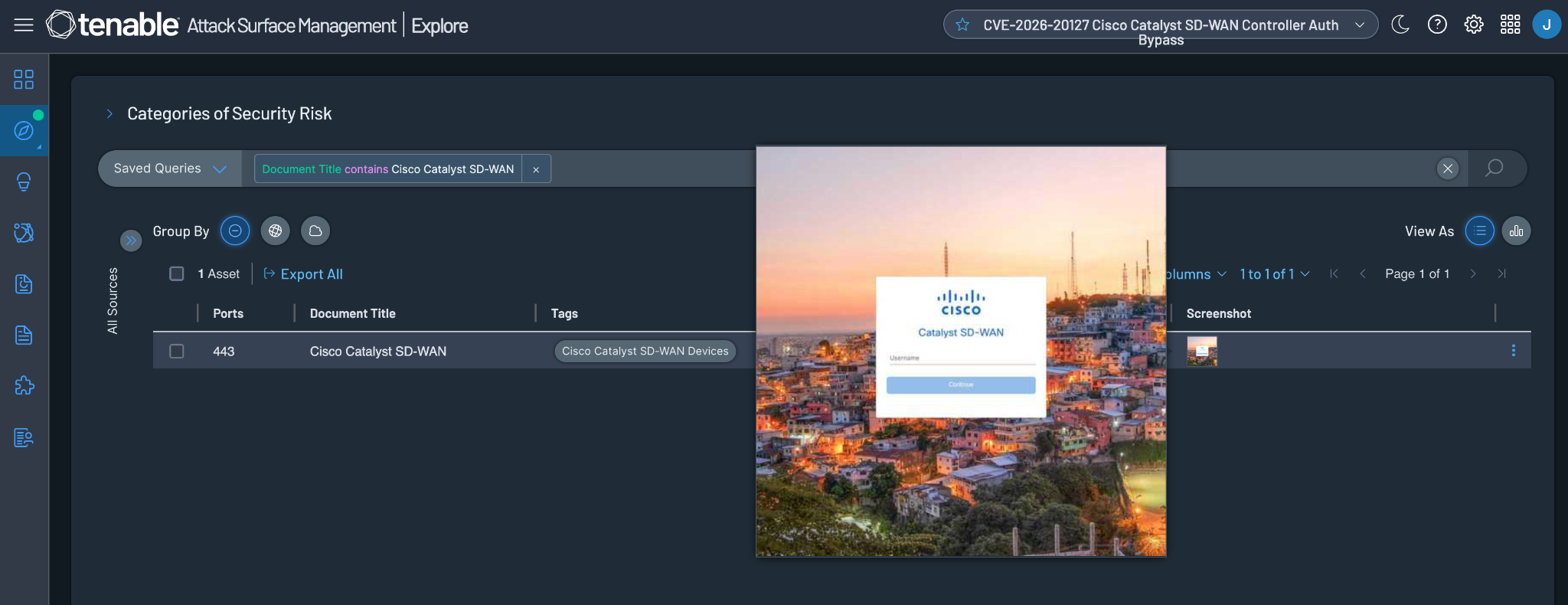
A screenshot of Tenable Attack Surface Management showing a query for Cisco Catalyst SD-WAN devices

Get more information

Join Tenable's Research Special Operations (RSO) Team on Tenable Connect for further discussions on the latest cyber threats.
Learn more about Tenable One, the Exposure Management Platform for the modern attack surface.