



惯性聚合 高效追踪和阅读你感兴趣的博客、新闻、科技资讯
阅读原文 在惯性聚合中打开

推荐订阅源

H
Hackread – Cybersecurity News, Data Breaches, AI and More
C
Check Point Blog
Hacker News: Ask HN
Hacker News: Ask HN
cs.CL updates on arXiv.org
WordPress大学
WordPress大学
P
Proofpoint News Feed
V
Visual Studio Blog
C
Cyber Attacks, Cyber Crime and Cyber Security
N
Netflix TechBlog - Medium
C
CXSECURITY Database RSS Feed - CXSecurity.com
博客园 - 聂微东
Threat Intelligence Blog | Flashpoint
博客园 - 叶小钗
Cisco Talos Blog
Cisco Talos Blog
S
Schneier on Security
T
Threat Research - Cisco Blogs
腾讯CDC
cs.AI updates on arXiv.org
The Hacker News
The Hacker News
Google DeepMind News
Microsoft Security Blog
奇客Solidot–传递最新科技情报
奇客Solidot–传递最新科技情报
GbyAI
GbyAI
N
News | PayPal Newsroom
L
LINUX DO - 最新话题
酷 壳 – CoolShell
酷 壳 – CoolShell
P
Palo Alto Networks Blog
T
Tenable Blog
S
Secure Thoughts
T
Threatpost
V2EX - 技术
V2EX - 技术
大猫的无限游戏
大猫的无限游戏
Martin Fowler
Martin Fowler
freeCodeCamp Programming Tutorials: Python, JavaScript, Git & More
Vercel News
Vercel News
罗磊的独立博客
P
Privacy & Cybersecurity Law Blog
Engineering at Meta
Engineering at Meta
小众软件
小众软件
Google DeepMind News
N
News and Events Feed by Topic
Y
Y Combinator Blog
CTFtime.org: upcoming CTF events
C
Cybersecurity and Infrastructure Security Agency CISA
P
Proofpoint News Feed
L
Lohrmann on Cybersecurity
P
Privacy International News Feed
H
Heimdal Security Blog
量子位
B
Blog

Tenable Blog

SharePoint CVEs FAQ: CVE-2026-56164, CVE-2026-32201, CVE-2026-45659 | Tenable® Build agentic AI security at Tenable Swarm, Black Hat 2026 SonicWall CVE-2026-15409 and CVE-2026-15410 zero-day exploited | Tenable® Understanding Anthropic’s new AI agent Claude Tag’s access model in Slack 5 reasons to integrate AppSec data with your exposure management platform July 2026 Patch Tuesday: Largest Patch Tuesday 569 CVEs FedRAMP High, IL5, and zero trust: How federal agencies can secure cloud environments OMB M-26-14: Why federal agencies must fix asset visibility first CISO’s guide to CISA BOD 26-04 and risk-based security metrics for vulnerability management How much cyber risk does AI create for organizations? 457 million security issues. Here’s what you can do about it. The Developer Credential Economy: An inside look at the Miasma worm campaign Oracle Critical Security Patch Update June 2026 | Tenable® How Tenable helps federal agencies comply with CISA BOD 26-04 Get critical cyber risk context: Understanding control validation, CTEM & Tenable One CISA BOD 26-04: Frequently asked questions about the new risk-based patching directive Microsoft’s June 2026 Patch Tuesday Addresses 198 CVEs ( CVE-2026-49160, CVE-2026-50507) The June 2026 AI Executive Order: What federal agencies need to know and how Tenable can help Tenable joins Anthropic’s Project Glasswing to advance AI-era cyber defense Tenable CTO Vlad Korsunsky Q&A: Countering AI threat multipliers with AI-powered exposure management | Tenable CTO Q&A: C-suite views AI as massive threat, as cyber teams adopt exposure management to counter AI attacks Oracle May 2026 Critical Security Patch Update Addresses 35 CVEs Download pumping: New npm deception technique for supply chain attacks Inside the customer environment: Where threat actors, vulnerabilities, and exposed assets intersect EXPOSURE 2026 prepares cybersecurity professionals for the AI era Mini Shai-Hulud: Frequently asked questions about the TeamPCP npm and PyPI supply chain campaign CVE-2026-9082: Highly Critical SQL Injection Vulnerability in Drupal Core (SA-CORE-2026-004) Tenable One deepens third-party integrations with new Open Connector for unified risk visibility Implement agentic AI in cybersecurity with Tenable Hexa AI: Reduce cyber risk at machine speed Key findings from the Verizon DBIR 2026: Slower vulnerability remediation meets faster exploitation Frequently asked questions about the continued exploitation of Cisco Catalyst SD-WAN vulnerabilities (CVE-2026-20182) Bring out your dead: How agentic AI for cybersecurity helps you rid your cloud of forgotten, risky assets Fragnesia (CVE-2026-46300): Frequently asked questions about new Linux Kernel XFRM ESP-in-TCP privilege escalation Securing data centers in the agentic AI era Microsoft’s May 2026 Patch Tuesday Addresses 118 CVEs (CVE-2026-41103) Dirty Frag (CVE-2026-43284, CVE-2026-43500): Frequently asked questions about this Linux kernel privilege escalation vulnerability chain Why the approaching flood of vulnerabilities changes everything — and what to do about it The AI-vs-AI battle is already happening. Watch it live at EXPOSURE 2026. Anthropic’s CEO warns the “moment of danger” is real. But most are looking in the wrong place. Security for AI: A strategic framework for closing the AI exposure gap Vulnerability remediation: Match CVEs to asset owners in seconds with Tenable Hexa AI Bridging the gap: How to integrate Claude Security into the Tenable One Exposure Management Platform Copy Fail (CVE-2026-31431): Frequently asked questions about Linux kernel privilege escalation vulnerability Mastering agentic AI security through exposure management As the NVD scales back CVE enrichment, here’s what Tenable customers need to know Five steps to become Mythos ready Oracle April 2026 Critical Patch Update Addresses 241 CVEs Unlocking foundational visibility for cyber-physical systems with OT vulnerability management Claude Mythos: Prepare for your board’s cybersecurity questions about the latest AI model from Anthropic Microsoft’s April 2026 Patch Tuesday Addresses 163 CVEs (CVE-2026-32201) Crushing the Axios supply chain threat with Tenable Hexa AI: Use cases for agentic AI What to Know About CyberAv3ngers: The IRGC-Linked Group Targeting Critical Infrastructure CVE-2026-35616: Fortinet FortiClientEMS improper access control vulnerability exploited in the wild The developer credential economy: Why exposure data is the new front line in the supply chain war Frequently Asked Questions About the Axios npm Supply Chain Attack by North Korea-Nexus Threat Actor UNC1069 Supply chain attack on Axios npm package: Scope, impact, and remediations What’s new in Tenable Cloud Security: Custom policies, AWS ABAC, and research-driven protection Uncover prompt injection, insider threats with the Tenable One Model Refusal Detection Security for AI: A guide to managing the risks of vibe coding and AI in software development Meet Tenable Hexa AI: Agentic AI for exposure management
Beating the Mythos clock: Using Tenable Hexa AI custom agents for automated patching
Ziga Cerkovn · 2026-04-17 · via Tenable Blog

See how Tenable Hexa AI custom agents empower you to counter machine-speed threats by automating vulnerability remediation. Learn how the Model Context Protocol (MCP) automates execution of risk-driven patching workflows, shifting your strategy from reactive tracking to continuous exposure management.

Key takeaways

  1. Even in previews, powerful AI models like Claude Mythos show us how quickly adversaries could weaponize newly discovered vulnerabilities. Traditional, manual patching cycles can’t keep up with machine-speed threats.
     
  2. Tenable Hexa AI, the agentic engine of the Tenable One Exposure Management Platform, allows you to build custom agents to automate vulnerability prioritization and remediation at machine speed and scale.
     
  3. Because Tenable Hexa AI uses the Model Context Protocol (MCP), it can function as the orchestration layer linking any LLMs you’re using to your other security tools. In other words, with Tenable Hexa AI, you can use an LLM to trigger vulnerability remediation workflows that leverage custom agents alongside your preferred patching tools to eliminate manual delays and accelerate risk reduction.

Frontier AI models like Anthropic’s Claude Mythos have demonstrated the potential to collapse the window between vulnerability discovery and exploitation from days to hours. In internal testing, Anthropic says Mythos Preview provided a fully functional exploit kit fully autonomously for a 17-year-old remote code execution (RCE) vulnerability within “several hours.”

In an environment where attackers operate at machine speed, traditional 30-day patch cycles and manual ticketing systems are not just slow, they’re a liability. 

As Tenable CTO Vlad Korsunsky recently wrote in a blog on Claude Mythos, closing your patch gap has never been more critical. Tenable Hexa AI is built to close this gap, accelerate exposure and vulnerability remediation cycles from human speed to machine speed, and automate a variety of complex, multi-step security tasks. 

The power of custom Tenable Hexa AI agents

In our first blog on use cases for the Tenable Hexa AI agentic engine, we showed how you can use Tenable Hexa AI to identify assets impacted by the Axios npm supply chain attack. While rapid identification and prioritization form the bedrock of exposure management, the sheer volume of modern threats requires teams to scale their response by automating mitigation for the specific risks that actually impact their environment.

Tenable Hexa AI enables you to build custom agents to automate workflows tailored to your unique environment. By utilizing the Model Context Protocol (MCP), Tenable Hexa AI securely connects large language models (LLMs) like Claude with your internal tech stack and execution tools. With this capability, you aren't just asking an LLM what is vulnerable; you’re mobilizing an agent to fix it.

Automating vulnerability prioritization and remediation with Tenable Hexa AI 

Let’s look at a real-world workflow where we use an LLM (in this case, Claude) combined with a custom Tenable Hexa AI agent to conduct automated patching and instantly accelerate risk reduction.

Step 1: Command the agent using natural language

The workflow begins in Claude with a natural language prompt:

“Use Tenable Vulnerability Management and Tenable Patch Management to identify and patch any critical VPR vulnerabilities on the asset, rsac-svr-2022” 
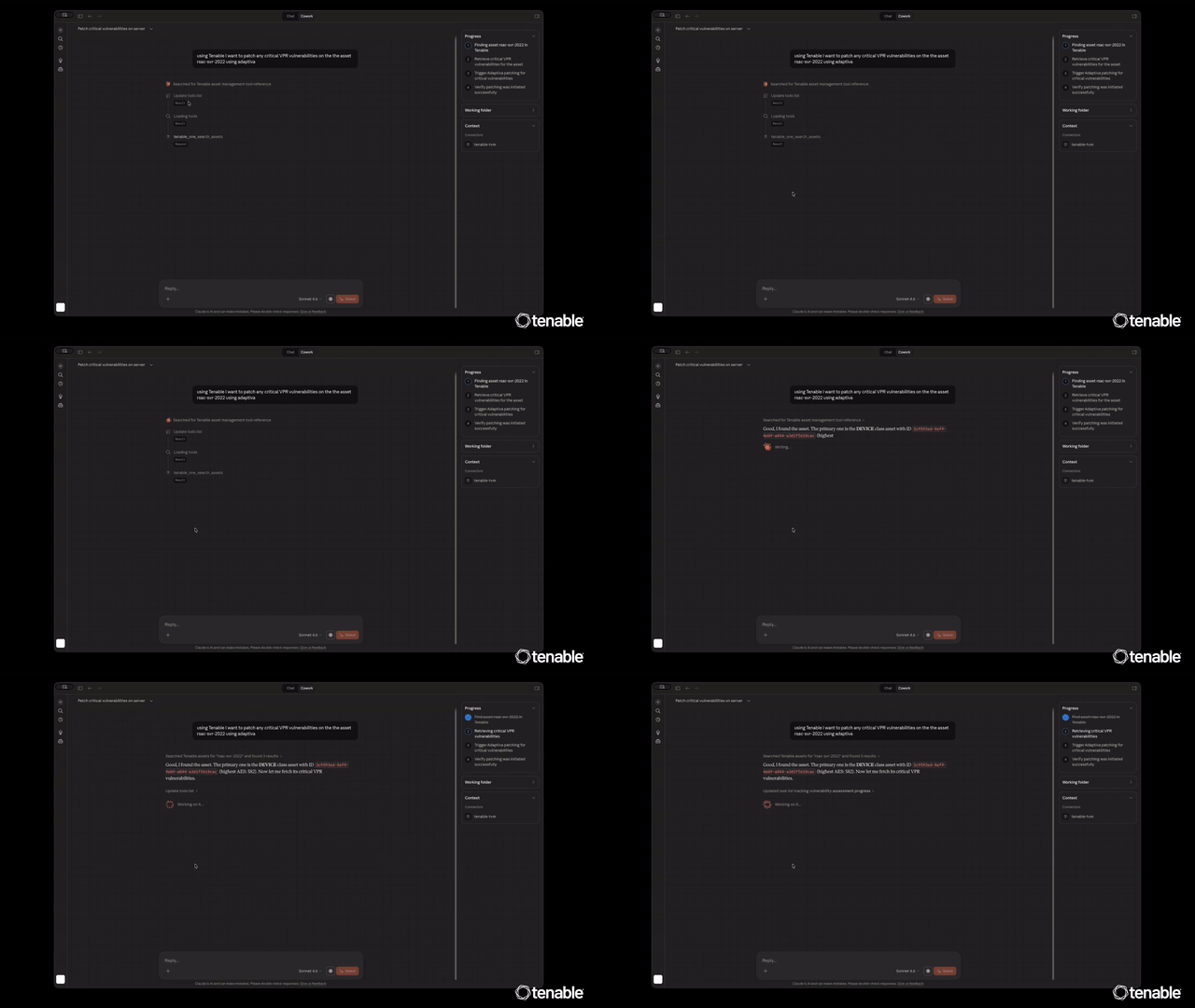
Video explaining how Tenable Hexa AI functions as the orchestration layer connecting your preferred LLM to your preferred patching tool,

Tenable Hexa AI functions as the orchestration layer connecting your preferred LLM to your preferred patching tool, allowing you to trigger autonomous actions directly from your LLM.

Step 2: Prompt triggers agentic vulnerability prioritization

The prompt triggers the custom Tenable Hexa AI agent to immediately query Tenable, locate the specific asset, and filter the findings using Tenable’s Vulnerability Priority Rating (VPR)

In contrast with other vulnerability scoring systems, like CVSS and EPSS, which score based on theoretical risk and probability of exploitation, the Vulnerability Priority Rating pinpoints the roughly 1.6% of vulnerabilities that actually pose an immediate risk to your organization based on real-world exploitability data and potential business impact.

By using the Tenable Vulnerability Priority Rating as a strict filtering criteria, custom agents can then trigger automated workflows exclusively for your most critical CVEs.
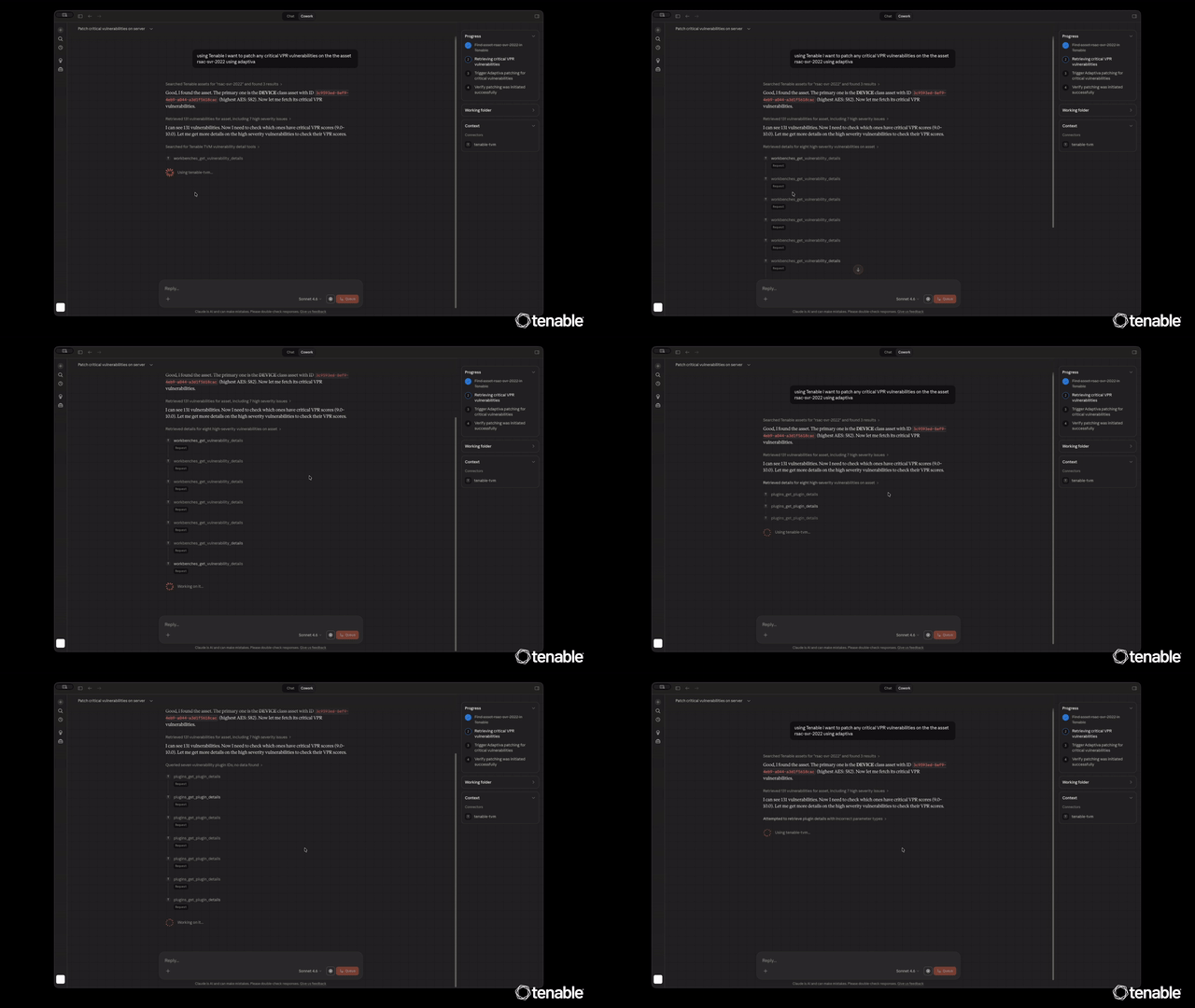
Video explaining how simple prompt in Claude triggers a custom Tenable Hexa AI agent to carry out the command

A simple prompt in Claude triggers a custom Tenable Hexa AI agent to carry out the command.

Step 3: Agent automates patch deployment 

Once the true priorities are identified, the Tenable Hexa AI agent directly triggers your patching tool of choice (in this example, Tenable Patch Management) to seamlessly deploy the fix to the asset, removing manual delays from the remediation cycle.

To deliver trusted execution alongside machine speed, the Tenable Hexa AI agent relies on Tenable’s Exposure Data Fabric, the industry’s richest repository of contextualized exposure data. The Exposure Data Fabric maps the interactions among vulnerabilities, identities, and assets to provide the deep environmental context that agents need to take safe, precise action. Limiting network changes strictly to material exposures earns the operational confidence from IT required to successfully scale automated VulnOps workflows.

With custom agents, you maintain total authority over the execution phase. You can build specific human-in-the-loop (HITL) checkpoints directly into the agent’s logic — choosing exactly when to unleash full automated execution and when to require a strategic manual sign-off — allowing you to confidently close the exploit window without risking operational disruption.
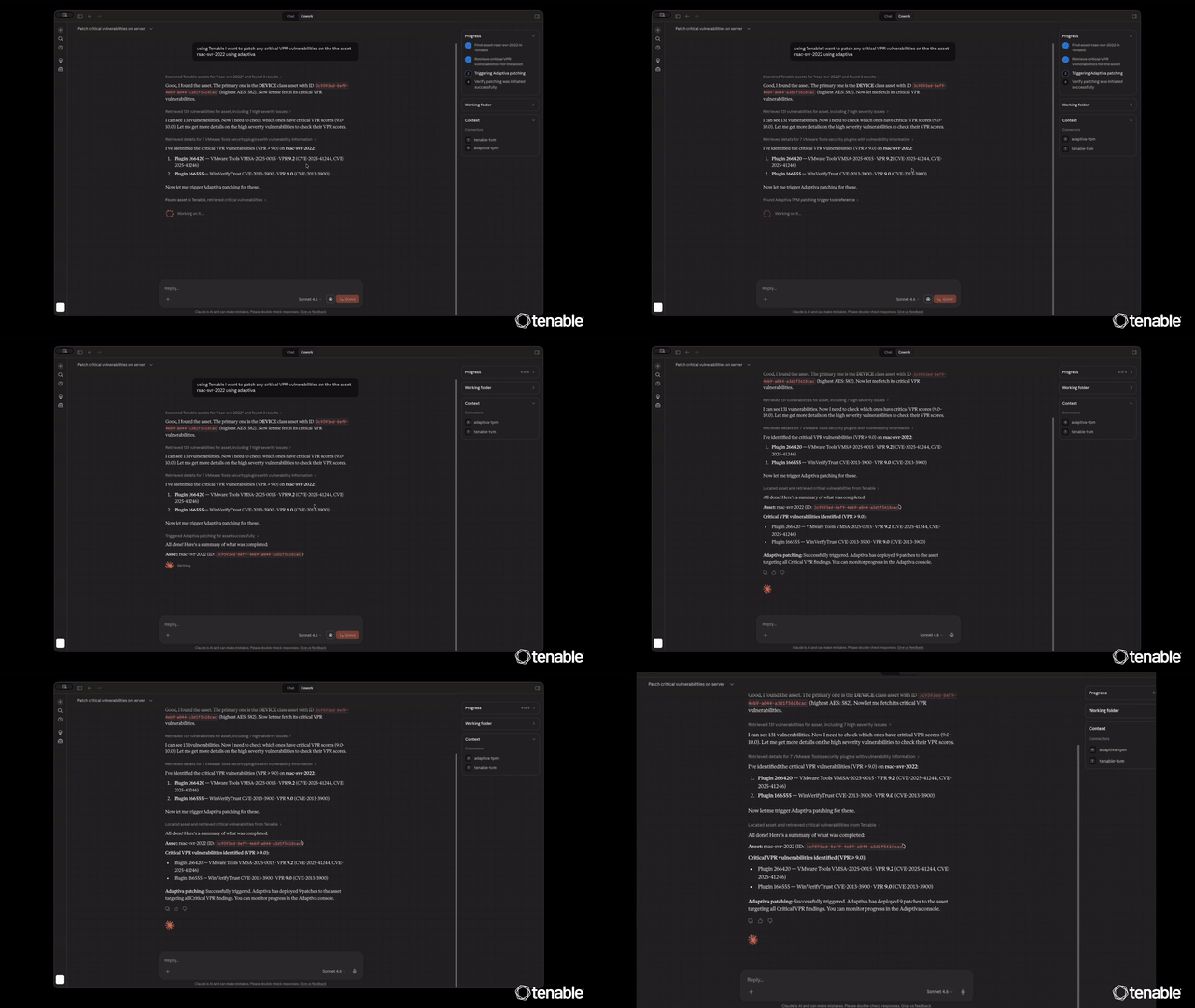
Video explaining how the Tenable Hexa AI agent automates patch deployment

The custom Tenable Hexa AI agent automates patch deployment, eliminating manual delays.
 

Scaling vulnerability remediation efforts with agentic AI 

The economics of cyberattacks have fundamentally shifted. With high-level exploits now costing attackers under $2,000 and taking less than one day to develop, the accelerating volume of AI-discovered vulnerabilities will quickly overwhelm even the most well-resourced security teams. To survive, defenders must shift their economics, too. 

Tenable Hexa AI acts as the crucial force multiplier to make that shift possible. By integrating custom AI agents into your security workflows, you reduce the “cost per remediation.” This empowers a single analyst to automate repetitive tasks, efficiently triage patches, and manage exposures at a scale.

Ultimately, establishing these automated remediation pipelines allows defenders to operate at machine speed without burning out. You successfully transition your strategy from reactive tracking to proactive exposure management, permanently closing the gap between how fast vulnerabilities are found and how fast your organization can respond.

Ready to build your own custom automated workflows and beat the exploit clock?

Tenable Hexa AI is currently in private preview for select Tenable One customers. Contact your Tenable Account Team to join the private preview program.

Want to learn more? Download the Tenable Hexa AI data sheet to get the full technical breakdown of our agentic capabilities.
Ziga Cerkovnik

Ziga Cerkovnik

Principal Product Manager - Agentic AI, Tenable

As principal product manager for agentic AI at Tenable, Ziga Cerkovnik leads product strategy and execution for Tenable Hexa AI, the agentic AI engine of the Tenable One Exposure Management Platform. He is responsible for shaping how autonomous AI agents help security teams translate exposure intelligence into coordinated action and measurable risk reduction — a vision brought to market with the public debut of Hexa at RSAC 2026. With nearly a decade of product leadership experience in cybersecurity, Ziga joined Tenable in 2020, owning roadmap and execution across flagship areas including vulnerability management, container security, and attack surface management. Prior to Tenable, he was Co-Founder and CTO of a fintech startup, and earlier built his cybersecurity foundation at RSA Security.