





惯性聚合 高效追踪和阅读你感兴趣的博客、新闻、科技资讯
阅读原文 在惯性聚合中打开

推荐订阅源

酷 壳 – CoolShell
酷 壳 – CoolShell
P
Privacy & Cybersecurity Law Blog
G
GRAHAM CLULEY
T
The Exploit Database - CXSecurity.com
www.infosecurity-magazine.com
Threat Intelligence Blog | Flashpoint
Project Zero
Project Zero
S
Security @ Cisco Blogs
TaoSecurity Blog
TaoSecurity Blog
A
Arctic Wolf
Webroot Blog
Webroot Blog
Hacker News - Newest:
Hacker News - Newest: "LLM"
Security Latest
Security Latest
H
Heimdal Security Blog
N
News and Events Feed by Topic
N
News | PayPal Newsroom
T
Tor Project blog
OSCHINA 社区最新新闻
OSCHINA 社区最新新闻
GbyAI
GbyAI
The Last Watchdog
The Last Watchdog
Y
Y Combinator Blog
宝玉的分享
宝玉的分享
Scott Helme
Scott Helme
A
About on SuperTechFans
M
MIT News - Artificial intelligence
V
V2EX
V
Visual Studio Blog
Recorded Future
Recorded Future
博客园 - 叶小钗
F
Fortinet All Blogs
L
Lohrmann on Cybersecurity
The GitHub Blog
The GitHub Blog
博客园 - Franky
P
Proofpoint News Feed
MyScale Blog
MyScale Blog
D
Darknet – Hacking Tools, Hacker News & Cyber Security
S
Secure Thoughts
D
DataBreaches.Net
Cyber Security Advisories - MS-ISAC
博客园 - 三生石上(FineUI控件)
I
InfoQ
SecWiki News
SecWiki News
Blog — PlanetScale
Blog — PlanetScale
Engineering at Meta
Engineering at Meta
J
Java Code Geeks
B
Blog RSS Feed
AWS News Blog
AWS News Blog
Know Your Adversary
Know Your Adversary
V
Vulnerabilities – Threatpost
H
Help Net Security

AWS News Blog

Amazon SQS turns 20: Two decades of reliable messaging at scale | Amazon Web Services AWS Weekly Roundup: AWS Builder Center at 1 year, Network Scanning in Security Hub, Loom for AWS, and more (July 13, 2026) | Amazon Web Services AWS Weekly Roundup: Claude Sonnet 5 on AWS, Amazon WorkSpaces for AI agents, AWS service availability updates, and more (July 6, 2026) | Amazon Web Services Upgrade Amazon EKS clusters with confidence using Kubernetes version rollbacks | Amazon Web Services Accelerate your infrastructure deployments by up to 4x with AWS CloudFormation Express mode | Amazon Web Services Amazon EC2 C9g and C9gd instances powered by AWS Graviton5 processors are now available | Amazon Web Services Automate public TLS certificate issuance with ACME support in AWS Certificate Manager | Amazon Web Services AWS Weekly Roundup, Agentic CX designer for Amazon Connect Customer, EC2 AMI Watermarks, Open Governance for MySQL, and more (June 29, 2026) | Amazon Web Services Run isolated sandboxes with full lifecycle control: AWS Lambda introduces MicroVMs | Amazon Web Services AWS Weekly Roundup: NY Summit recap, Local Zone in Hanoi, Grok 4.3 in Bedrock, price reductions, and more (June 22, 2026) | Amazon Web Services Announcing Amazon EC2 G7 instances accelerated by NVIDIA RTX PRO 4500 Blackwell Server Edition GPUs | Amazon Web Services Amazon ECS introduces new high-resolution metrics for faster service auto scaling | Amazon Web Services Top announcements of the AWS Summit in New York, 2026 | Amazon Web Services Introducing Amazon Bedrock Managed Knowledge Base for faster, more accurate enterprise AI applications | Amazon Web Services Announcing Web Search on Amazon Bedrock AgentCore: Ground your AI agents in current, accurate web knowledge | Amazon Web Services Proactively reduce tech debt autonomously with AWS Transform – continuous modernization (preview) | Amazon Web Services AWS DevOps Agent adds release management capabilities to assess code changes before production (preview) | Amazon Web Services AWS Security Agent adds threat modeling, Kiro power and Claude Code plugin, and more | Amazon Web Services Amazon S3 annotations: attach rich, queryable context directly to your objects | Amazon Web Services AWS WAF adds AI traffic monetization capability to help content owners charge AI bots for content access | Amazon Web Services AWS Weekly Roundup: AWS FinOps Agent in preview, Gemma 4 on Bedrock, Kiro Pro Max, and more (June 15, 2026) | Amazon Web Services Now available: Amazon EC2 M9g and M9gd instances powered by new AWS Graviton5 processors | Amazon Web Services Anthropic Claude Fable 5 on AWS: Mythos-class capabilities with built-in safeguards now available | Amazon Web Services AWS Weekly Roundup: BYOM for Amazon RDS for SQL Server, AWS IoT Device SDK for Swift, and more (June 8, 2026) | Amazon Web Services Try the new console experience in Amazon Bedrock, optimized for Anthropic- and OpenAI-compatible APIs | Amazon Web Services Improve your application resilience with Amazon Cognito multi-Region replication | Amazon Web Services AWS Weekly Roundup: Claude Opus 4.8 on AWS, Aurora MySQL with Kiro Powers, and more (June 1, 2026) | Amazon Web Services Introducing the next generation of AWS Resilience Hub for generative AI-based SRE resilience journey | Amazon Web Services Introducing the next generation of Amazon OpenSearch Serverless for building your agentic AI applications | Amazon Web Services Meet Our Newest AWS Heroes – May 2026 | Amazon Web Services AWS Weekly Roundup: AWS Local Zones in Istanbul, open-source ExtendDB, Kiro Web, and more (May 25, 2026) | Amazon Web Services AWS Weekly Roundup: AWS Transform at 1 year, Claude Platform on AWS, EC2 M3 Ultra Mac instances, and more (May 18, 2026) | Amazon Web Services Amazon Bedrock introduces new advanced prompt optimization and migration tool | Amazon Web Services Amazon Redshift introduces AWS Graviton-based RG instances with an integrated data lake query engine | Amazon Web Services AWS Weekly Roundup: Amazon Bedrock AgentCore payments, Agent Toolkit for AWS, and more (May 11, 2026) | Amazon Web Services The AWS MCP Server is now generally available | Amazon Web Services Modernize your workflows: Amazon WorkSpaces now gives AI agents their own desktop (preview) | Amazon Web Services AWS Weekly Roundup: What’s Next with AWS 2026, Amazon Quick, OpenAI partnership, and more (May 4, 2026) | Amazon Web Services Top announcements of the What’s Next with AWS, 2026 | Amazon Web Services AWS Weekly Roundup: Anthropic & Meta partnership, AWS Lambda S3 Files, Amazon Bedrock AgentCore CLI, and more (April 27, 2026) | Amazon Web Services AWS Weekly Roundup: Claude Opus 4.7 in Amazon Bedrock, AWS Interconnect GA, and more (April 20, 2026) | Amazon Web Services Introducing Anthropic’s Claude Opus 4.7 model in Amazon Bedrock | Amazon Web Services AWS Interconnect is now generally available, with a new option to simplify last-mile connectivity | Amazon Web Services AWS Weekly Roundup: Claude Mythos Preview in Amazon Bedrock, AWS Agent Registry, and more (April 13, 2026) | Amazon Web Services Launching S3 Files, making S3 buckets accessible as file systems | Amazon Web Services AWS Weekly Roundup: AWS DevOps Agent & Security Agent GA, Product Lifecycle updates, and more (April 6, 2026) | Amazon Web Services Amazon Bedrock Guardrails supports cross-account safeguards with centralized control and management | Amazon Web Services Announcing managed daemon support for Amazon ECS Managed Instances | Amazon Web Services Announcing the AWS Sustainability console: Programmatic access, configurable CSV reports, and Scope 1–3 reporting in one place | Amazon Web Services AWS Weekly Roundup: AWS AI/ML Scholars program, Agent Plugin for AWS Serverless, and more (March 30, 2026) | Amazon Web Services Customize your AWS Management Console experience with visual settings including account color, region and service visibility | Amazon Web Services Announcing Amazon Aurora PostgreSQL serverless database creation in seconds | Amazon Web Services AWS Weekly Roundup: NVIDIA Nemotron 3 Super on Amazon Bedrock, Nova Forge SDK, Amazon Corretto 26, and more (March 23, 2026) | Amazon Web Services 20 years in the AWS Cloud – how time flies! | Amazon Web Services Our First 2026 AWS Heroes Cohort Is Here! | Amazon Web Services AWS Weekly Roundup: Amazon S3 turns 20, Amazon Route 53 Global Resolver general availability, and more (March 16, 2026) | Amazon Web Services Twenty years of Amazon S3 and building what’s next | Amazon Web Services Introducing account regional namespaces for Amazon S3 general purpose buckets | Amazon Web Services AWS Weekly Roundup: Amazon Connect Health, Bedrock AgentCore Policy, GameDay Europe, and more (March 9, 2026) | Amazon Web Services Introducing OpenClaw on Amazon Lightsail to run your autonomous private AI agents | Amazon Web Services AWS Weekly Roundup: OpenAI partnership, AWS Elemental Inference, Strands Labs, and more (March 2, 2026) | Amazon Web Services AWS Security Hub Extended offers full-stack enterprise security with curated partner solutions | Amazon Web Services Transform live video for mobile audiences with AWS Elemental Inference | Amazon Web Services AWS Weekly Roundup: Claude Sonnet 4.6 in Amazon Bedrock, Kiro in GovCloud Regions, new Agent Plugins, and more (February 23, 2026) | Amazon Web Services
Get started with OpenAI GPT-5.5, GPT-5.4 models, and Codex on Amazon Bedrock | Amazon Web Services
Channy Yun ( · 2026-06-02 · via AWS News Blog

AWS News Blog

Voiced by Polly

As we previewed in What’s Next with AWS 2026, we’re announcing the availability of OpenAI GPT-5.5, GPT-5.4 models, and Codex on Amazon Bedrock, giving you access to frontier models and a coding agent for software development.

According to OpenAI, GPT-5.5 and GPT-5.4 models are excellent for coding, reasoning, agentic workflows, and complex professional work. You can use GPT-5.5 for the hardest customer workloads and GPT-5.4 for the best price-performance. You can call them through Responses API on Amazon Bedrock’s next-generation inference engine built for high performance, reliability, and security.

Codex is the OpenAI coding agent for AI-powered software development. According to OpenAI, more than 4 million developers use Codex every week to write, refactor, debug, test, and validate code across large codebases. With GPT-5.5 powering inference, Codex introduces a new class of intelligence optimized for complex, long-horizon developer workflows. You can use the Codex App, the Codex CLI, and IDE integrations with Visual Studio Code, JetBrains, and Xcode, with all model inference routed through the Responses API on Amazon Bedrock.

For customers with data residency requirements, all processing stays within the Bedrock Region you select. You pay per token with no seat licenses and no per-developer commitments.

GPT-5.5 and GPT-5.4 models on Bedrock in action
You can access the model programmatically using the OpenAI Responses API to call the bedrock-mantle endpoints through the OpenAI SDK, command-line tools such as curl.

Let’s start with OpenAI SDK for Python. Install OpenAI SDK.

pip install -U openai

Set the environment variables for authentication.

export OPENAI_BASE_URL="https://bedrock-mantle.us-east-2.api.aws/openai/v1"
export OPENAI_API_KEY="<BEDROCK_API_KEY>"
export BEDROCK_OPENAI_MODEL_ID="openai.gpt-5.5"

Here is a sample Python code to call GPT-5.5 model on Bedrock:

import os
from openai import OpenAI
 
client = OpenAI(
    base_url=os.environ["OPENAI_BASE_URL"],
    api_key=os.environ["OPENAI_API_KEY"],
)
 
response = client.responses.create(
    model=os.environ["BEDROCK_OPENAI_MODEL_ID"],
    input=[
        {
            "role": "developer",
            "content": "You are a software engineer with excellent AWS cloud knowledge. Be concise and practical.",
        },
        {
            "role": "user",
            "content": "Design a distributed architecture on AWS in Python that should support 100k requests per second across multiple geographic regions.",
        },
    ],
    reasoning={"effort": "medium"},
    text={"verbosity": "low"},
)
 
print(response.output_text)

You can call directly the model endpoint using curl.

curl "$OPENAI_BASE_URL/responses" \
  -H "Content-Type: application/json" \
  -H "Authorization: Bearer $OPENAI_API_KEY" \
  -d '{
    "model": "openai.gpt-5.5",
    "input": [
      {
        "role": "developer",
        "content": "You are a software engineer with excellent AWS cloud knowledge."
      },
      {
        "role": "user",
        "content": "Design a distributed architecture on AWS in Python that should support 100k requests per second across multiple geographic regions."
      }
    ],
    "reasoning": {"effort": "medium"},
    "text": {"verbosity": "low"}
  }'

You can use the Responses API when you want to use model-managed multi-turn state, need hosted tools, function tools, or richer tool orchestration, and run background or long-running work. To learn more, visit the OpenAI Cookbook Responses examples and getting started guide.

Using OpenAI Codex with GPT-5.5 on Amazon Bedrock
You can download Codex CLI, Codex App or Codex VS Code extension and get started with the Bedrock for model inference. Codex supports two Bedrock authentication pathways: Amazon Bedrock API key or AWS SDK credential chain. If you set AWS_BEARER_TOKEN_BEDROCK, Codex uses it first; otherwise Codex falls back to AWS SDK credential chain.

Set AWS_BEARER_TOKEN_BEDROCK in the environment that Codex will read:

export AWS_BEARER_TOKEN_BEDROCK=<your-bedrock-api-key>

Then, configure your preferred Region and set the model ID to openai.gpt-5.5 in ~/.codex/config.toml, which is required for Bedrock API-key authentication. You can also choose openai.gpt-5.4, openai.gpt-oss-120b, or openai.gpt-oss-20b. For the desktop app or VS Code extension, put any environment variables the app needs in ~/.codex/.env.

model = "openai.gpt-5.5"
model_provider = "amazon-bedrock"
[model_providers.amazon-bedrock.aws]
region = "us-east-2"

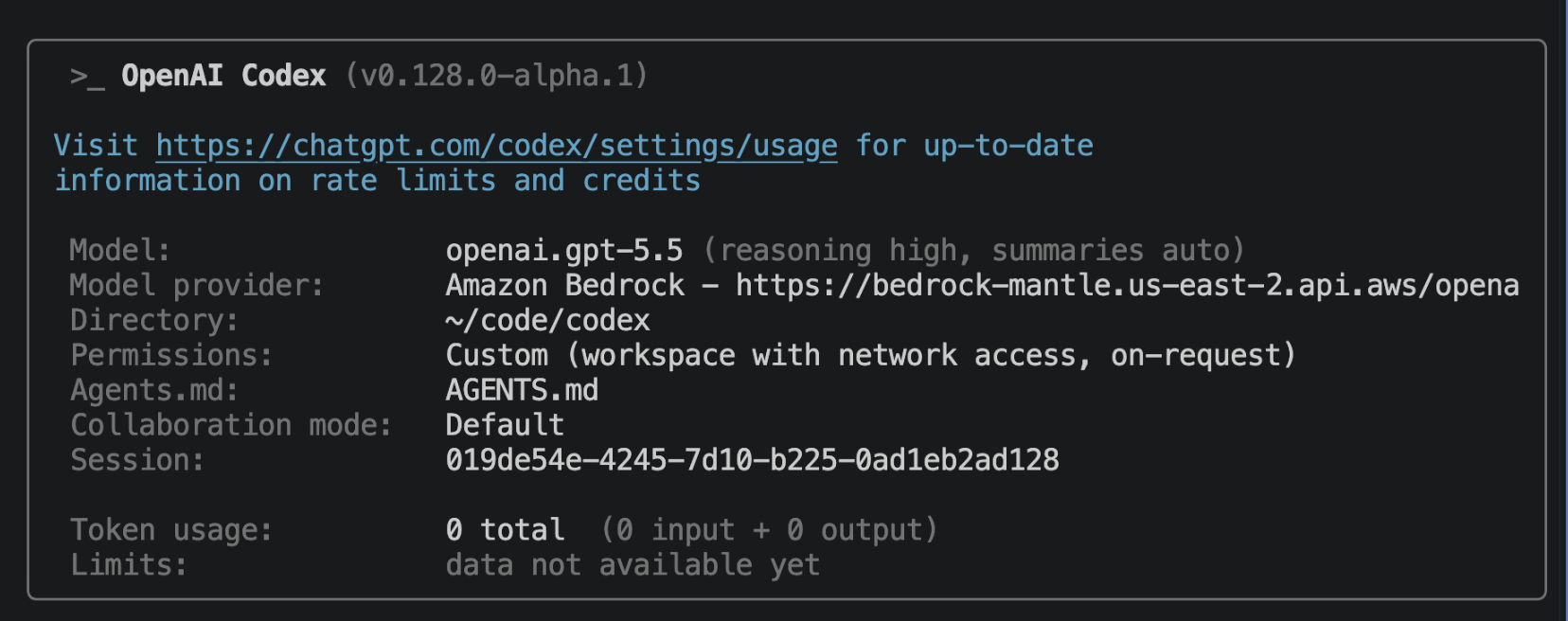
Restart the desktop app or VS Code extension after changing ~/.codex/config.toml or ~/.codex/.env. In Codex CLI, you should see a /status tab that looks like this:
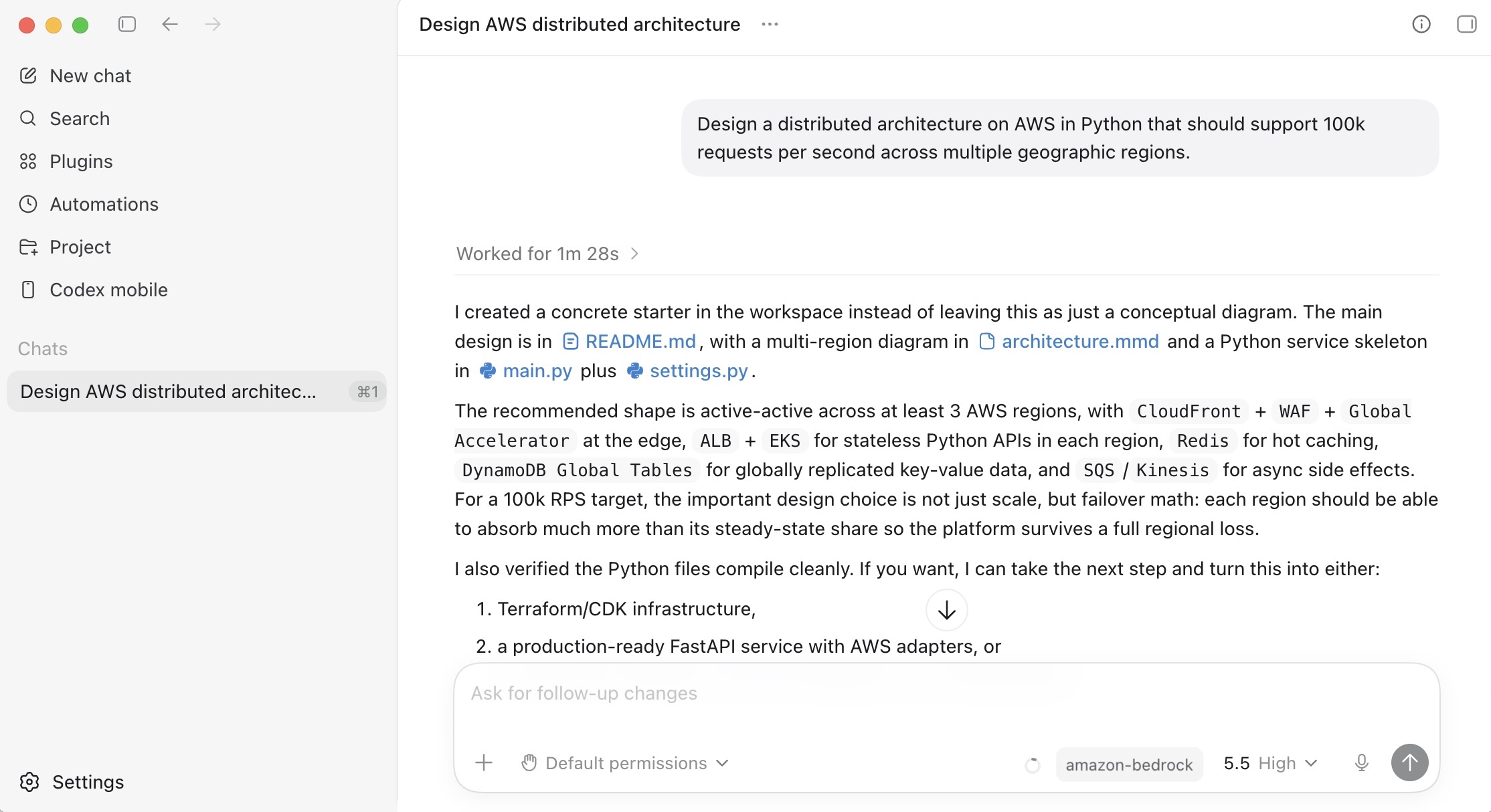
In Codex App, you can use GPT-5.5 model through Amazon Bedrock inference.
To learn more about how to configure Codex to use OpenAI models on Amazon Bedrock, visit Use Codex with Amazon Bedrock.

Things to know
Let me share some important technical details that I think you’ll find useful.

  • Model latency: OpenAI model information positions GPT-5.5 as fast and GPT-5.4 as medium speed, but customer-perceived latency depends on reasoning effort, output length, tool calls, background mode, Region, quotas, throttling, prompt size, and cache hits. Start GPT-5.5 at medium effort. Start GPT-5.4 with effort set explicitly rather than relying on its none default.
  • Scaling and capacity: Bedrock’s new inference engine is designed to rapidly provision and serve capacity across many different models. When accepting requests, we prioritize keeping steady state workloads running, and ramp usage and capacity rapidly in response to changes in demand. During periods of high demand, requests are queued, rather than rejected.

Now available
OpenAI GPT models and Codex on Amazon Bedrock are available today: GPT-5.5 model in the US East (Ohio) Region, GPT-5.4 model in the US East (Ohio) and US West (Oregon) Regions. Check the full list of Regions for future updates. To learn more, visit the OpenAI on Amazon Bedrock page and the Amazon Bedrock pricing page.

Give GPT-5.5, GPT-5.4 models, and Codex on Amazon Bedrock a try today and send feedback to AWS re:Post for Amazon Bedrock or through your usual AWS Support contacts.

Channy

Updated on June, 1, 2026 – The GPT 5.5 and 5.4 models now support the Responses API only on Amazon Bedrock, and console support is coming soon.

Updated on June, 3, 2026 – Amazon Bedrock now supports GPT‑5.4 from OpenAI in AWS GovCloud (US-West) Region.

Updated on June, 7, 2026 – You can use the GPT 5.5 and 5.4 models in the new Amazon Bedrock console.