



惯性聚合 高效追踪和阅读你感兴趣的博客、新闻、科技资讯
阅读原文 在惯性聚合中打开

推荐订阅源

月光博客
月光博客
钛媒体:引领未来商业与生活新知
钛媒体:引领未来商业与生活新知
人人都是产品经理
人人都是产品经理
IT之家
IT之家
Cyberwarzone
Cyberwarzone
T
Troy Hunt's Blog
有赞技术团队
有赞技术团队
阮一峰的网络日志
阮一峰的网络日志
T
Threat Research - Cisco Blogs
S
SegmentFault 最新的问题
Apple Machine Learning Research
G
GRAHAM CLULEY
cs.CL updates on arXiv.org
博客园 - 叶小钗
Last Week in AI
Last Week in AI
C
CERT Recently Published Vulnerability Notes
The Hacker News
The Hacker News
Jina AI
Jina AI
T
Tor Project blog
V
Vulnerabilities – Threatpost
酷 壳 – CoolShell
酷 壳 – CoolShell
Spread Privacy
Spread Privacy
博客园_首页
C
Cybersecurity and Infrastructure Security Agency CISA
Threat Intelligence Blog | Flashpoint
freeCodeCamp Programming Tutorials: Python, JavaScript, Git & More
Simon Willison's Weblog
Security Latest
Security Latest
cs.CV updates on arXiv.org
cs.AI updates on arXiv.org
博客园 - 司徒正美
V2EX - 技术
V2EX - 技术
I
Intezer
The Cloudflare Blog
Cisco Talos Blog
Cisco Talos Blog
SecWiki News
SecWiki News
博客园 - 【当耐特】
奇客Solidot–传递最新科技情报
奇客Solidot–传递最新科技情报
L
Lohrmann on Cybersecurity
Scott Helme
Scott Helme
Google Online Security Blog
量子位
The Last Watchdog
The Last Watchdog
AI
AI
Application and Cybersecurity Blog
S
Security Affairs
P
Palo Alto Networks Blog
S
Secure Thoughts
OSCHINA 社区最新新闻
OSCHINA 社区最新新闻
Attack and Defense Labs

AWS News Blog

Amazon SQS turns 20: Two decades of reliable messaging at scale | Amazon Web Services AWS Weekly Roundup: AWS Builder Center at 1 year, Network Scanning in Security Hub, Loom for AWS, and more (July 13, 2026) | Amazon Web Services AWS Weekly Roundup: Claude Sonnet 5 on AWS, Amazon WorkSpaces for AI agents, AWS service availability updates, and more (July 6, 2026) | Amazon Web Services Upgrade Amazon EKS clusters with confidence using Kubernetes version rollbacks | Amazon Web Services Accelerate your infrastructure deployments by up to 4x with AWS CloudFormation Express mode | Amazon Web Services Amazon EC2 C9g and C9gd instances powered by AWS Graviton5 processors are now available | Amazon Web Services Automate public TLS certificate issuance with ACME support in AWS Certificate Manager | Amazon Web Services AWS Weekly Roundup, Agentic CX designer for Amazon Connect Customer, EC2 AMI Watermarks, Open Governance for MySQL, and more (June 29, 2026) | Amazon Web Services Run isolated sandboxes with full lifecycle control: AWS Lambda introduces MicroVMs | Amazon Web Services AWS Weekly Roundup: NY Summit recap, Local Zone in Hanoi, Grok 4.3 in Bedrock, price reductions, and more (June 22, 2026) | Amazon Web Services Announcing Amazon EC2 G7 instances accelerated by NVIDIA RTX PRO 4500 Blackwell Server Edition GPUs | Amazon Web Services Amazon ECS introduces new high-resolution metrics for faster service auto scaling | Amazon Web Services Top announcements of the AWS Summit in New York, 2026 | Amazon Web Services Introducing Amazon Bedrock Managed Knowledge Base for faster, more accurate enterprise AI applications | Amazon Web Services Announcing Web Search on Amazon Bedrock AgentCore: Ground your AI agents in current, accurate web knowledge | Amazon Web Services Proactively reduce tech debt autonomously with AWS Transform – continuous modernization (preview) | Amazon Web Services AWS Security Agent adds threat modeling, Kiro power and Claude Code plugin, and more | Amazon Web Services Amazon S3 annotations: attach rich, queryable context directly to your objects | Amazon Web Services AWS WAF adds AI traffic monetization capability to help content owners charge AI bots for content access | Amazon Web Services AWS Weekly Roundup: AWS FinOps Agent in preview, Gemma 4 on Bedrock, Kiro Pro Max, and more (June 15, 2026) | Amazon Web Services Now available: Amazon EC2 M9g and M9gd instances powered by new AWS Graviton5 processors | Amazon Web Services Anthropic Claude Fable 5 on AWS: Mythos-class capabilities with built-in safeguards now available | Amazon Web Services AWS Weekly Roundup: BYOM for Amazon RDS for SQL Server, AWS IoT Device SDK for Swift, and more (June 8, 2026) | Amazon Web Services Try the new console experience in Amazon Bedrock, optimized for Anthropic- and OpenAI-compatible APIs | Amazon Web Services Improve your application resilience with Amazon Cognito multi-Region replication | Amazon Web Services Get started with OpenAI GPT-5.5, GPT-5.4 models, and Codex on Amazon Bedrock | Amazon Web Services AWS Weekly Roundup: Claude Opus 4.8 on AWS, Aurora MySQL with Kiro Powers, and more (June 1, 2026) | Amazon Web Services Introducing the next generation of AWS Resilience Hub for generative AI-based SRE resilience journey | Amazon Web Services Introducing the next generation of Amazon OpenSearch Serverless for building your agentic AI applications | Amazon Web Services Meet Our Newest AWS Heroes – May 2026 | Amazon Web Services AWS Weekly Roundup: AWS Local Zones in Istanbul, open-source ExtendDB, Kiro Web, and more (May 25, 2026) | Amazon Web Services AWS Weekly Roundup: AWS Transform at 1 year, Claude Platform on AWS, EC2 M3 Ultra Mac instances, and more (May 18, 2026) | Amazon Web Services Amazon Bedrock introduces new advanced prompt optimization and migration tool | Amazon Web Services Amazon Redshift introduces AWS Graviton-based RG instances with an integrated data lake query engine | Amazon Web Services AWS Weekly Roundup: Amazon Bedrock AgentCore payments, Agent Toolkit for AWS, and more (May 11, 2026) | Amazon Web Services The AWS MCP Server is now generally available | Amazon Web Services Modernize your workflows: Amazon WorkSpaces now gives AI agents their own desktop (preview) | Amazon Web Services AWS Weekly Roundup: What’s Next with AWS 2026, Amazon Quick, OpenAI partnership, and more (May 4, 2026) | Amazon Web Services Top announcements of the What’s Next with AWS, 2026 | Amazon Web Services AWS Weekly Roundup: Anthropic & Meta partnership, AWS Lambda S3 Files, Amazon Bedrock AgentCore CLI, and more (April 27, 2026) | Amazon Web Services AWS Weekly Roundup: Claude Opus 4.7 in Amazon Bedrock, AWS Interconnect GA, and more (April 20, 2026) | Amazon Web Services Introducing Anthropic’s Claude Opus 4.7 model in Amazon Bedrock | Amazon Web Services AWS Interconnect is now generally available, with a new option to simplify last-mile connectivity | Amazon Web Services AWS Weekly Roundup: Claude Mythos Preview in Amazon Bedrock, AWS Agent Registry, and more (April 13, 2026) | Amazon Web Services Launching S3 Files, making S3 buckets accessible as file systems | Amazon Web Services AWS Weekly Roundup: AWS DevOps Agent & Security Agent GA, Product Lifecycle updates, and more (April 6, 2026) | Amazon Web Services Amazon Bedrock Guardrails supports cross-account safeguards with centralized control and management | Amazon Web Services Announcing managed daemon support for Amazon ECS Managed Instances | Amazon Web Services Announcing the AWS Sustainability console: Programmatic access, configurable CSV reports, and Scope 1–3 reporting in one place | Amazon Web Services AWS Weekly Roundup: AWS AI/ML Scholars program, Agent Plugin for AWS Serverless, and more (March 30, 2026) | Amazon Web Services Customize your AWS Management Console experience with visual settings including account color, region and service visibility | Amazon Web Services Announcing Amazon Aurora PostgreSQL serverless database creation in seconds | Amazon Web Services AWS Weekly Roundup: NVIDIA Nemotron 3 Super on Amazon Bedrock, Nova Forge SDK, Amazon Corretto 26, and more (March 23, 2026) | Amazon Web Services 20 years in the AWS Cloud – how time flies! | Amazon Web Services Our First 2026 AWS Heroes Cohort Is Here! | Amazon Web Services AWS Weekly Roundup: Amazon S3 turns 20, Amazon Route 53 Global Resolver general availability, and more (March 16, 2026) | Amazon Web Services Twenty years of Amazon S3 and building what’s next | Amazon Web Services Introducing account regional namespaces for Amazon S3 general purpose buckets | Amazon Web Services AWS Weekly Roundup: Amazon Connect Health, Bedrock AgentCore Policy, GameDay Europe, and more (March 9, 2026) | Amazon Web Services Introducing OpenClaw on Amazon Lightsail to run your autonomous private AI agents | Amazon Web Services AWS Weekly Roundup: OpenAI partnership, AWS Elemental Inference, Strands Labs, and more (March 2, 2026) | Amazon Web Services AWS Security Hub Extended offers full-stack enterprise security with curated partner solutions | Amazon Web Services Transform live video for mobile audiences with AWS Elemental Inference | Amazon Web Services AWS Weekly Roundup: Claude Sonnet 4.6 in Amazon Bedrock, Kiro in GovCloud Regions, new Agent Plugins, and more (February 23, 2026) | Amazon Web Services
AWS DevOps Agent adds release management capabilities to assess code changes before production (preview) | Amazon Web Services
Esra Kayabal · 2026-06-17 · via AWS News Blog

Voiced by Polly

Today, we’re announcing a new release management capability in AWS DevOps Agent that is now available in preview. AWS DevOps Agent is your always-available teammate that spans software changes and operations across AWS, multicloud, and on-premises environments. The practice of DevOps aims to make software change and operations smooth and increasingly autonomous, and AWS DevOps Agent delivers on both by leveraging its deep understanding of your environment, your services, their dependencies, and how they behave in production. Already generally available for post-deployment operations, it autonomously investigates incidents, provides root cause analysis and mitigation steps, and delivers targeted recommendations to prevent recurring issues. With today’s preview, AWS DevOps Agent adds release readiness review of code changes and autonomous release testing. These new features verify every change against the natural language standards you give to the DevOps Agent and run change-specific tests in production-like environments. AWS DevOps Agent now supports teams from code creation to production, helping reviewers and testers keep pace with the volume of AI-generated code.

As development teams adopt AI coding tools, the volume of pull requests moving through delivery pipelines has increased faster than review and testing processes can handle. When teams are under pressure to keep up, reviews are approved without thorough examination, and test environments drift from production. The value that coding agents generate sits waiting in review queues instead of reaching end users. At the same time, AI models are increasingly capable of catching functional and security issues that human reviewers might miss under time pressure, making speedy and safe delivery a requirement rather than a tradeoff.

The release readiness review feature evaluates every code change against production requirements, dependency safety, and the standards and best practices you provide to the DevOps Agent. The agent checks cross-repository dependency risks that could affect other services, access control changes against AWS Well-Architected Framework best practices, and compliance with any standards you have defined. When no standards are provided, the agent applies general best practices. As part of the review, the agent also runs your software in an AWS-managed isolated environment, executing lightweight user journey tests to verify the software builds, runs, and passes basic functional checks before the change enters the pipeline. Findings appear in the AWS DevOps Agent console and as comments on pull requests in GitHub or GitLab. You can also invoke reviews directly from your IDE through the Kiro power or Claude Code plugin, so developers can identify and fix dependency risks, standards violations, and access control issues before the change is committed to version control.

The autonomous release testing feature goes further, generating and running change-specific test plans for web and API-based applications in customer-provisioned, production-like environments before the change merges. Rather than running a static test suite, the agent reasons about what the change does and constructs tests tailored to it, covering functional correctness, behavioral regressions, and integration scenarios that a manually maintained test plan might not anticipate. Every test run produces structured artifacts including metrics, logs, traces, and an execution summary, giving reviewers a consistent record of what was tested and what the results were.

Getting started with AWS DevOps Agent release management
This walkthrough shows how to run an on-demand release readiness review using the AWS DevOps Agent web app. Before you begin, confirm that you have at least one GitHub or GitLab repository connected to your Agent Space. Once your repositories are connected, AWS DevOps Agent will index your code and build a knowledge graph of cross-repository and cloud dependencies.

To open the web app, navigate to the AWS DevOps Agent console, select your Agent Space, and choose the Web app tab. Choose Operator access to open the web app.

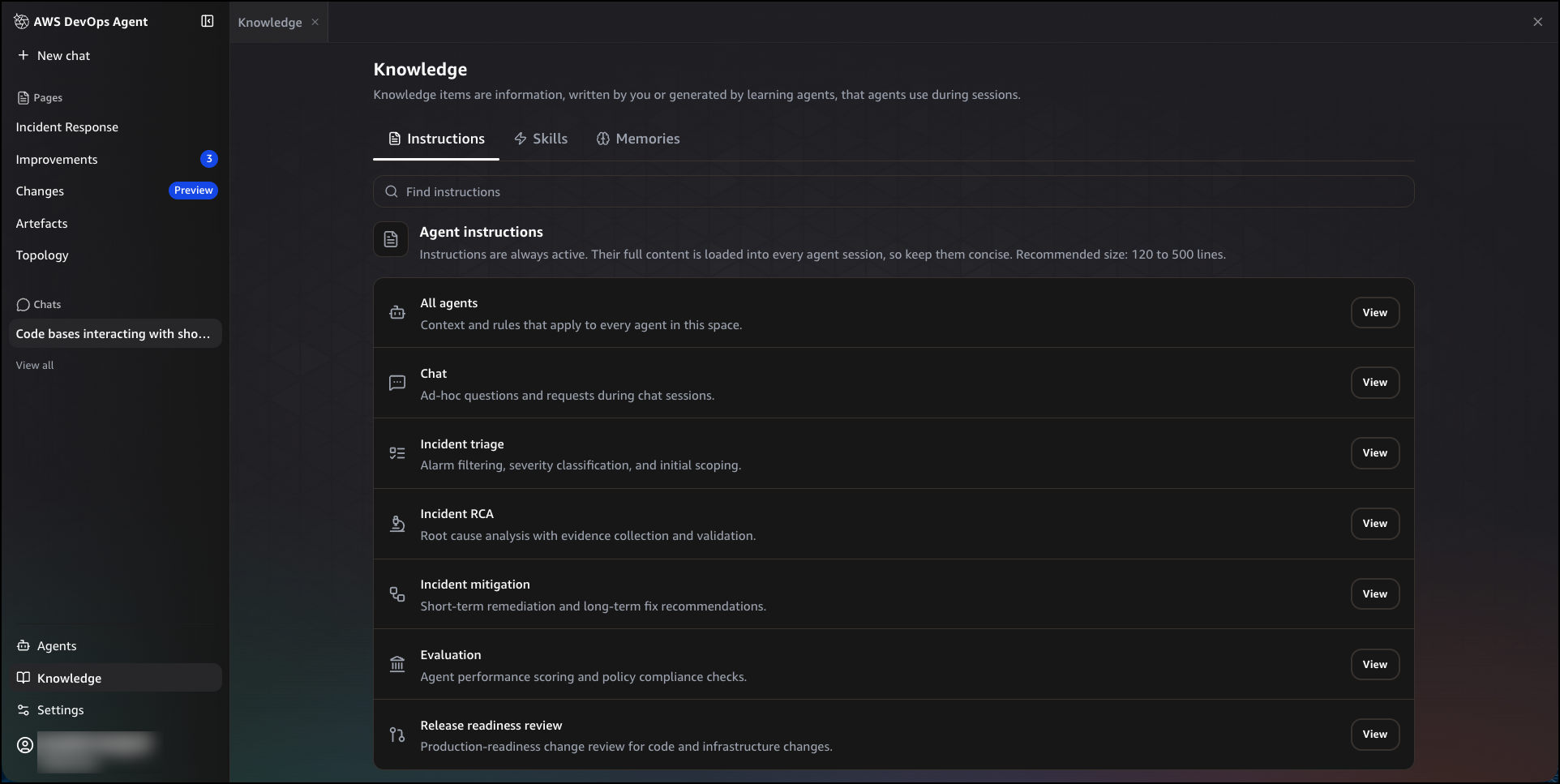
Without standards configured, the agent applies general best practices. To tailor reviews to your internal standards, navigate to Knowledge, then choose the Instructions tab. You will see a list of instruction sets, each scoped to a specific agent or task. Choose View next to Release readiness review to edit the instructions for production-readiness change review. Write your internal standards in plain English. For example, you can define infrastructure and data standards on encryption or network access rules, best practices that warn without blocking such as logging and observability requirements, and sensitive data classification best practices that identify applications or resources requiring higher security measures. To apply instructions across all agents in your space, choose View next to All agents.
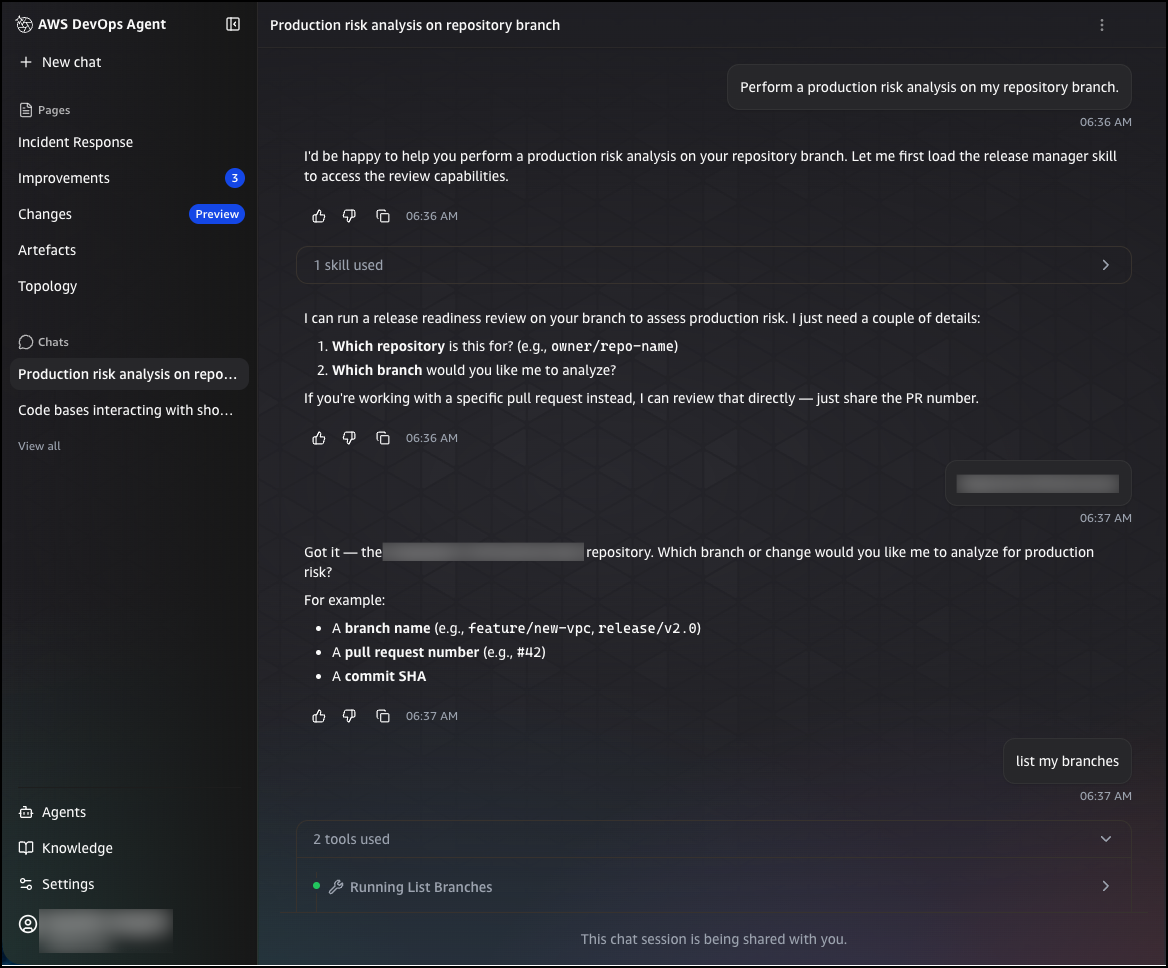
You can trigger a release readiness review in two ways: by submitting a pull request to a connected repository, or by entering an on-demand query in the chat interface. To run an on-demand review from chat, choose New chat and enter a request such as:

Perform a production risk analysis on my repository branch

The agent will ask for the repository and branch you want to analyze. You can provide a branch name, a pull request number, or a commit SHA. Once you confirm your selection, the agent queues the review and analyzes the change for production risks, including infrastructure impacts, configuration changes, and potential issues.

After the review completes, you can ask follow-up questions directly in the chat to explore the findings in more detail. For example, you can ask which downstream consumers a change affects, and the agent will return a structured breakdown of in-repository and cross-repository consumers that will break, the specific files and line numbers affected, and the recommended steps to resolve the issue before deployment.
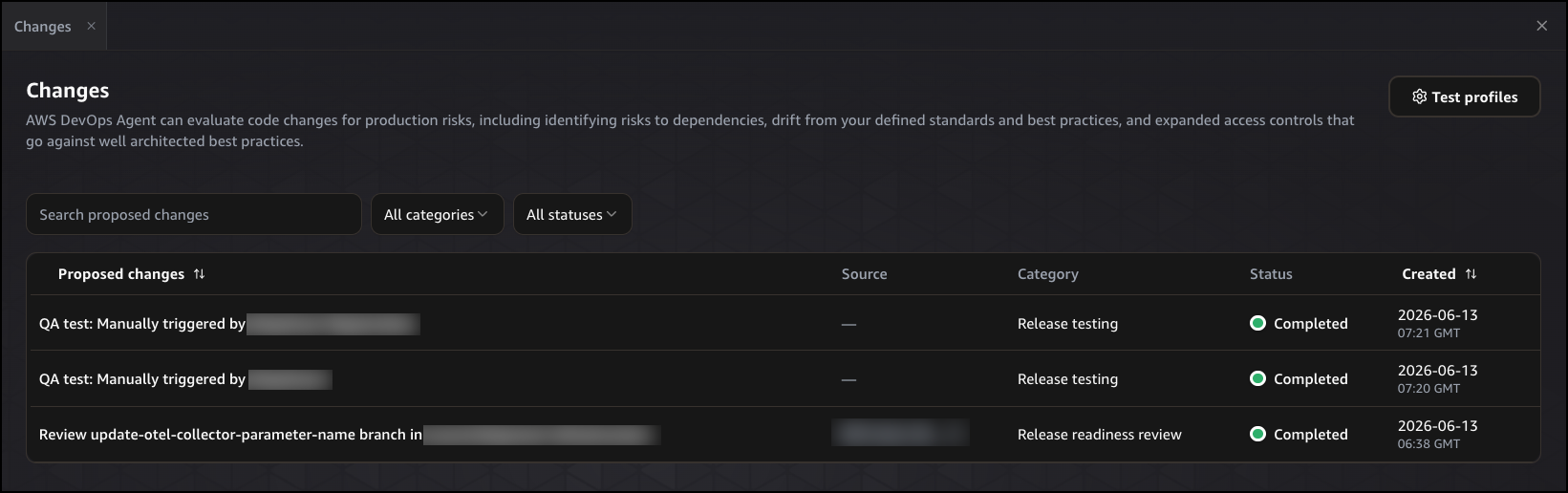
After submitting a review request, navigate to Changes in the left navigation pane. The Proposed changes table shows each review that has run, including the proposed change description, its source, category, status, and when it was created. You can filter by category or status to find specific reviews, or search by name using the search bar. Choose any entry to open the full execution detail.
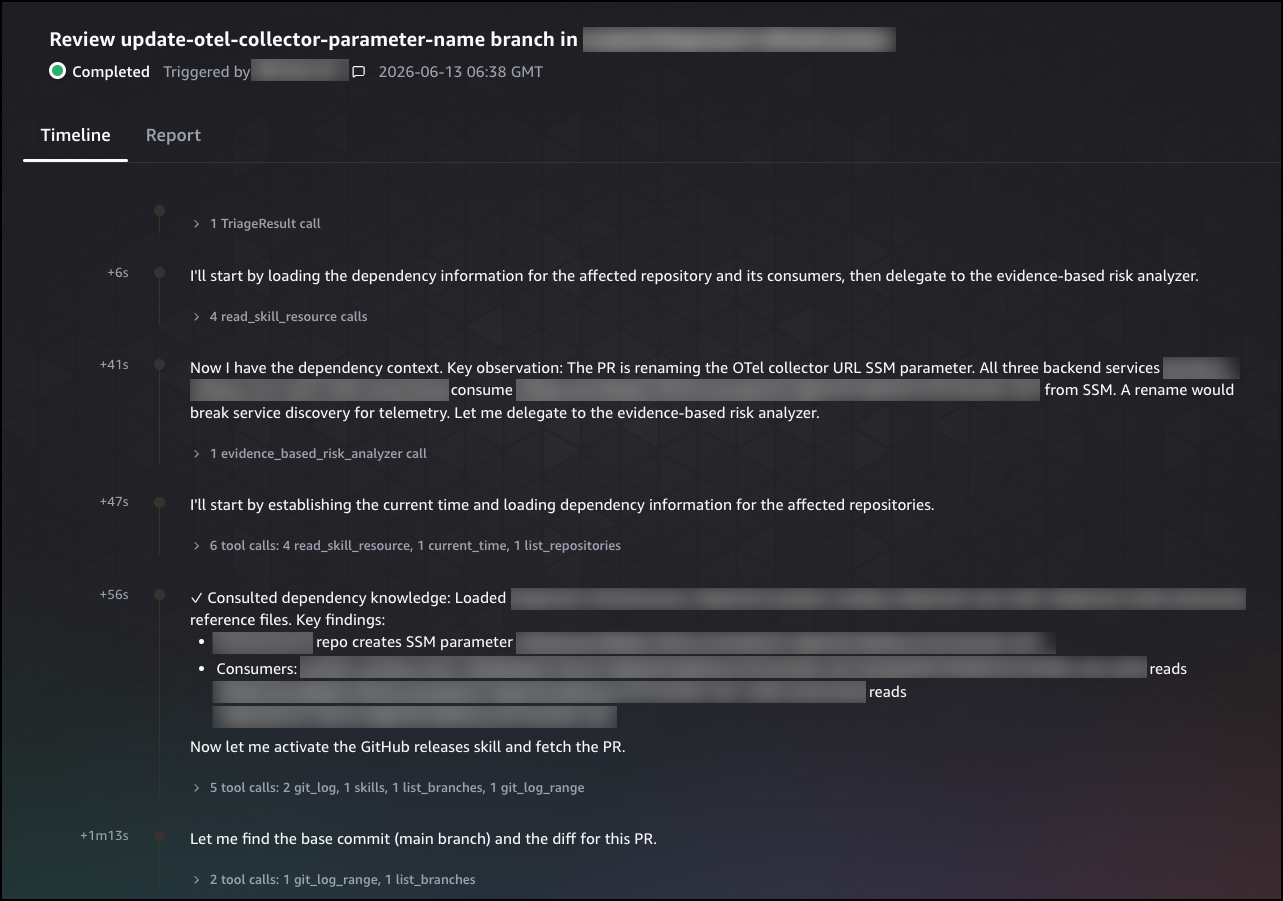
The Timeline tab shows the agent’s step-by-step reasoning process, including the tools it called, the dependencies it consulted, and the observations it made at each step. Each entry is timestamped, giving you a complete record of how the agent built its understanding of the change and reached its conclusion.
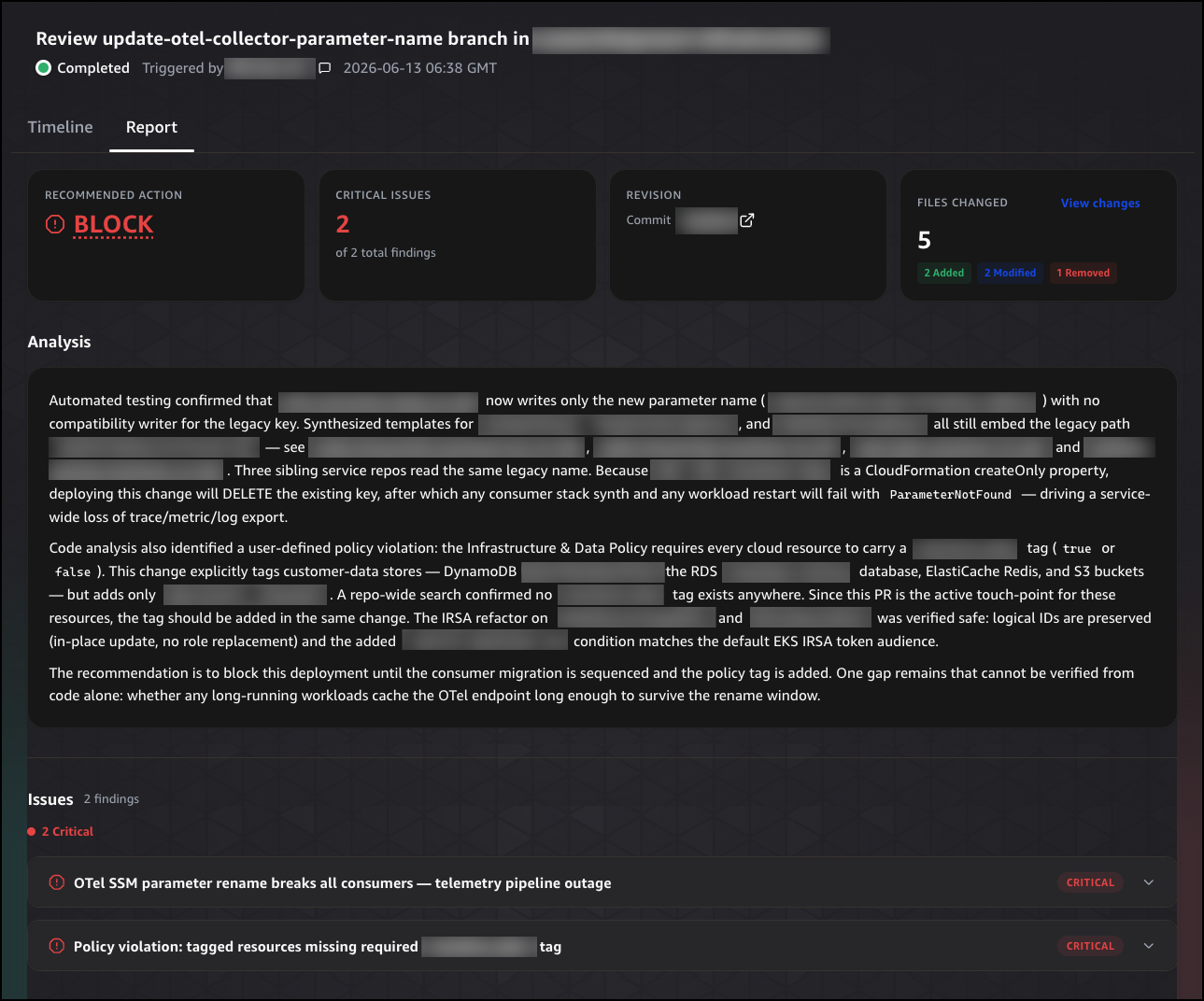
Choose the Report tab to see the final recommendation. The report opens with a summary header showing the recommended action, the number of critical issues found, the commit revision, and the number of files changed. The recommended action is either BLOCKProceed with Caution, or Safe to Release.

Below the summary header, the Analysis section explains why the recommendation was made, citing specific risks and the evidence the agent found to support its conclusion. The Issues section lists each finding by severity, giving you a prioritized view of what needs to be addressed before the change can proceed. The Recommendations section provides specific, actionable steps the developer can take to resolve each issue. Finally, the Changes section lists each file that was modified, with the type of change, the category it falls under, and a description of what was changed, so reviewers have a complete picture of what the change does before it merges.
You can also invoke the autonomous release testing feature directly from the chat interface. To run an autonomous release test on a web or API-based application, choose New chat and enter a query such as:

Run a release test on my application deployed at [application URL]

The agent generates a change-specific test plan and executes it in your provisioned environment. Results appear in Changes, where you can review the execution steps and a structured summary of what was tested.

Get started today
The release readiness review and autonomous release testing features for AWS DevOps Agent are available in preview. These features are available at no additional cost during preview in the US East (N. Virginia) Region. For pricing information on other AWS DevOps Agent features, visit the AWS DevOps Agent pricing page.

For configuration details, visit the AWS DevOps Agent user guide.

— Esra