









Anyone who has seen the impressive frame of Stonehenge against the morning’s sunrise cannot help but be struck by its resilience, how it has withstood time and the unpredictable impact of nature and humans. And partly because of this, a recent conversation I had with the CIO of a large healthcare technology company made me realize that it was a fitting metaphor for cybersecurity.

As our conversation wove through familiar topics — the challenges and breakthroughs in enterprise IT architecture — we recognised and discussed a recurring pattern throughout most EMEA and multinational enterprises. Those organisations have gradually but surely evolved into a mosaic of vendor fragmentation, ‘micro-platforms’ across vendor-specific technologies, and rapidly developing data silos that no single IT architecture can solve on its own.
The increased heterogeneity of hardware, operating systems, and cloud architectures now comes with a dizzying mix of cybersecurity tools and services, often optimised for Vendor X’s platform. This has led to the situation that a large organisation typically has more than 30 cybersecurity point solutions in place to protect their digital assets. And now that we have thrown AI into that mix, designing the right cybersecurity solution is as confusing as it is imperative.
That’s when I was reminded of Stonehenge. Its lintel-and-joinery design is strikingly simple and elegant, and it stands as a brilliant monument to long-term resilience. Just as Stonehenge has endured against natural and human threats, so organisations must build a cybersecurity architecture that endures a revolutionary rate of change and threat diversity, including geopolitical turbulence and AI entering the value chain.
For CISOs, CIOs, board members, C-suite executives and line-of-business leaders concerned with operational resilience, cybersecurity architecture matters—deeply.
And we should not forget that cybersecurity is a data problem. The more telemetry data you have, the more effectively you can execute security algorithms and protect your digital essentials across all your enterprise IT pillars, i.e., IT, OT, Clouds, Networks, Workplace, Endpoints, etc. We at Palo Alto Networks are able to combine relevant telemetry data from networks, firewalls, clouds, browsers, endpoints and the internet.
Stonehenge was built from massive, self-reinforcing pillars and platforms of stone. The lintels and joinery help hold together the overall structure as a cohesive unit, and they have striking similarities to how IT architects are now thinking about cybersecurity. In today’s technology architecture, Stonehenge’s vertical pillars are an IT organisation’s specialised, vendor-specific IT domains—sometimes with its own security tools and capabilities rather than as a strategically integrated zero-trust cybersecurity framework across your enterprise IT pillars.
Now, Stonehenge’s with its unique resilience, can also serve in its own construction as a model for modern cybersecurity architecture. Like our evolution towards modular platformisation evolved deliberately and assuredly over time and it spans all key domains of cybersecurity, ie network, cloud, AI, identity security and all key building blocks for an AI-driven SOC, the last line of defense that has to be real-time. In other words, it is the linchpin of our strategy for enterprise security built upon such key areas as Identity, the Autonomous SOC, and Network Security.
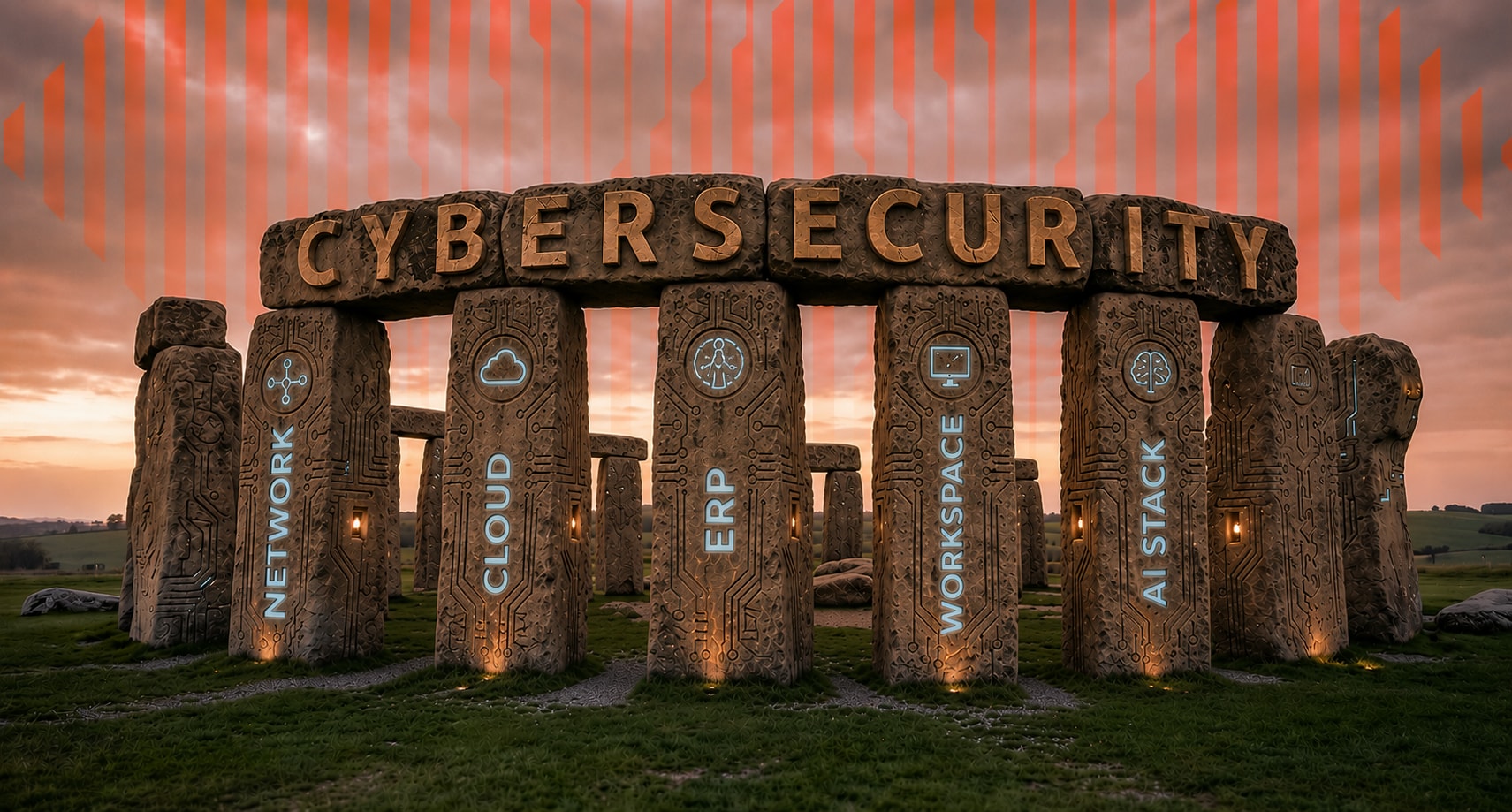
Stonehenge’s lintel is analogous to cybersecurity platformization, a growing trend rapidly replacing the now-outdated best-of-breed point solution mindset. This employs a modular approach that gives flexibility and control to the security architect looking to add security domain capabilities as needs evolve. The mortise-and-tenon joinery of Stonehenge works because the parts fit together rather than being stacked as an afterthought, in much the same way modern cybersecurity frameworks are built upon the concept of embedded functionality rather than being bolted on.
An important example here is Palo Alto Networks’ decision to power the cybersecurity platform core with Precision AI, rather than its technology being added as a separate tool. This approach enables Precision AI to power data, analytics, and workflows, making it an omnipresent resource for smarter and faster prevention, detection and response.
Another important element of any enduring architecture is its ability to provide stability to the overall framework. In cybersecurity architecture, this is the all-important cyber data layer across an integrated zero trust framework. As organisations continue to struggle with data silos across networks, cloud environments, security operations centres, and edge systems, the cybersecurity data lake takes on a heightened role of importance for the resilience of the entire cyber framework. Again, let’s not forget, cybersecurity is a data problem, a domain in its own right across all vertical IT pillars.
Now, Stonehenge with its unique resilience, can also serve in its own construction as a model for modern cybersecurity architecture. Like our evolution towards modular platformization evolved deliberately and assuredly over time and it spans all key domains of cybersecurity, i.e. network, cloud, AI, endpoints, identity security and all key building blocks for an AI-driven SOC, the last line of defense that has to be real-time. In other words, it is the linchpin of our strategy for enterprise security built upon such key areas as Identity, the Autonomous SOC, and Network Security/SASE.
Another critical element of the cyber platform is something even Stonehenge hasn't had to face: securing AI itself, especially the opportunity and threat represented by agentic AI. AI security must become part of the platform design and implementation, as we have done with our Prisma AIRS (AI Runtime Security) platform for enabling an organisation's growing AI portfolio to remain a vital asset and not an inviting attack vector. Agents now are not just another non-human identity; they are an entirely new class of identity, with a striking mismatch in speed between agent decision-making and human governance. The inside-out attack paths taken by hackers' ill-intentioned agents represent a major threat to under-protected AI supply chains. The same pressure now also comes from geopolitics and from AI moving into the value chain itself, such as in the case of the Factory of the Future.
Similarly, our recent acquisition of CyberArk gives us what we believe is the industry’s strongest identity security platform, Idira, positioning it as yet another vertical pillar connected to the overall cybersecurity platform lintel. Cortex XSIAM and its security data lake are deliberately open — ingesting and correlating third-party telemetry alongside our own, over 17 petabytes of telemetry data each day — to form a secure data layer that is accessible to users based on policy management and credentials validation. Palo Alto Networks leverages this mountain of data, along with around-the-clock scanning of more than 5 billion daily security events, to feed Precision AI in order to detect and block potentially devastating attacks. Currently, we detect about 9,6m new attacks per day that have not been there the day before. The use of automated AI in attack vectors has been accelerating the time of exfiltration of data from the compromise of an organization. This delay was 9 days about 3 years ago, now data is exfiltrated in most cases in less than a day, sometimes already within less than one hour!
In this context, it's also important to highlight the importance of an Autonomous SOC pillar, particularly since compliance reporting windows are continuously contracting from days to mere hours calling for real-time, highly automated defence. Today, mean-time-to-detect and mean-time-to-respond are board-level imperatives commanding more conversation and attention at an organisation’s highest levels. The Autonomous SOC pillar is a vital element in helping enterprises achieve even faster detection and remediation, ideally down into single minutes. If it also integrates the historic enterprise SIEM you can further simplify your SOC operations and gain solid financial benefits by platformization of your security relevant data.
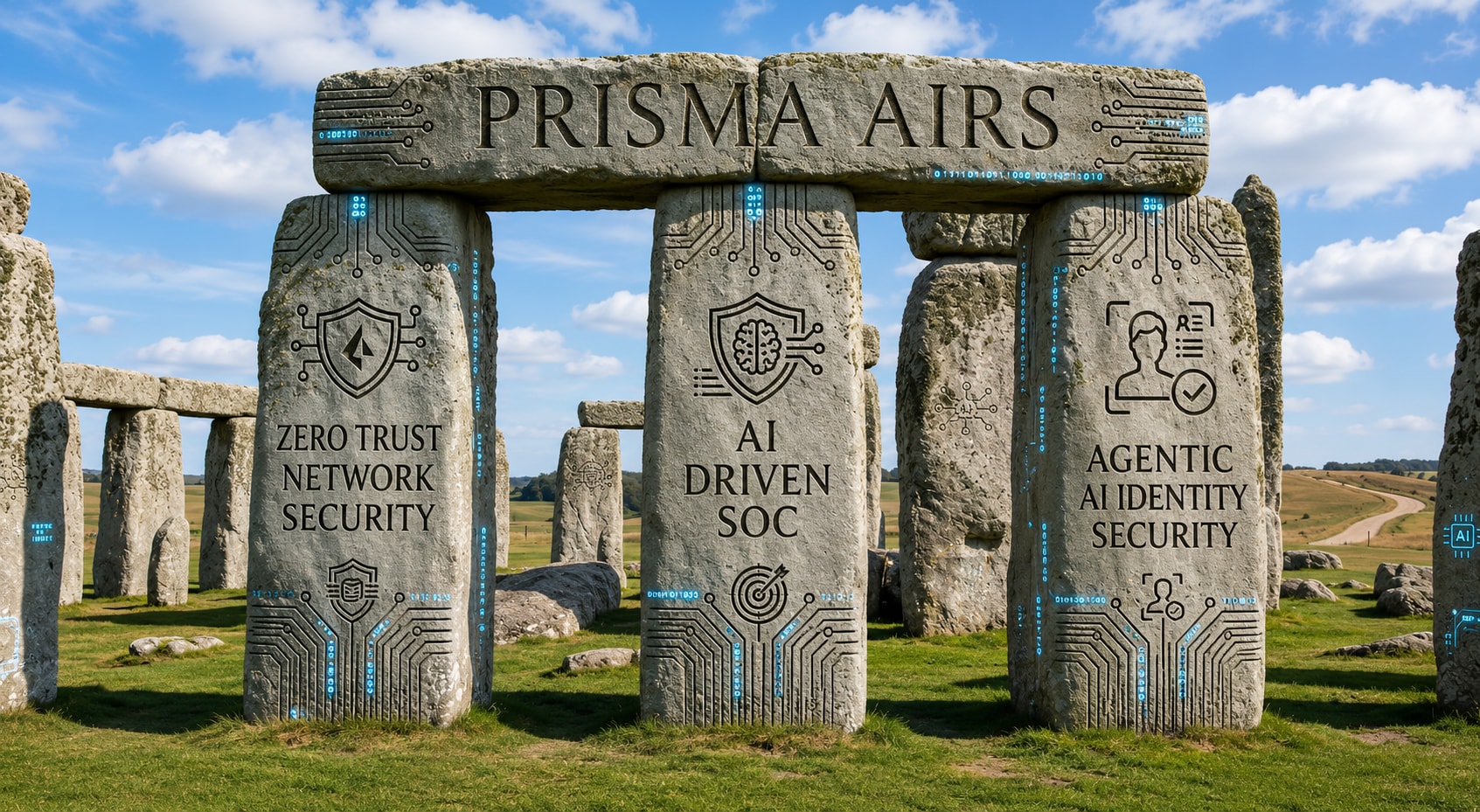
Finally, keep in mind the use of supply chains to build the actual platform. For Stonehenge, that was an impressive physical supply chain: The bluestones used in the structure were hauled about 250 kilometers from Wales without the benefit of air, rail, or truck transport. For Palo Alto Networks’ cybersecurity platform, the supply chain was no less impressive, but more virtual than physical, often faced with attacks on third-party interdependencies such as SaaS applications, APIs and in times of Frontier AI models, the Open Source components.
Like the pyramids, the Great Wall of China, and the Roman road system, the most remarkable aspect to Stonehenge isn’t just its engineering elegance, but its ability to withstand changing conditions and threats over time. Whether you’re a CEO, board member, CIO, CISO or security engineer, the decisions you make about cybersecurity carry significant impact and implications. In order to achieve Stonehenge-like resiliency, technical and business leaders should commit to an architectural model designed not only for today’s needs, but for what those needs are likely to be over the long term.
Therefore, cybersecurity should be architected as a horizontal, dedicated platform across all your IT domains and businesses. With this you are able to provide real-time and platformized cybersecurity for tomorrow. And tomorrow is going to be a more and more AI-driven business world.
Helmut Reisinger is CEO for Europe, Middle East, and Africa at Palo Alto Networks.
此内容由惯性聚合(RSS阅读器)自动聚合整理,仅供阅读参考。 原文来自 — 版权归原作者所有。