





6 Min Read
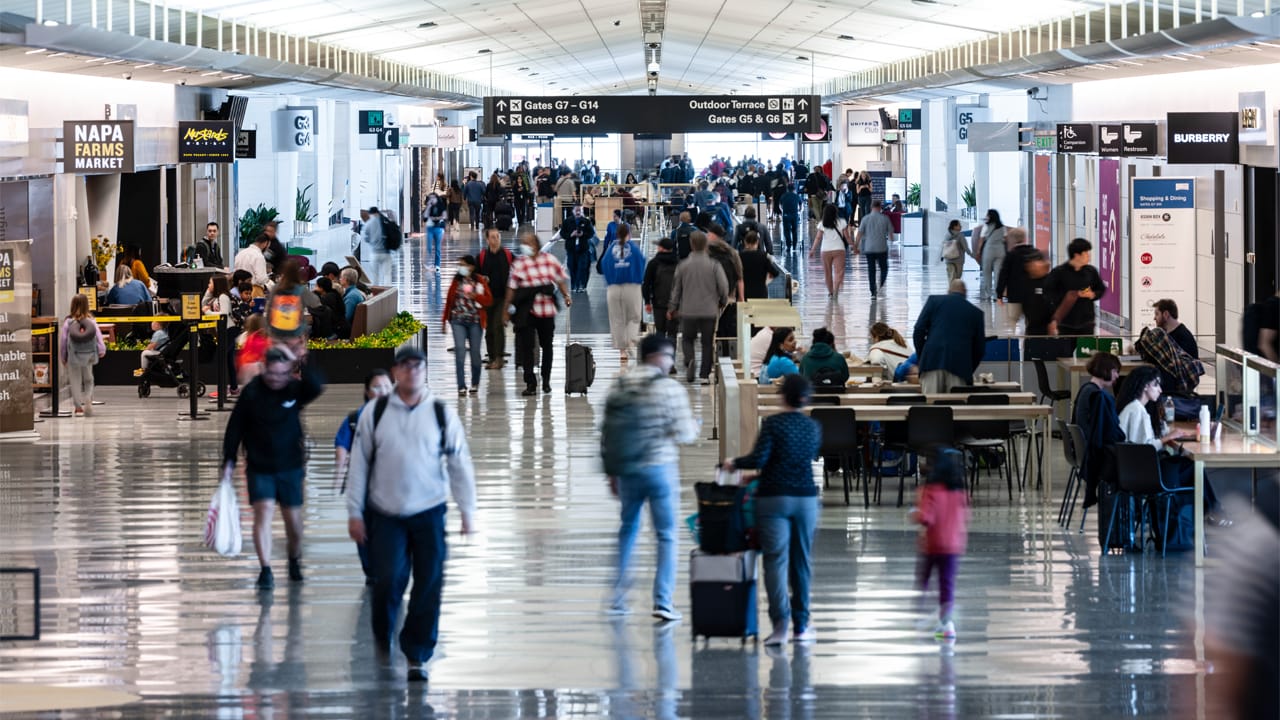
Photo Courtesy San Francisco International Airport
While passengers interact with airline staff and Transportation Security Administration (TSA) agents as they hurry to grab snacks and locate their gates at San Francisco International Airport (SFO), an unseen team works behind the scenes using geospatial data to track both airport operations and passenger movement.
This tracking system operates within a digital twin of SFO, developed in coordination with geographic information system (GIS) software company Esri. The system integrates geospatial data, including construction drawings, into a real-time model of airport operations.
Passenger-facing, high-touch areas are a high priority for SFO to maintain, and the digital twin helps triage resources to keep those areas operating smoothly, said Hanson "Guy" Michael, geospatial systems principal at SFO.
The team running the digital twin is SFO's Airport Integrated Operations Center (AIOC), which opened a new facility spanning over 22,000 feet in January. The AIOC, SFO's "nerve center," includes key stakeholders -- such as 911, aviation security, airlines and TSA -- and airport experts who use technology and data to oversee airport operations and deliver a smooth traveling experience for passengers.
Related:How Anthropic is reordering SaaS — and where CIOs go next
Prior to the AIOC, teams managing airport operations were "somewhat siloed, working in different locations, and not really speaking to each other on a daily basis. The key for the 'I' portion of the AOC is integrating those folks," said Nancy ByunRidel, director of the AIOC at SFO. The digital twin breaks down those silos by bringing operational data together in one place, integrating data previously stored in "bespoke systems and proprietary business systems," Michael added.
ByunRidel said, "We have a lot of information that comes at us that's not easy for a human being to take in and make sense of, but putting it on a geospatial tool allows us to see where our flights are and where airplanes are moving … and is very, very helpful in managing an airport operation."
The AIOC uses the digital twin to access real-time geospatial data by layering it over 600,000 features of static "base infrastructure data," such as runways, taxiways, buildings and roadways. For example, the digital twin combines real-time data of flights arriving and departing with static data on gate locations. The digital twin also tracks 18 million square feet of interior building space at SFO.
With the digital twin, the AIOC can access data points throughout a traveler's journey, including potential traffic along the highway to the airport, wait times at security, checkpoint status and passenger congestion at terminals.
Related:CIOs caught in the middle as AI startups disrupt vertical Saas
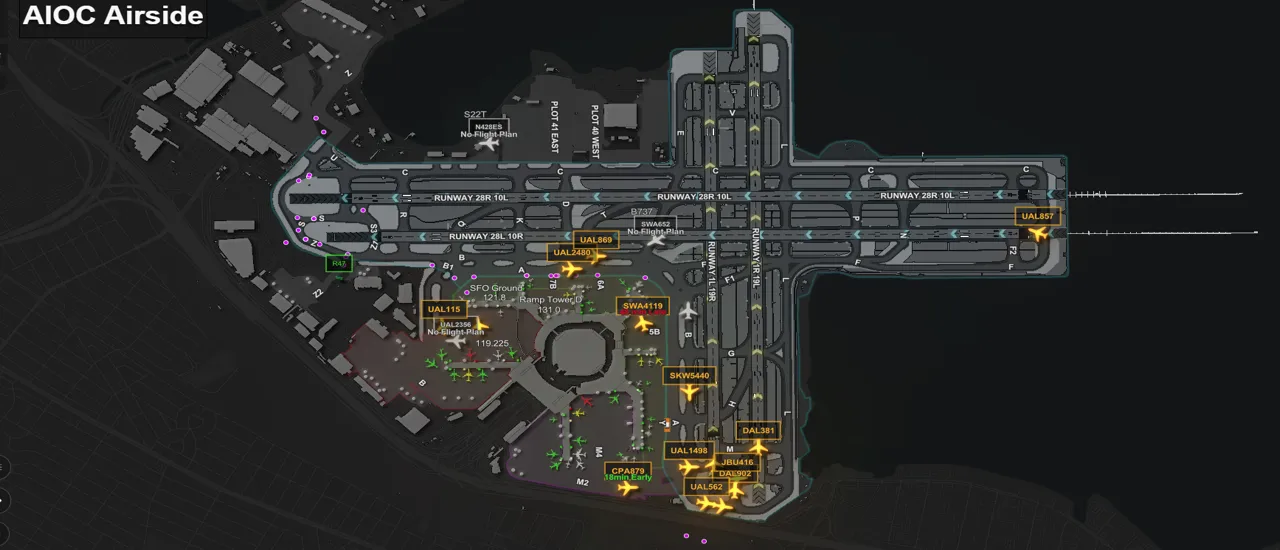
SFO's digital twin includes a dashboard displaying real-time aircraft movement and gate availability. Source: Nancy Byun Riedel, director of the AIOC for SFO.
One use case for the SFO digital twin is tracking airspace status. The digital twin accesses data from third parties, including airlines and the FAA, to track where potential air traffic control issues will arise. The airplanes are color-coded within the dashboard to indicate delayed or canceled flights, and users can hover their cursors over an airplane's avatar to access additional information.
SFO's digital twin accesses data via its own APIs and APIs connecting to dozens of third-party providers, including SITA Airport Management (an information display board), FlightAware, the National Weather Service, INIRX transportation analytics, the Federal Aviation Administration, Pareto by reelyActive to locate indoor assets, Kaiterra for air quality, and FeedbackNow for customer experience data. If AIOC team members notice discrepancies within the data, they alert the corresponding third party to request changes.
"A lot of this data [from third parties] is not spatial data, so we have to bring in the API and then create shapes -- spatial objects -- to join the real-time API information, too, so we can display it on the map," Michael said.
Related:Workday’s AI reset: Agents and the race to remake SaaS
The IT team can also apply data from the APIs to dashboards, like Tableau and other platforms, to display it in a chart or graphical format instead of a spatial display of the data, Michael said.
The AIOC is one of many users of the digital twin platform -- SFO's finance department and aviation security group are among the departments utilizing the platform. The digital twin platform is also adaptable to different departments -- the business and finance groups, for example, have access to the same data, but it's represented in a way that relays what's most important to their particular business needs.
Inputting and managing data within the digital twin isn't a one-and-done effort -- it requires constant monitoring and updates to the data. Issues also arise when converting data into a format the digital twin can use -- the AIOC has faced challenges obtaining standardized construction drawings from project teams that can be easily incorporated into GIS. The team has addressed that challenge by also using 3D laser scanning to keep up with changes to the airport's architecture. Esri has also helped maintain data, obtain construction drawings that are integrated into the digital twin, and more.
"There's always a lot of customizations to bring new data into the GIS and keeping track of all the constant change that occurs at an airport is always a challenge," Michael said.
Alexander Thompson, senior analyst of IoT at Omdia, echoed these challenges: "Digital twins rely on large volumes of data from multiple sources, such as IoT devices, sensors and enterprise systems. Integrating and harmonizing this data into a cohesive model can be technically challenging, especially when dealing with legacy systems or incompatible formats."
Some organizations have difficulty quantifying the ROI of digital twin initiatives. "Without a clear business case, stakeholders may be hesitant to allocate resources to digital twin projects," Thompson said.
Digital twins can provide users with the means to "monitor how complex real-world assets are performing," optimize operations to lower costs, improve productivity, avoid downtime and reduce safety incidents. However, maintaining quality, real-time data and a "lack of standardization between vendors" can create challenges, said Paul Miller, vice president and principal analyst at Forrester.
The AIOC plans to have multiple phases of development of its digital twin and will launch additional capabilities, including the ability to perform prediction and regression modeling, conduct scenario-based modeling and potentially embed AI technologies. Currently, the team is determining where it would be most useful to use AI within the digital twin.
For other organizations and CIOs considering deploying a digital twin, Miller suggested first examining the business challenge or pain point to determine if a digital twin is the best route or if an alternative like hiring -- or upskilling -- employees will solve the problem. In addition to providing a clear business case with expectations outlined, organizations should consider the costs and ROI of deploying a digital twin, Thompson said.
"If a digital twin is a viable way to solve the business challenge you're concerned about, do you have the data and the sensors and the models you'll need?" Miller said. "If you don't, do you know who could build them for you or with you? Keep the business outcome in mind and listen to the people on the ground who actually face this problem every day."

Senior Editor, InformationWeek
Kelsey Ziser is a senior editor at InformationWeek, where she covers C-suite dynamics, data strategies and the evolving cybersecurity threat landscape.
Kelsey also oversees the publication's IT Leaders Fast-5 column, which brings peer insights to IT professionals, and the tech layoffs tracker. She has been with InformationWeek since September 2025.
Before joining InformationWeek, she spent nine years at sister publication Light Reading, reporting on a broad range of topics including smartphones and devices, AI, satellite connectivity and enterprise networking. Kelsey has a Bronze Regional Azbee Award in the Technical Article category. Outside of work, she enjoys reading four (or 12) books at once, watching movies about space travel, crafting and tending to an ever-growing collection of houseplants. Kelsey has a bachelor's degree in journalism and mass communication from UNC-Chapel Hill and is based in Raleigh, N.C. She can be reached at [email protected] or on LinkedIn.
此内容由惯性聚合(RSS阅读器)自动聚合整理,仅供阅读参考。 原文来自 — 版权归原作者所有。