



惯性聚合 高效追踪和阅读你感兴趣的博客、新闻、科技资讯
阅读原文 在惯性聚合中打开

推荐订阅源

D
Docker
MyScale Blog
MyScale Blog
WordPress大学
WordPress大学
N
News and Events Feed by Topic
Exploit-DB.com RSS Feed
MongoDB | Blog
MongoDB | Blog
V
Vulnerabilities – Threatpost
月光博客
月光博客
罗磊的独立博客
Threat Intelligence Blog | Flashpoint
Apple Machine Learning Research
有赞技术团队
有赞技术团队
K
KPMG report finds enterprise disconnect between AI and its ROI | CIO
F
Full Disclosure
Simon Willison's Weblog
D
DataBreaches.Net
T
Threatpost
Hacker News: Ask HN
Hacker News: Ask HN
阮一峰的网络日志
阮一峰的网络日志
TaoSecurity Blog
TaoSecurity Blog
Microsoft Azure Blog
Scott Helme
Scott Helme
S
Securelist
W
WeLiveSecurity
K
Kaspersky official blog
The GitHub Blog
The GitHub Blog
Attack and Defense Labs
博客园 - 三生石上(FineUI控件)
The Hacker News
The Hacker News
Google Online Security Blog
Stack Overflow Blog
Stack Overflow Blog
Hacker News - Newest:
Hacker News - Newest: "LLM"
Security Latest
Security Latest
M
MIT News - Artificial intelligence
人人都是产品经理
人人都是产品经理
The Last Watchdog
The Last Watchdog
C
Check Point Blog
T
Troy Hunt's Blog
P
Proofpoint News Feed
J
Java Code Geeks
G
Google Developers Blog
Schneier on Security
Cyberwarzone
Cyberwarzone
S
Security @ Cisco Blogs
宝玉的分享
宝玉的分享
Recent Commits to openclaw:main
A
About on SuperTechFans
T
The Blog of Author Tim Ferriss
L
LINUX DO - 最新话题
Jina AI
Jina AI

informationweek

2026 tech company layoffs How Sedgwick scaled AI in legacy claims workflows InformationWeek Podcast: CTOs on using AI in regulated spaces How top CIOs are measuring the real ROI of IT automation What AI must learn from Roosevelt, conservation and 1929 Experian's chief innovation officer gleans AI gains with startup collab ETS CIO on competing with AI startups 'running with scissors' Before the next VMware: How CIOs prepare for vendor shocks The strategic alignment powering cyber-resilient organizations The AI infrastructure bottleneck is becoming a CIO problem InformationWeek Podcast: CTOs on reining in rogue AI agents Workplace equity in the age of AI Why and how to implement an AI asset rationalization strategy Why companies are shifting toward private AI models AI agents in automation: When to build, when to buy Navan CTO AI on trial: The Workday case that CIOs can The AI infrastructure boom is coming for enterprise budgets How CIOs can manage LLM costs: A practical guide What CIOs miss when buying vertical SaaS software InformationWeek Podcast: How CTOs balance AI and their teams Whirlpool, Duke Energy, Cleveland Clinic CIOs on scaling AI Where CIOs get stuck rebuilding the enterprise: What 'Rewired' reveals As AI makes projects harder to track, will CIOs need new controls? Why disaster recovery plans fail in geopolitical crises A silent erosion of enterprise AI by data poisoning Priceline CTO prioritizes engineers able to 'hold a room and a roadmap' InformationWeek Podcast: When CTOs need to restart IT projects Wayfair CTO maps agentic path across digital and brick-and-mortar commerce The AI contract gaps the Google-Pentagon deal just made visible Non-human identity sprawl is agentic AI's real risk Anthropic's Mythos forces a rethink of vulnerability management Outsourcing contracts weren't built for AI. CIOs are renegotiating now The AI spend hangover companies didn't plan for The power of CIO networking in the competitive AI world Why CIOs see AI projects stall: Speed without structure kills scale IT leaders should never let a good crisis go to waste SFO's digital twin maps airport operations from the curb to takeoff CIOs caught in the middle as AI startups disrupt vertical Saas Submit an IT Leadership column to InformationWeek Podcast: Rightsizing AI frameworks to avoid failure modes Why AI teams treat training data like capital Ask the Experts: How CIOs can identify and overcome cultural barriers to innovation Nobody told legal about your RAG pipeline -- why that's a problem Meta's new 'AI Zuckerberg' is a mirror for every C-suite Will the music stop for AI's funding dance? Rethink tech talent: Local is the smartest play for IT InformationWeek Podcast: Catching errors in AI-powered code CIOs can combat talent scarcity with AI-augmented leadership -- Gartner How Bellevue, Wash., is applying AI to streamline a broken permitting process Ignore the hype: Smarter tech bets at speed of change Who controls the fix? Colorado's repair fight tests CIO power Ask the Experts: The red flags that signal an AI project isn't worth pursuing The hidden high cost of training AI on AI Red Hat's Marco Bill: Resource control is key for AI sovereignty InformationWeek Podcast: New IT architecture, cloud, edge and AI Enterprises need Tier 1 provider relationships to deliver on AI How CIOs run and rebuild the business at the same time in the AI era It's not your tech stack, it's your structure -- fix it Confidential computing resurfaces as security priority for CIOs FinOps: Helpful tool, or a cloud control placebo for CIOs? Cleveland's open data overhaul: From sticky notes to public dashboards As Microsoft expands Copilot, CIOs face a new AI security gap Why build vs. buy doesn't fit modern IT systems InformationWeek Podcast: Is quantum computing slumbering? Your AI vendor is now a single point of failure Vibe coding: Speed without security is a liability A practical guide to controlling AI agent costs before they spiral AI fuels a new wave of technical debt The sunsetting of Sora: A hard lesson in AI portfolio resilience HP pushes broad internal AI use after early productivity gains Why value-based pricing is inevitable InformationWeek Podcast: Safeguarding ecosystems from outsiders Why AI scaling is so hard -- and what CIOs say works Humans are the North Star for AI-native workplaces -- Gartner How IT leaders build a culture for what comes next Compliance costs risk widening the AI gap AI-driven layoffs add new demands on CIOs to prove value AI transformation: Early wins are not enough for CIOs Why CIOs can't let users wait on IT Memory shortage doesn't have to spell disaster for IT budgets Accelerate AI adoption: 3 reasons for adopting MCP How techno-nationalism is complicating IT resilience and supply chains for CIOs InformationWeek Podcast: Compliance crackdown on AI and BYOD Workday’s AI reset: Agents and the race to remake SaaS Why enterprise AI initiatives keep dying before production Metrics of meaning: What do we really measure in AI? Techno-nationalism is reshaping CIO infrastructure strategy Using AI to pick team leaders -- without crossing legal or ethical lines What Oracle's layoffs reveal about running IT with fewer people Chief AI Officer on course-correcting when AI moves too fast Large enterprises need high-performing networks to scale AI InformationWeek Podcast: When do smaller AI models make sense? The future belongs to AI-driven IT Ways AI supercharges risk awareness and data insights for CIOs How automation prepares you for agentic NetOps Should the CIO, CFO or CEO hold the kill switch on AI? The CIO's new mandate: Redesign work itself Ask the Experts: CIOs say they wouldn’t pull workloads back from the cloud How AI is Reshaping the Enterprise
The invisible labor crisis inside IT: AI work the org chart can't see
Pam Baker · 2026-04-21 · via informationweek

The loudest conversations about AI and jobs focus on what disappears. Inside IT, the more immediate problem is what quietly multiplies. As AI capabilities spread across the stack, they splinter work into new, poorly defined skill demands: prompt engineering here, orchestration there and model evaluation somewhere in between. None of it aligns neatly with existing roles, reporting lines, or hiring frameworks. 

The result is an accumulation of invisible labor. Critical, unscoped work is absorbed by already stretched teams, bypassing formal ownership and eluding traditional workforce planning. For CIOs, the risk isn't just a skills gap. It's an operating model that can no longer see, measure or manage the work required to run AI at scale.

While AI implementations differ from organization to organization, their impact on IT work is near universal.

"AI systems break the ownership boundaries," said Sridhar Rao Muthineni, engineering manager at PwC. 

Related:Will the music stop for AI's funding dance?

A model's behavior spans training data, prompts, infrastructure, validation, governance and its user interface, Muthieni explained, so "when something goes wrong -- say, a customer-facing model hallucinates financial advice -- no single traditional owner can be held accountable because every layer contributed."

Diagnosing the problem: AI is not just another layer in the tech stack 

The situation -- while understandable -- results in a whopping hole in IT in terms of accountability, responsibility and a clear chain of authority for AI implementations that, by definition, are continuously evolving. 

"AI isn't a deployment. It's a living system. It drifts, it breaks in subtle ways, it requires continuous human judgment. Executives can't see the skills gap because the work is invisible," said Bud Caddell, CEO of NOBL, a consultancy. 

Every department in an organization is struggling to use AI, and more than a few are unsure to whom in IT they should turn to help them succeed. For example, according to a recent Coupa report, 85% of the 600 CFOs surveyed identified AI as central to their strategy, yet 92% worry about their ability to implement it -- an increase from 66% last year. 

The clearest signal of organizational drift typically starts at the leadership level, where ownership of AI capability development is undefined, which leads to initiatives without a governing authority. So departments don't just lack skills, they lack a clear front door into IT for AI work. The result is that AI is no longer a centralized function. It is everywhere and nowhere, dissolving clear escalation paths and leaving business units guessing which team owns outcomes.

Related:The hidden high cost of training AI on AI

At the heart of the problem, of course, is AI's disruption of how business has always been done. 

Legacy IT roles were built for deterministic systems where the code did what you told it to do, Masud said. AI breaks that model, requiring new roles, updated adjacent roles and a shift in mindset among those "who still think this is just another layer in the stack," he said. 

Caddell diagnosed the problem as follows: "The org chart maps responsibilities to technical layers, but AI doesn't respect those boundaries." In practice, the data team doesn't understand the model, the app team doesn't understand the data, security gets looped in last -- and nobody owns the outcome. "That's not a job description problem. That's a work process problem," Caddell said.
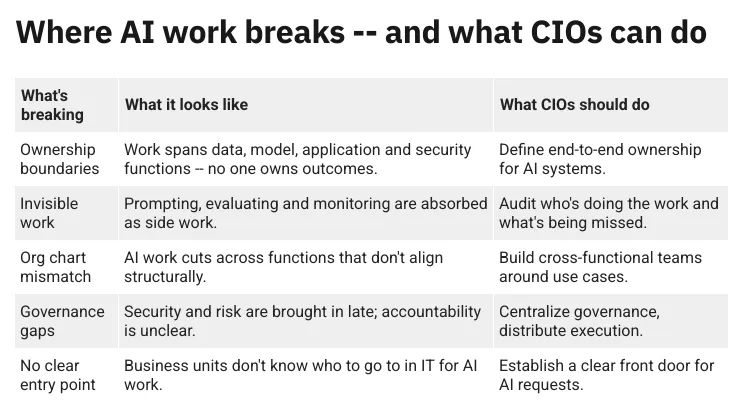
Chart depicting where AI work breaks, and what CIOs can do in response.

The CIO conundrum

Even studying the AI ownership issue in search of a fix introduces additional complexity. 

"Yes, it is partly a process problem and partly a job description problem, but more than anything it is an operating model problem," said Zack Tisch, partner of portfolio services at Pivot Point Consulting, a healthcare IT consulting company.

AI work is often added as side work to existing IT teams, "creating bottlenecks, hidden capacity issues and confusion about who owns risk versus who owns outcomes," Tisch said.

Related:Red Hat CIO Marco Bill: Resource control is key for AI sovereignty

The organization-wide confusion leads to a CIO conundrum: how to manage the situation so it works at every level and for every department. The first step may be to reframe the problem. 

"The problem isn't that AI doesn't fit the org chart. The problem is that the org chart doesn't fit AI," said Paul McDonagh-Smith, senior lecturer at the MIT Sloan School of Management and former senior advisor at NASA Goddard Space Flight Center. 

"Traditional organizational structures were built for a world of silos -- discrete functions with defined boundaries, clear handoffs and hierarchies designed to control the flow of information upward and decisions downward. Today, we are trying to navigate a world of flows with a map drawn for a world of walls," McDonagh-Smith said.

Steps CIOs can take 

Certainly, a rethink is in order -- and perhaps a full-blown reorganization of work, where, according to McDonagh-Smith, the focus shifts from hierarchies to how intelligence flows across the team. 

How this translates into real-world IT operations, however, remains unclear.

"Leading CIOs are starting to treat this as an operational discipline, not just a technology deployment," said Tony Grout, chief product and technology officer at M-Files, a document management system provider. That means centralizing governance while enabling distributed execution, he said, often through emerging functions like AI operations, model governance councils or cross-functional AI teams.

"They're also investing in standardized frameworks for evaluation, monitoring and data readiness, so teams aren't reinventing the wheel with every use case. The goal is to reduce fragmentation by creating shared guardrails and visibility, while still allowing innovation at the edges," Grout added. 

Creating a new org chart for AI may be in order, if only to clarify how work gets done across the business.

"The strongest CIOs are defining shared standards for governance, evaluation and security, then building cross-functional teams around high-value use cases," said Atif Khan, CTO of Alkira, an AI-native network IaaS. This often takes the form of a hub-and-spoke model, with a central team setting policy and architecture and domain teams executing.

Regardless of how individual companies approach this problem, the fundamental gap between the question and the answer remains. 

"Mapping AI work onto existing roles hides the gaps rather than closing them. Start with an audit of where AI is running, who's doing the work and what's being left undone," said Mark Friend, director at Classroom365, which provides IT support for schools across the UK. 

Most CIOs find the audit eye-opening, Friend said, adding that the practical next step is to create a small cross-functional AI operations function -- not a new department, but a focused group with clear ownership of governance, prompt management and output evaluation.

"In the schools we support, the biggest gains come where someone has been given a formal AI lead role with actual ring-fenced time, not a side project. That single point of ownership makes a bigger difference than any tool purchase we've seen," Friend said.