








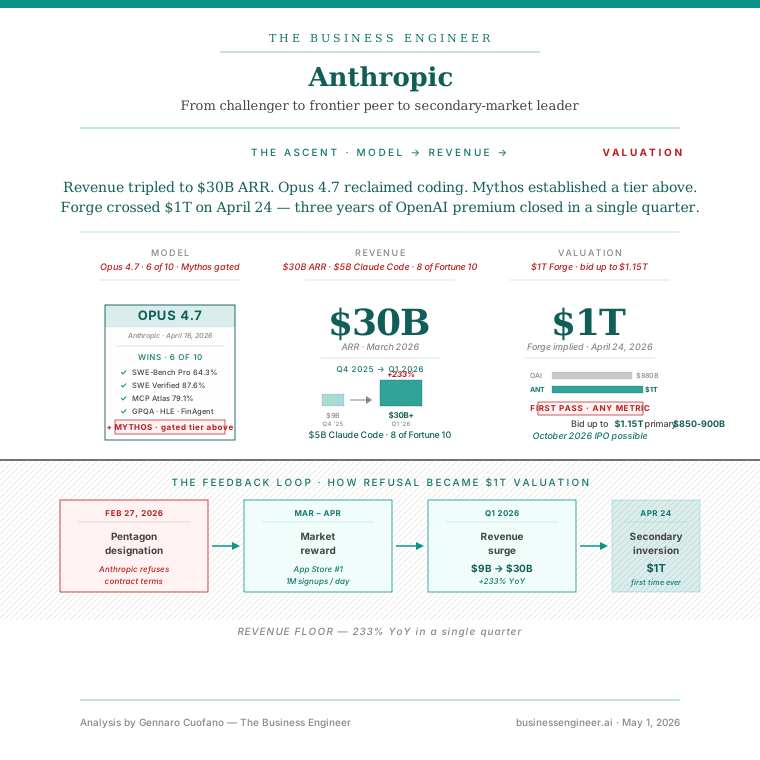
The visual below shows Anthropic’s position across the seven-layer AI stack using The Business Engineer’s Map framework. While the company dominates performance benchmarks and commands premium revenue, the map reveals critical strategic vulnerabilities.
Source: The Business Engineer — Map of AI, May 2026
Anthropic leads 6 out of 10 major AI benchmarks and generates over $30B in revenue with Claude Code driving $5B ARR. The model layer shows exceptional strength, with Claude 3.5 Sonnet outperforming GPT-4 on reasoning tasks.
But the framework exposes a dangerous concentration risk. Anthropic only controls 2 of the 7 critical layers — models and agentic capabilities — while depending entirely on external partners for the other 5.
The compute vulnerability stands out starkly. Google provides 100% of Anthropic’s training infrastructure through their $2B cloud partnership. One contract renegotiation could cripple operations overnight.
Distribution presents another weakness mapped in the framework. Claude holds just 6% web share compared to ChatGPT’s 60% dominance. OpenAI’s consumer moat translates directly to enterprise adoption advantages.
The applications layer tells a similar story. While Anthropic excels at constitutional AI and safety, companies like Microsoft (through Copilot) and Google (via Workspace integration) control the productivity software where enterprise customers live daily.
Data infrastructure remains entirely outsourced to AWS and Google Cloud. Anthropic processes billions of conversations but owns none of the underlying storage or pipeline technology that makes scaling possible.
The semiconductor layer shows total dependence on NVIDIA’s H100 chips, allocated through cloud partners. Unlike OpenAI’s custom silicon partnership with Microsoft, Anthropic has no hardware differentiation strategy.
Even the governance layer presents challenges. While Anthropic’s constitutional AI approach leads on safety benchmarks, regulatory capture often favors incumbents like Google and Microsoft with established government relationships.
This creates the “hollow unicorn” pattern visible in the framework. Strong core capabilities surrounded by critical dependencies that could become competitive disadvantages as the AI market matures and partners potentially become competitors.
The complete Business Engineer’s Map reveals which layer gaps matter most for different AI business models — and which companies are building true strategic moats versus impressive but vulnerable feature sets.
THE MAP OF AI — MAY 2026
See All 25 Visual Frameworks
7 layers, 7 players, 5 cascades — the complete visual map of AI.