



惯性聚合 高效追踪和阅读你感兴趣的博客、新闻、科技资讯
阅读原文 在惯性聚合中打开

推荐订阅源

MyScale Blog
MyScale Blog
Apple Machine Learning Research
H
Help Net Security
雷峰网
雷峰网
V
Visual Studio Blog
G
Google Developers Blog
Microsoft Azure Blog
Hugging Face - Blog
Hugging Face - Blog
爱范儿
爱范儿
IT之家
IT之家
Engineering at Meta
Engineering at Meta
Microsoft Security Blog
aimingoo的专栏
aimingoo的专栏
大猫的无限游戏
大猫的无限游戏
M
MIT News - Artificial intelligence
月光博客
月光博客
A
About on SuperTechFans
B
Blog RSS Feed
奇客Solidot–传递最新科技情报
奇客Solidot–传递最新科技情报
The GitHub Blog
The GitHub Blog
N
Netflix TechBlog - Medium
J
Java Code Geeks
云风的 BLOG
云风的 BLOG
Blog — PlanetScale
Blog — PlanetScale

FourWeekMBA

Musk vs Altman: The $90B Fight That Will Define AI’s Future Why DeepMind’s $1.1B Bet Signals the End of Human-Trained AI The AI Orchestrator's Leverage Points AI & The Harness Theory Why AI Companies Are Selling Fiction as Partnership Strategy Google’s $40B Anthropic Bet Reveals AI Infrastructure Wars Anthropic’s Agent Economy Signals End of Human-Mediated Commerce Claude OS: The AI Strategy Skill That Turns Claude Into Your Analyst Agent Harness OS: Build AI-Augmented Strategic Operations 🔥 AI & The Harness Theory 🔥 The Harnessing Players Map of AI 🔥 The Business Engineer’s Claude Code OS 🔥 Skills as the Architecture of the Personal OS Google's $40B Anthropic Bet Exposes Big Tech's AI Desperation Google's $40B Anthropic Bet Signals Platform Wars 2.0 20 Mental Models For AI Business Google's TPU Gambit: Why Hardware Will Crown the AI King LinkedIn Business Model: How LinkedIn Makes Money (2026) Netflix Organizational Structure: The Culture of Freedom (2026) Amazon Pricing Strategy: How Amazon Uses Price to Win Amazon Supply Chain: The Logistics Empire (2026) Apple Supply Chain: How Apple Built the World’s Best Supply Chain Tesla Supply Chain: Vertical Integration Strategy (2026) Anthropic Business Model: How Anthropic Makes Money (2026) OpenAI Business Model: How OpenAI Makes Money (2026) Meta (Facebook) Organizational Structure 2026 Google's Agentic TPUs Signal the Death of Traditional SaaS Google's $40B Anthropic Bet Signals The End of AI Independence The OpenAI–Anthropic Convergent Bets Google’s $40B Anthropic Bet Signals the End of Open AI Innovation
Google's Full-Stack AI Dominance — The Visual Breakdown
Gennaro Cuofano · 2026-05-04 · via FourWeekMBA

The visual below shows Google’s unprecedented control across all seven layers of the AI stack — the only Big Tech company to achieve true vertical integration from silicon to software.
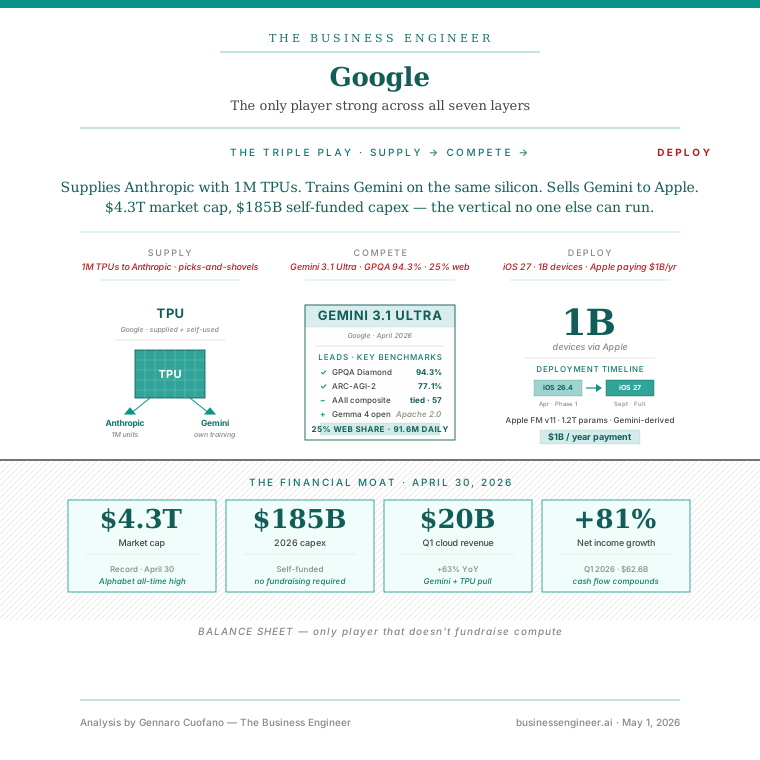
Google's Full-Stack AI Dominance — The Visual Breakdown

Source: The Business Engineer — Map of AI, May 2026

At the foundation layer, Google designs its own TPU chips, giving it hardware advantages that competitors like Meta and OpenAI simply don’t have. This silicon-to-software control drives their $185 billion capital expenditure strategy.

The cloud compute layer reveals Google’s massive infrastructure — as explored in the economics of AI compute infrastructure — investment, with a $462 billion backlog supporting their enterprise AI growth of 800%. Amazon Web Services and Microsoft Azure compete here, but neither controls the underlying silicon like Google.

In the model layer, Gemini represents Google’s answer to OpenAI’s GPT and Anthropic’s Claude. The visual demonstrates how Google’s model training benefits from their integrated TPU infrastructure — a competitive moat that pure AI companies lack.

The distribution advantage becomes clear in the platform layer. Google Search processes 8.5 billion queries daily, while YouTube reaches 2.7 billion users monthly. Meta has social distribution through Facebook and Instagram, but Google’s search dominance creates unique AI training data.

At the application layer, Google Workspace integrates AI across Gmail, Docs, and Sheets for 3 billion users. Microsoft competes with Copilot integration, but the visual shows Google’s deeper stack integration advantage.

The interface — as explored in the interface layer wars reshaping consumer tech — layer highlights Android’s role as an AI delivery mechanism to 3 billion devices globally. Apple controls iOS but lacks Google’s cloud infrastructure depth, while Amazon’s Alexa remains device-limited.

This full-stack control creates compounding advantages that isolated AI companies cannot match. OpenAI relies on Microsoft’s Azure, while Anthropic depends on Amazon’s cloud — neither owns their complete destiny like Google.

What other hidden patterns emerge when you map the complete AI competitive landscape across all seven layers?

FREE NEWSLETTER

Get AI Strategy Intelligence Daily

Join 90,000+ strategists. Business model analysis, AI maps, and earnings deep dives — free.

THE MAP OF AI — MAY 2026

See All 25 Visual Frameworks

7 layers, 7 players, 5 cascades — the complete visual map of AI.

Read the Full AI Map →