








Students stream into a small flat in a Mumbai suburb until late in the evening. They seat themselves on the floor around their teacher, one of several modern-day exponents of the guru-shishya tradition of Indian music with its classic face-to-face pedagogy.. Rigorous practitioners themselves, these teachers immerse their students in the chosen genre. Their focussed passion is the aadhaara sruti, the drone note that holds everything in tune, the defining pitch of their lives.
Arun Kashalkar is one such little-known guru of khayal, the centuries-old vocal genre of Hindustani classical music, who survived for years on low-paying day jobs before becoming known. For him music is a primary calling, not a side-job, nor a “time-pass”. Indeed, it is “secret masters” like Kashalkar who keep khayal not only alive but also thriving vigorously on the fringe of today’s mainstream Hindustani classical music. They have zealously nurtured, developed, and passed on this dynamic undercurrent to learners who will go on to become creators and teachers themselves.
To show how this actually happens, the journalist Sumana Ramanan takes the reader behind the curtain in her book The Secret Master: Arun Kashalkar and a Journey to the Edge of Music. When imperial patronage disappeared in the post-Mughal era, migrating musicians carried the khayal to the courts of Gwalior, Jaipur, Lucknow, and Patiala. Astonishingly, despite a century-long decline of princely patronage, this distinctive syncretic tradition sprouted anew in Maharashtra in the years after Independence, without significant dilution of its essential character.
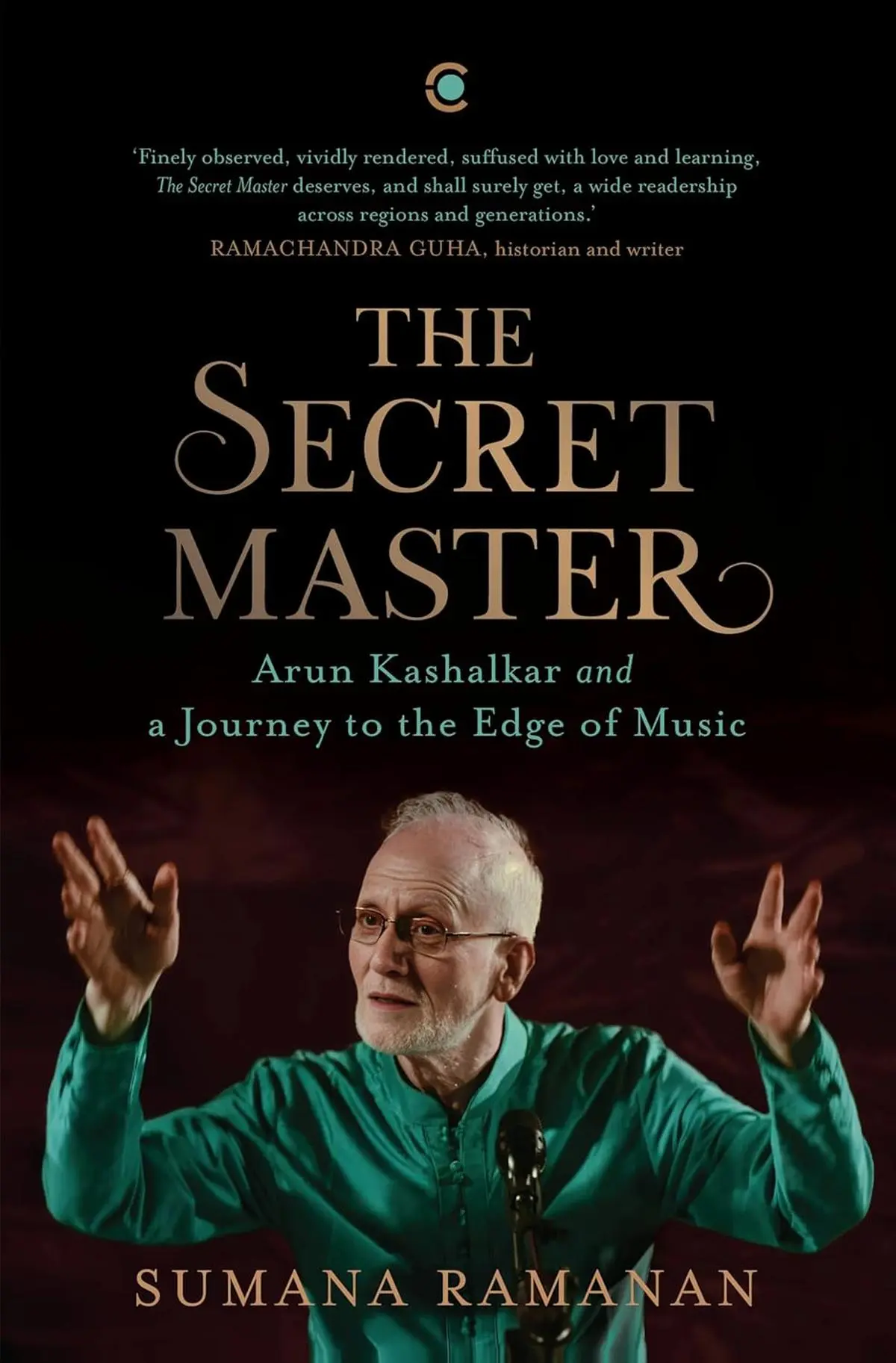
The Secret Master
Arun Kashalkar and a Journey to the Edge of Music
By Sumana Ramanan
Context
Pages: 466
Price: Rs. 899
And what is this character? What is khayal? Sumana’s words, however evocative and nuanced, were not enough for me. So here I was, at a khayal concert by Mukul Kulkarni, one of Kashalkar’s accomplished shishyas. I settled down to savour this unusual experience for a rasika of Carnatic music who knows very little of Hindustani classical music.
First came a leisurely circling, followed by an unhurried lift. Then came the smooth float…Suddenly, a calculated dip, and one after the other, a swooping down and a soaring above, and for a few endless minutes, being suspended somewhere in intergalactic space, before a gentle downward swerve to a deep plunge… Rising again and hovering, before sweeping regally down, and the final reassuring thud on the ground.
“The high-minded take on
what’s hard to do
Small minds shirk, and shun
work that must be done”
Valluvar’s kural 26 is a fair description of the task Sumana has set for herself in this work of literary non-fiction centring on the life of a “high-minded” Hindustani classical khayal musician. As one of Kashalkar’s students, writing about his life and work without resorting to hagiographic praise, and yet critically assessing the artistic integrity of such a practitioner and teacher who has remained a passionate learner, must have been a challenge. As for trying to define or describe khayal in any language, let alone English, it is not easy, to put it mildly. A poet himself, Kashalkar’s own vivid metaphors are sprinkled like masala in this book.
My first reaction to Sumana’s claim that khayal has “radical potential … it forces listeners to slow down” was “No!” When plenty of accelerated sensory gratification is at hand, why would anyone who can switch on Youtube want to listen to such obviously slow music? The feeling that one must somehow get on with life as quickly as possible leads us to fast-paced entertainment. So, does a listener—or for that matter, a performer in this deafening era of musical fast-food—really “get” music, any music?
This unspoken question reverberates throughout this book, urging the reader to become a listener. It is hard to say this without sounding subjective, but does not music of any kind give one a healthy perspective of one’s own experiential clutter? I venture to say that music is that aadhaara sruti that is quietly at work in some indefinable corner of the human mind everywhere on the planet. Unacknowledged and often inarticulate, this subjective experience is an imperative in music.
As for music in the subcontinent, it imparts a rapport which no other art or literary form can quite match. Musicians from the Hindustani and Carnatic classical traditions, from the numerous folk traditions, and from the burgeoning culture of popular music, have all shared a continuing grip on the public imagination. Dard Neuman, an American scholar of Indian classical music, speaks of its “inspired hybridisation”. This creative quality has protected the various genres from runaway homogenisation, defying so-called “purification”. One example is the Pakistani singer Naseeruddin Sami’s “Lanka Chalo Ram”, which embodies this fusion. Says Sumana, describing khayal lyrics by such poets as Zaoor Baksh (also known as Ramdas) which are sung by Muslim artistes even today: “Whether in India or across the border in Pakistan, religious fundamentalists’ drive to ‘purify’ culture threatens to stymie the voice and stifle the imagination.”
The word khayal means “idea”, or “imagination”. It also means awareness. Imaginative awareness results in khayal’s distinctive fusion of raga melody, rhythm, and poetry, and a variety of stylistic approaches. Complex and even cryptic at one level, at a higher level khayal throws its conceptual doors open to an instantly recognisable, universal experience. Like the sciences and the arts, musical creativity requires public awareness, and a framework of institutions within which it can grow.
Interestingly, it is the palpable ethos of this diverse society which has kept both Carnatic and Hindustani classical music alive. How does this happen, despite the decline of not only old-world patronage but also the diminishing of government support that was made available in the early years of free India? State support for the arts is often a double-edged sword. Yet in the cultural upsurge after Independence, certain institutions like All India Radio and the Sangeet Natak Akademi did give much-needed space to music. Market forces elbowed out much of this public-sector support after privatisation in the 1990s. Since then the challenge for classical music has been to resist being silenced by the entertainment industry.
Fortunately, sections of the listening public have stepped into the breach through innumerable music societies, teaching institutions, and cultural non-profit organisations. In Mumbai these sponsoring organisations promote a shared language: what the cultural theorist Tejaswini Niranjana calls a “ lingua musica”. Sumana mentions the Parsi community’s involvement with the Swar Sadhana Samiti which promoted Hindustani music.
In the world of Carnatic music, the Music Academy in Chennai, which sits at the apex of a feeder system of small sabhas in other cities and towns, has kept corporatisation at bay. In the early 1980s, there was a conscious, youth-driven effort to revitalise the sabha culture. Over the years, it has proved receptive to what Sumana calls “good faith criticism”. Apart from a lively culture of review in the press, one example is the Carnatic musician T.M.Krishna’s boycott of the Academy in 2015, on the grounds that it was reflecting certain biases of the influential listening elite. Despite the cold-shouldering that followed, the Academy finally conferred on him the Sangeeta Kalanidhi Award in 2024.
The National Centre for the Performing Arts, set up by JRD Tata and Jamshed Bhabha in Mumbai in 1969, was envisaged as an outlet for both Western and Indian classical music. Taking a distinct turn towards the West, its grandiose goal of creating facilities for symphony orchestras to match those emerging in China has practically eclipsed its commitment to Indian classical music. Corporate initiatives, too, tend to have their own sub-texts.
With empathy and clinical precision, Sumana uses the khayal to gauge the overall pulse level of what passes for “Indian” culture today: “As a living testament to the Indian subcontinent’s tradition of religious syncretism, (khayal) flew in the face of crude and cynical narratives about the past, propagated by an ascendant Hindutva, an ethno-majoritarian political project that worried me both as a citizen and as a journalist.”
Though Sumana often zeroes dizzyingly into the intricate techniques of khayal, thankfully for the not-so-knowledgeable, she also zooms out and casts light on its past and present milieu. This richly detailed and well-written investigation of the socio-cultural and economic environment will prove invaluable for students of the fine arts. And for anyone who gives ear to the plaintive undertones of Indian culture. Swamped by the current cacophony, they are crying out to be heard. One wishes, though, that she had put in a glossary and an index for those of us trying to listen in.
Vasantha Surya is a poet and translator, and has written articles and reviews on social change and education.
Also Read | From passion to piety
Also Read | Mastering the middle