









Asha Bhosle’s passing signifies the end of an era. An era that included several legends of Indian playback such as her sister Lata Mangeshkar, Mukesh, Mohammad Rafi, Kishore Kumar, Talat Mahmood, Manna Dey, Hemant Kumar, and Mahendra Kapoor. Unlike the rest, the Mangeshkar sisters lived on till their 90s, singing and recording intermittently. Asha’s last recorded song was ‘The Shadowy Light’, a collaboration with the British virtual band Gorillaz. In late 2024, she also recorded a song “Saiyaan Bina” with her granddaughter Zanai Bhosle.
Of the five Mangeshkar siblings, Asha stood out like a defiant child, rebellious in both her personal and musical life. By most accounts, the siblings had it tough, having to earn their keep early on. Their father, Pandit Deenanath Mangeshkar, had his own share of struggles but managed to emerge as a well known vocalist and actor. He died when the children were very young. Lata, the eldest, was 13 and Hridaynath, the youngest, was 5, while Asha was only 9.
Like Lata, she too carved her own niche, a style no playback singer in Bombay cinema at least has managed to emulate. There were a few who may have come close to the texture of Lata’s voice, but none could approximate Asha’s husky sensuality and remarkable range. Her voice defied the conservative and somewhat demure style that became Lata’s hallmark. Although there were notable exceptions, like “Aa Jaane Jaan”, that Lata sang, picturised on Helen from the film Intaqam. But it was Asha’s voice that became synonymous with the voice of the “other woman”, the siren that lured, teased and titillated the male gaze, defying pattern and tradition.
She became the voice of the seductress, the vamp, the forbidden woman—loved by audiences for her subversive characters but not yet socially accepted. People would wait in anticipation for the moment the screen dimmed to introduce a Helen, a Bindu or a Padma Khanna. It was time for that special number that would send pulses racing. Music aficionados too knew that the voice would be indomitably none other than Asha’s. If the female character was dressed in glitzy “western” clothes, or had to give coquettish expressions, it had to be Asha giving voice to the character.
Children were gently nudged to shut their eyes while women secretly longed to enjoy those grudging freedoms depicted on screen by the western-clad, skirt-with-slits, low-neck-blouse, shimmery-dressed and cigarette-smoking vamp while outwardly turning up their noses at the suggested libertarianism. There was subtlety in moral policing, as through cinema, society was learning to accommodate such representations of supposedly promiscuous women. And when Sharmila Tagore held up a cigarette and sashayed to the lilting, inviting notes of “Teri Meri Yaari Badi Puraani”, she was loved none the less.
But it was Asha alone who could infuse life into the character and the scene. She stood out in duets with her siblings, not because they were any less impressive, but because she brought that extra flair and playfulness into the song. There were a few duets with her younger sibling Usha Mangeshkar. In “Dekho Bijli Dole Bin Baadal Ke” composed by O.P. Nayyar the line “Jhanan Jhanan Dhun Payal Ki” is one such example of her unique abilities, especially the emphasis on “Payal Ki”. “Kaahey Tarsaaye Jiyara” (music by Roshan, film Chitralekha, lyrics by Sahir Ludhianvi) was another gem she crooned to in Raag Kalavati with Usha. In “O Chaand Jahan Woh Jaaye”, set to tune by C. Ramachandra, the slightly “bolder” lyrics are sung by Asha to suit Shyama’s chirpy character while Lata sings the relatively moody lines to blend with Meena Kumari’s role.
The special role of composers
But it is impossible to appreciate Asha’s oeuvre without acknowledging the special role of composition stylists such as O.P. Nayyar, R.D. Burman, and A.R. Rahman. And then there was Rajesh Roshan, Salil Chowdhury, S.D. Burman, Naushad, Bappi Lahiri, Laxmikant-Pyarelal and Usha Khanna, who also understood her immense vocal range well.
Her collaboration with O.P. Nayyar and R.D. Burman was the longest. She sang more than 12,000 songs across languages. Her maximum duets were with Rafi followed by Kishore. According to music lore, Lata and Nayyar had a famous falling out, which opened the door for Asha to become the female voice for the bulk of his compositions. If it was an O.P. Nayyar or R.D. Burman composition, it would be safe to assume that Asha would be one of the singers. Although her duets with Rafi and Kishore stood out, her songs with other playback singers like Mukesh or Bhupinder Singh, though fewer, were no less notable.
In the 1990s, when remakes of South Indian films were made, Asha effortlessly adapted to compositions by Bappi Lahiri which were runaway hits. “Naino Mein Sapna” with Kishore in Himmatwala or the song “Deewana Dil Sangeet Ka” from the film Hoshiyar—a duet with Bappi Lahiri—showed that Asha was herself an innovator and natural improviser.
Songs like the haunting “Piya Tu Ab To Aaja”, or the chillum-infused “Dum Maaro Dum” from Hare Rama Hare Krishna are good examples of her flair. She could tease audiences with equal aplomb in “Parde Mein Rehne Do” from the 1960s film Shikar and in “Jawan-e-Janeman” from Namak Halaal, a film made two decades later. With her chirpy innocence she could also belt out “Aayi Pari Rang Bhari” (film Do Phool, 1958, music composed by Vasant Desai) and the hit duets “Hawa Ke Saath Saath” and “Sa Re Ke Saare” with Kishore Kumar.
She also lent her voice to S.D. Burman, whom she considered her mentor. In an interview, she shared how it was he who encouraged her to use her own alto voice range, an octave or so lower, and not go the way of Lata’s falsetto style. Eventually, there were rumours of a rift between Burman and Lata. Soon enough, Asha became his lead voice and gave many hits in the 1950s.
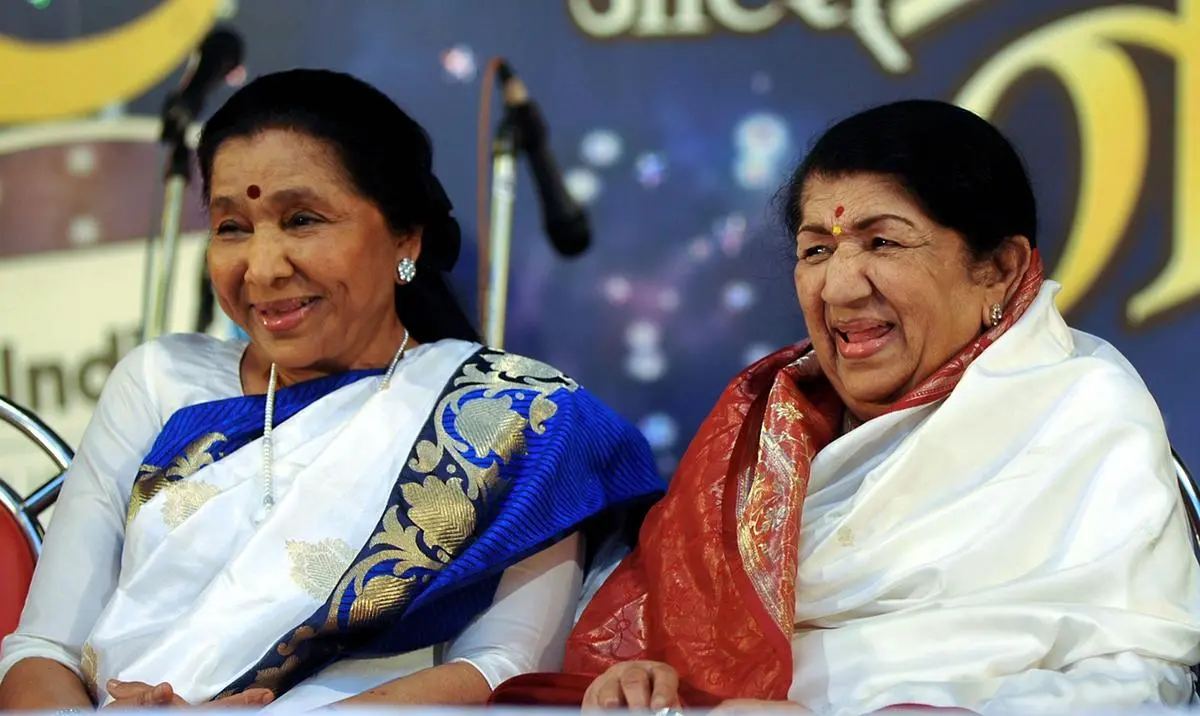
Asha Bhosle and Lata Mangeshkar at Pandit Hridaynath Mangeshkar Award ceremony, in Mumbai, on March 31, 2013. | Photo Credit: AFP
She could effortlessly convey a range of emotions that specific compositions demanded. If there was a trendy pop number like “Zuby Zuby Jalembu” (film An Evening in Paris), there were also melodic ones like “Tora Man Darpan”. Others like the peppy “Suno Zindagi Gaati Hai”, the sultry “Sharmana Yun Ghabrana” (film Joshila) and the 12-minute qawwali “Nigahen Milane Ko” are but a few examples of her amazing versatility.
Only an Asha could bring out the zest in songs like “Aaj Ki Raat Koi Aane Ko Hai” picturised on Helen on a dimly lit dance floor. It was only she who could have done the “Ta Ra Ru Ta Ra Ru” ending with a firm “Ya” in the song “Mera Naam Hai Shabnam” picturised on Bindu or the “Chori Chori Solah Singar Karoongi” from the “A” rated film Manoranjan, picturised on a very young Zeenat. Her voice had no difficulty in slipping into a variety of different characters—be it that of Waheeda Rahman vocalising in “Paan Khaye Saiyan Hamaro” and “Saawan Aaye Ya Na Aaye”, Sadhana in “Jhumka Gira Re”, Yogita Bali in the sensuous “Haye Bichhua Das Gayo Re”, and the sultry Nadira in “Mud Mud Ke Na Dekh”.
Collaborations across generations
She lent her voice to different generations of actors, for example Neetu Singh in “Haye Re Haye Tera Ghungta” or Urmila Matondkar in “Ho Ja Rangeela”, never seeming out of place or time.
She could sing a pretty straightforward yet fun-filled “Main Sitaron Ka Tarana” with Kishore in Chalti Ka Naam Gaadi or display her amazing vocal range in “Daiyya Ye Main Kahan Aa Phasi” (film Caravan) and “Jaane Jaan Dhoondta”. Just have plain fun in Itni Badi Mehfil picturised on Helen or slip into a deep pathos in “Dil Lagakar Hum Ye Samjhe”, “Dil Ki Manzil Hai Kuch Aisi”, “Ek Tu Hai Piya”, “Main Shayad Tumhare Liye” or “Ga Mere Man Ga”.
Then there were the distinctly moody numbers like “Ye Raaste Hain Pyar Ke”, “Aisa Laga Kahin Door Se” from Nabendu Ghosh’s Trishagni, Ang Lag Ja Balma, Poocho Na Hamein, Chehre Pe Khushi, Kali Ghata Chhaye and Aye Gham-e-Dil Kya Karoon.
There were also songs with a sense of dreamy abandon, such as “Balma Khuli Hawa Mein”, “Jayen Jahan Meri Nazar” from the 1960s film Kalpana, “Jab Chali Thandi Hawa”, “Kitna Haseen Hai Ye Jahan”, “Kyon Mujhe Itni Khushi”, “Man More Gaa Jhoomke”, “O Matwale Sajna”, “Woh Haseen Dard De Do”, “Aankhon Se Jo Utri Hai Dil Mein”, “Reshmi Ujala Hai” and the “Ta Thai Tat Thai” from Tere Mere Sapne.
A potpourri of her duets where she worked with a range of different male singers—Hemant, Mahendra Kapoor, Manna Dey, Bhupinder Singh, Mukesh, Mukesh—deserves a special mention. The same goes for her collaborations with Geeta Dutt (”Jaanu Jaanu Re”), sister Lata (”Aji Chale Aao”, “Kya Huwa Ye Mujhe”, “O Chand Jahan Wo Jaye”, and “Man Kyun Behka Re”), and sister Usha (”Kahe Tarsaye Jiyara”, “Dekho Bijli Dole”, “Huzurewala”).
The work of lyricists like Shamsul Huda Bihari or S.H. Bihari as he was popularly known, Sahir Ludhianvi, Shailendra, Rajinder Krishan, Neeraj, Majrooh Sultanpuri, Jan Nisar Akhtar, Shakeel Badayuni and Qamar Jalalabadi also contributed majorly to her early hits. In the 1980s, Gulzar collaborated with R.D. Burman and Asha to produce the unforgettable songs of Ijaazat.
She was also comfortable singing in many languages. Equally versed in Marathi, her mother tongue, Asha’s repertoire included Bengali film songs, non-film adhunik songs and Rabindra Sangeet.
Asha’s was (and is) the versatile voice that slips between moods, textures, and genres with effortless ease. Together with her sister, they did not compete so much as complete a musical universe in Indian cinema. And within that universe, Asha too moved freely, through duets, ghazals, qawwalis, cabaret numbers, folk-inspired melodies, and countless regional songs, leaving behind a legacy of not just hits, but of lasting impressions.
She exemplifies hope just as her name Asha does. It is poignant when she lilts her farewell—“Aage Bhi Jaane Na Tu.... jo bhi hai, bas yehi ek pal hai.”
You know not what the future holds; what you have is but this moment.
Also Read | Beyond boundaries
Also Read | 1949: Lata Mangeshkar arrives as the voice of India