










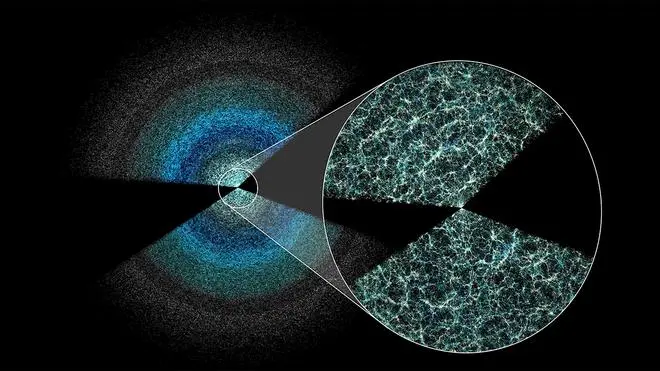
DESI completes five-year observation to create a complete 3D map of the universe
The Dark Energy Spectroscopic Instrument (DESI) is an international experiment involving 900 researchers from over 70 institutions. The instrument is mounted on the US National Science Foundation’s Nicholas U. Mayall 4-metre telescope at the Kitt Peak National Observatory in Arizona and is managed by the US Department of Energy’s Lawrence Berkeley Laboratory.
DESI began collecting data in May 2021 with a plan to capture light from 34 million galaxies and quasars (extremely distant yet bright objects with black holes at their cores). Since then, it has far surpassed the original goals. It has completed ahead of time the originally planned five-year mission and mapped more than 47 million galaxies and quasars and 20 million stars—vastly more data than expected—and created the largest high-resolution 3D map of the universe to date.
At different stages of its data gathering, the DESI map has formed the basis for researchers to explore dark energy, the fundamental ingredient that makes up about 68 per cent of the earth’s universe and is driving its accelerating expansion.
By comparing how galaxies clustered in the past with their distribution today, the researchers have traced dark energy’s influence over 11 billion years of cosmic history. DESI’s first three years of data have hinted that dark energy, once thought to be a “cosmological constant”, might be evolving and weakening over time. The significantly greater information from the full set of five-year data will enable researchers to test whether the hint persists. If confirmed, it would mark a break in the standard cosmological model and a major shift in how we think about our universe and its ultimate fate, which hinges on the balance between matter and dark energy.
Because of the instrument’s excellent performance, and the hints that dark energy is evolving, DESI will continue observations until 2028 and expand the map further by about 20 per cent (from 14,000 square degrees to 17,000 sq degrees; for comparison, the moon covers approximately 0.2 sq degree, and the full sky has over 41,000 sq degrees), the Berkeley Lab’s press release said.
“DESI’s five-year survey has been spectacularly successful,” said Michael Levi, DESI director. “The instrument performed better than anticipated. The results have been incredibly exciting. And the size and scope of the map and how quickly we’ve been able to execute is phenomenal. We’re going to celebrate completion of the original survey and then get started on the work of churning through the data, because we’re all curious about what new surprises are waiting for us.”
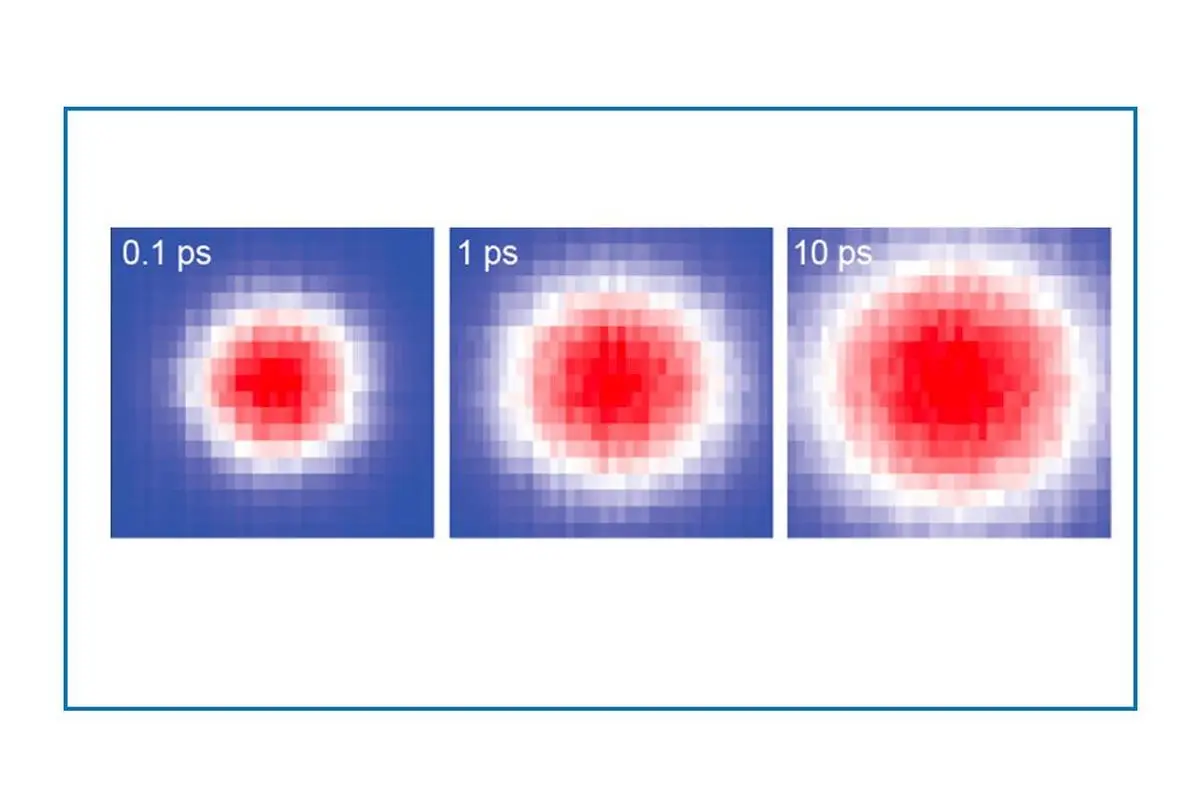
A sequence showing how thermal energy, carried by electrons, spreads through theta-phase tantalum nitride after the metallic material is struck by a pulse of light, from 0.1 to 10 picoseconds. | Photo Credit: H-Lab/UCLA
Record-setting heat-conducting material found
For more than a century, copper and silver have represented the upper bound of thermal conductivity among metals. In metallic materials, heat is carried by both free-moving electrons and atomic vibrations known as phonons. Strong interactions between electrons and phonons and phonon-phonon interactions have historically limited how efficiently heat can flow in metals.
Now, a discovery by a multi-institution research team, led by the University of California at Los Angeles (UCLA), is challenging long-standing assumptions about the limits of heat transport in metallic materials.
The study by Yongjie Hu, a professor at the UCLA Samueli School of Engineering, and associates was published in a recent issue of Science. The team found that metallic theta-phase tantalum nitride conducted heat nearly three times more efficiently than copper or silver.
Theoretical modelling suggested that theta-phase tantalum nitride could exhibit unusually efficient heat transport due to its unique atomic structure: tantalum atoms are interspersed with nitrogen atoms in a hexagonal pattern. The team confirmed the material’s performance using multiple techniques, including synchrotron-based high-resolution inelastic X-ray scattering with the recently upgraded Advanced Photon Source at the Argonne National Laboratory, Illinois, and ultra-fast optical spectroscopy. These measurements revealed extremely weak electron–phonon interactions that enabled heat to flow far more efficiently than in conventional metals.
Materials with high thermal conductivity are essential for removing localised hot spots in electronic devices, where overheating limits performance, reliability, and energy efficiency. Copper, which has a thermal conductivity of about 400 watts per metre-kelvin (W/mK), currently dominates the global heat-sink market, accounting for roughly one-third of commercial thermal-management materials.
In contrast, metallic theta-phase tantalum nitride was found to have an ultra-high thermal conductivity of about 1,100 W/mK, which sets a new benchmark and redefines what is possible for heat transport in metals.
“As AI technologies advance rapidly, heat-dissipation demands are pushing conventional metals like copper to their performance limits, and the heavy global reliance on copper in chips and AI accelerators is becoming a critical concern,” said Hu. “Our research shows that theta-phase tantalum nitride could be a fundamentally new and superior alternative for achieving higher thermal conductivity and may help guide the design of next-generation thermal materials.”
Beyond microelectronics and AI hardware, the researchers said the discovery could impact a wide range of technologies increasingly limited by heat, including data centres, aerospace systems, and emerging quantum platforms.
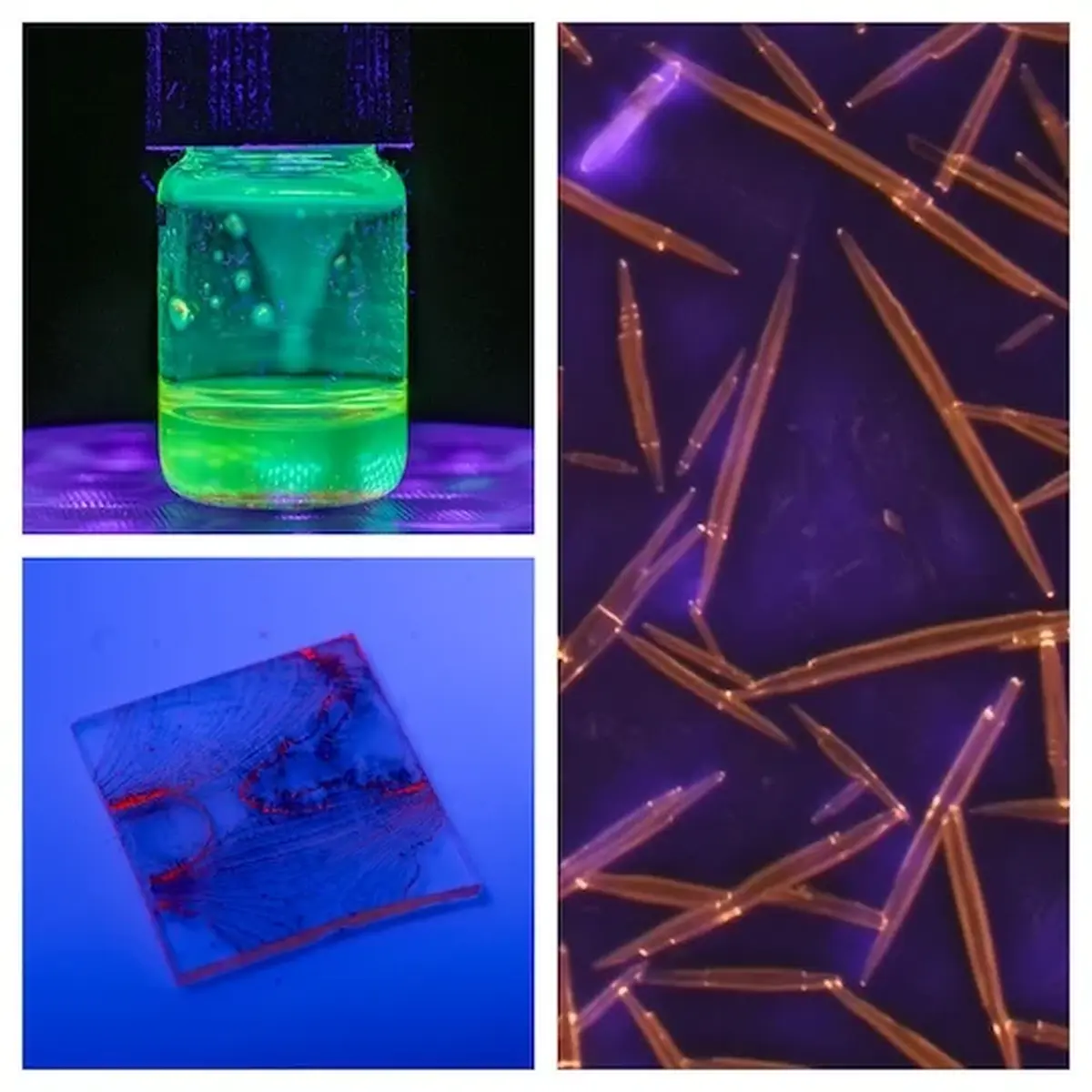
Top and bottom left: The different absorption and emissions signals observed in 9,10-bis (phenylethynyl)anthracene. Right: A microscopic image of its structural defects. | Photo Credit: Rice University
Decades-old mystery in organic light-emitting crystals resolved
Many technologies, ranging from solar energy to advanced imaging systems, are based on materials that emit or manipulate light. But even in well-studied materials, some fundamental behaviours have remained unexplained.
For years, an unusual optical behaviour has been observed in 9,10-bis (phenylethynyl)anthracene, a model system for studying how light energy moves through materials. Two distinct absorption and emission signals that did not match existing theories were seen. In a study published in Journal of the American Chemical Society, researchers at Rice University at Houston, Texas, showed that the two signals actually came from completely different processes, thus resolving a long-standing puzzle.
To unravel its behaviour, they combined spectroscopy experiments with advanced simulations. Their findings showed that the material’s unusual light absorption comes from interactions between two types of excited states: excitons, which carry energy through the material, and charge-transfer states, where electrons shift between molecules.
But it was the material’s light emission that was counter-intuitive. Instead of originating purely from the crystal itself, the team found that the lower-energy light emission comes from tiny structural imperfections, where molecules form X-shaped pairs. These irregularities act as energy localisation sites, or trap states, that behave differently from the rest of the material.
“These defects aren’t just imperfections, they actually create new pathways for energy flow, essentially turning apparent flaws into desirable features,” said Lea Nienhaus of the Rice Advanced Materials Institute.
Theoretical studies showed that rather than reducing performance, these defect sites actually enhanced a process called triplet-triplet annihilation—an energy transfer mechanism where two molecules in their triplet excited states interact to form a lower energy ground state molecule and a higher energy singlet state molecule—which allows materials to convert lower-energy light into higher-energy light. The defects also suppressed competing energy pathways that would otherwise reduce efficiency.
That is, imperfections can actually improve how energy is converted and emitted in a material. The findings challenge the long-held notion that structural defects are inherently detrimental. Instead, the results suggest that carefully controlled imperfections could increase light conversion efficiency.
“Our work shows that material defects can actually improve performance, creating a target for materials engineering,” said Peter J. Rossky Natural Sciences Emeritus Chair at Rice. “By understanding how molecular structure, disorder, and electronic interactions work together, we can begin to design materials where these effects are not just tolerated but deliberately used to control how energy moves.”
This insight could help researchers design more efficient materials for applications in solar energy, optoelectronics, and light-based sensing technologies. By intentionally tuning how molecules pack together and where defects form, scientists may be able to create materials that convert and control light more efficiently than ever before.
Also Read | Universe, now in Ultra HD; and the Dirac dip
Also Read | Spooky action at the Hadron Collider; the milk of human kindness; and a cosmic goliath