





On April 13, 2026, a large number of factory workers in Noida, Uttar Pradesh—one of New Delhi’s suburban industrial centres—took to the streets. They were protesting against low wages and poor working conditions. Details on what followed remain hazy, with the protesters charging that the police attacked them without provocation and the police claiming that the protesters turned violent, necessitating action.
What is noteworthy is that protests by workers in Haryana against a measly increase in wages recommended by the State government had preceded the stir at Noida. In Noida, the initial protest involved workers from multiple factories who had been coordinating and mobilising through social media. It soon spread across a cluster of factories in unrelated industries and brought domestic workers, many of whom are poorly paid and treated badly by their employers, into the fray. The protests signalled resentment that runs deep and is quite widespread.
The workers have a strong case. Many are paid as low as Rs.10,000 to Rs.11,000 a month for 12-hour shifts on working days. Being contract workers hired through agents, many of them lack security of tenure and any social security benefits. Even the benefits due to them are not provided by employers. And norms on payments for overtime work are ignored. In addition to being treated badly in the workplace, workers find it difficult to meet basic needs. When any new shock is felt, such as the rise in fuel prices following the US-Israeli war against Iran, life proves unbearable, and the situation turns volatile. The implicit violence at work spills over as violence on the streets.
What fuels anger further is evidence of the huge differential between the benefits derived and lifestyles led by employers and privileged managers and the earnings and standards of life of workers in these relatively newer business enclaves, which reflect the new modes of doing business in neoliberal India. These enclaves are populated with units relying on unskilled workers or those with “lower-valued” skills, which, when successful, deliver large profits by riding on low wages and poor working conditions in a country plagued by precarity because of high under-employment, inadequate education, and laws that do not preclude or even permit the recognition of violations by employers and managers.
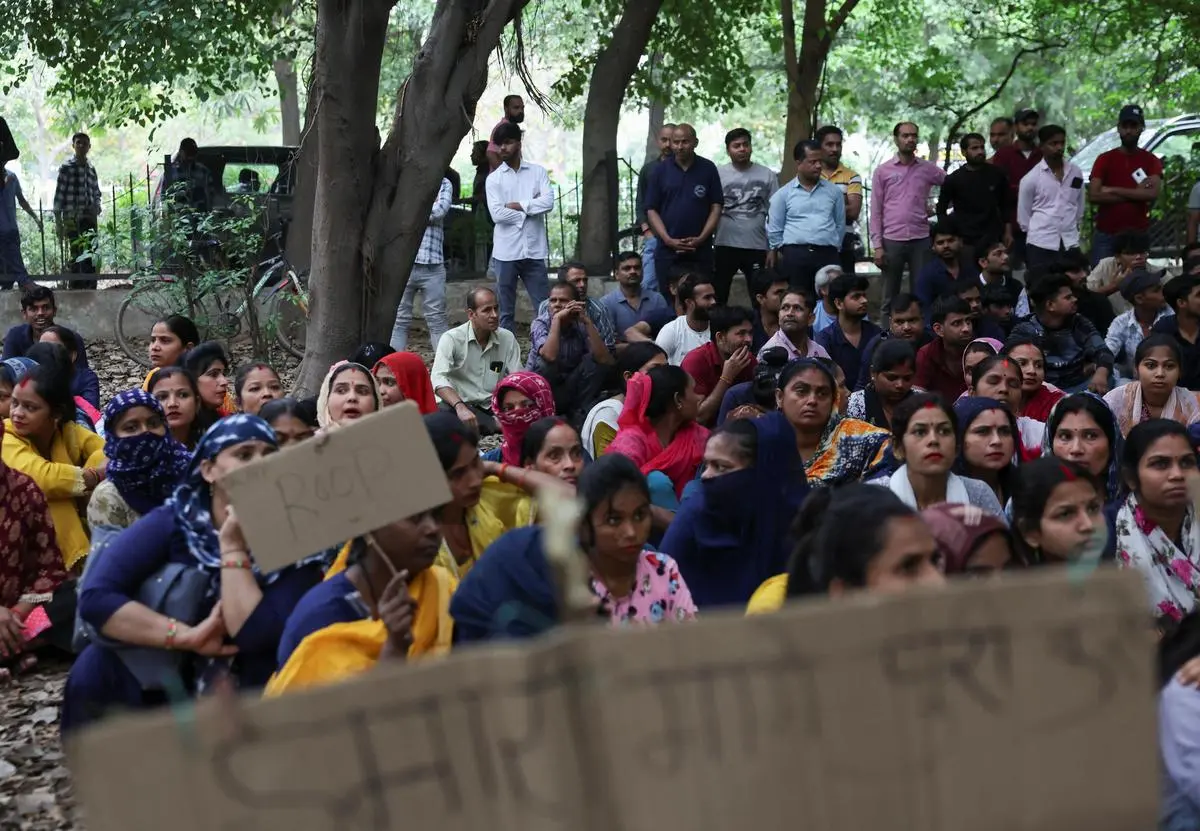
Workers demanding wage hikes, in Manesar, Haryana, on April 7, 2026. | Photo Credit: Bhawika Chhabra/Reuters
Moreover, the state that is expected to mediate to improve workers’ wages over time by raising the minimum wage floor it sets has failed to do so. By definition, the minimum wage consists of a basic component and a component linked to the consumer price index to be adjusted for inflation. The basic component, which is expected to be adjusted upwards at least once in five years, was last revised in Haryana and Uttar Pradesh more than a decade ago. The perception of collusion between state actors and private employers is, therefore, strong.
It does not help that an authoritarian government apparatus that favours factory owners keeps worker dissent suppressed and discourages trade union activity. With little space for a negotiated and reasonable settlement of grievances on a routine basis, spontaneous “revolt” is the vent for accumulated worker anger.
As far back as 2012, in Manesar, another NCR suburb, in the factory of the auto major Maruti Suzuki, worker anger led to violent protests that resulted in the death of a human resources manager. Then, too, the workers had a case. State reprisal was brutal, and the management opted for a lockout and sought to set an example of what could happen to workers following such protests: more than 500 permanent workers and close to 2,000 contractual workers, many of whom were not even identified by the police as protesters, lost their jobs. Even today, some of them return to protest and demand reinstatement and compensation, with no success.
Shifting the blame
The Uttar Pradesh government’s response to the recent Noida protests is revealing. On the one hand, it implicitly admitted that workers were being exploited—by notifying a 21 per cent increase in minimum wages for workers in the State (much lower than what the workers are demanding) and promising a scrutiny of working conditions—and, on the other, it attributed the protests to conspiracies hatched by “outsiders” who were aiming to sully the good name of the State government, no less.
The government of Uttar Pradesh has, according to an official statement, “constituted a high-level committee with the objective of establishing effective dialogue with the concerned stakeholders and maintaining industrial harmony and law and order”. The district administration is threatening to cancel the licences of 203 contractors, blacklist them, and require them to pay workers dues in excess of Rs.1 crore. The attempt is to blame the contractors rather than the system.
Meanwhile, Uttar Pradesh Chief Minister Yogi Adityanath declared that when “the double engine government under the leadership of Prime Minister [Narendra] Modi” was striving to create an environment of “development and peace, some people are trying to create unrest through conspiracies”. The DGP claimed that “provocation” by “external elements” led to the protests. Claiming that his “government stands with workers”, the Chief Minister promised “protection to every worker” and “proper remuneration for them”. Given their experience, workers are not convinced.
It is more than likely that the workers arrested will be held for a long time and be deprived of their jobs, as happened in Manesar many years ago. Meanwhile, employers and contractors are likely to escape being penalised.
The evidence is telling. Under neoliberalism, collusion between the state and private capital facilitated profit inflation at the expense of the living standards and working conditions of undervalued workers during the years when inflows of foreign financial capital and debt drove an artificial boom. There are multiple signs that the boom is giving way to a downturn.
This is likely to justify use of the exploitative apparatus constructed during the boom to sustain profitability. New rounds of violence at work and on the streets seem inevitable.
C.P. Chandrasekhar taught for more than three decades at the Centre for Economic Studies and Planning, Jawaharlal Nehru University, New Delhi. He is currently a senior research fellow at the Political Economy Research Institute, University of Massachusetts Amherst, US.
Also Read | Pushing workers to the edge
Also Read | Dictatorship of the employer?