


On April 13, 2026, the industrial township of Noida—a satellite city of Delhi with over 10,000 factories and service units—saw scenes long feared by the ruling establishment. Thousands of workers spilled onto the streets in a cascading uprising that had begun three days earlier and now spread across sector belts. Their demands were elemental: a living wage, an eight-hour workday, and the basic dignity of being treated as human beings rather than disposable inputs in a global supply chain.
Noida’s workforce is largely composed of migrant labourers hired on temporary contracts through private agencies that skim a share of their already meagre wages. A substantial section are women. They produce mobile phones, auto components, medicines, garments, and electronic goods for Indian and multinational corporations—among them TCS, HCL, Samsung, Xiaomi, Microsoft, and several European brands. Goods flow outward, profits upward; what remains for workers is roughly Rs.11,000 to Rs.13,000 a month, earned through 12-hour shifts, often without Provident Fund, Employees’ State Insurance (ESI), job security, or the right to organise.
The state’s response was swift and harsh. Within hours, hundreds of workers—men and women—were beaten, dragged through the streets, and detained. By April 15, around 300 workers had been arrested, and arrests have continued since. Trade union leaders were placed under house arrest, and bystanders picked up. The state had chosen its side, and it was not the workers’.
Rather than address the demands, the BJP deployed a familiar tactic: manufacturing a conspiracy. Uttar Pradesh Labour Minister Anil Rajbhar said agencies were probing a “Pakistan connection” behind the unrest. Chief Minister Adityanath warned that “misleading and disruptive elements” might be attempting to revive Naxalism. Noida Police Commissioner Laxmi Singh described the violence as a “mala fide, internationally organised activity”—without producing evidence. Labour activists Manisha Chauhan, Rupesh Rai, and Aditya Anand of the Mazdoor Bigul Dasta were arrested and branded “masterminds” for speeches and social media posts highlighting workers’ conditions.
This conversion of economic protest into a national security threat is standard practice, not an aberration. It reflects a regime that has steadily weakened workers’ rights while claiming to defend them. To accuse underpaid workers of foreign conspiracy is not merely false; it is calculated contempt. Workers do not need instigation to resist wages that cannot withstand inflation, or 12-hour workdays. The real conspiracy lies not in Islamabad, but in the legislative and administrative centres of power in Lucknow and New Delhi.
Inhuman exploitation
The Noida uprising did not emerge in isolation. It is the cumulative outcome of conditions that have steadily worsened over more than a decade of BJP rule at the Centre and, in Uttar Pradesh, under Adityanath, where “development” has often meant the suppression of dissent.
The structural issue is straightforward: wages have failed to keep pace with rising consumer prices. Across India’s industrial belt, an increasing share of workers are employed on temporary contracts, stripped of basic statutory protections—PF, ESI, gratuity, and regulated working hours. The recent spike in cooking gas prices, intensified by inflationary pressures linked to the West Asia conflict, became the tipping point. For workers earning around Rs.11,000 a month, a single cylinder of cooking gas now consumes an untenable share of income, rendering basic survival arithmetic impossible.
The trigger was sharper because of geography. On April 9, the Haryana government raised minimum wages by about 35 per cent—taking unskilled wages from Rs.11,274 to Rs.15,220 a month. Across the state border, Uttar Pradesh’s revised wages, effective April 1, remained significantly lower. Workers in Noida asked an obvious question: how is a worker in Gurugram worth Rs.6,000 more than a worker doing the same job in Noida?
Noida was only one node in a wider pattern. In recent months, similar eruptions have occurred across Faridabad in Haryana, the Indian Oil Corporation refinery at Panipat, the ArcelorMittal Nippon Steel project at Hajira in Surat, and Barauni in Bihar. At Panipat in February 2026, over 30,000 contract workers—clocking 12-hour shifts and awaiting delayed wages—walked out spontaneously after an accident at the site, only to face baton charges from paramilitary forces. In Faridabad, workers at Motherson Sumi Systems faced lathi charges when they took to the streets in mid-April. This is not an isolated flare-up; it is a nationwide assertion by the working class against the systematic erosion of their rights and dignity.
The ghost of Manesar
To understand what Noida’s workers face, one need only look 50 km west to Manesar in Haryana, where the shadow of India’s most emblematic labour struggle still hangs over the industrial belt. The story of Maruti Suzuki workers is a stark lesson in what happens when organised labour confronts capital: the character of the anti-labour state gets exposed.
Beginning in 2011, workers at the Manesar plant mounted a sustained struggle against harsh conditions, contractualisation, and the denial of union recognition. After three major strikes—two involving factory occupations—they compelled management to recognise the Maruti Suzuki Workers’ Union. Within four months, the backlash came. The events of July 18, 2012, when an HR manager died during a shop-floor clash, became the pretext. Hundreds of union activists were arrested; 546 permanent workers were dismissed and around 1,800 contract workers terminated—almost the entire workforce. The Haryana government, under both the Congress and later the BJP, functioned as the employer’s instrument.
In March 2017, after almost five years of incarceration and a widely contested trial, 13 worker leaders were sentenced to life imprisonment—a verdict many labour scholars and legal observers have called a judicial frame-up. Of 148 arrested workers, 117 were eventually acquitted, but only after losing years to prison, financial collapse, and familial devastation. Two convicted workers, Pawan Dahiya and Jiya Lal, died in 2021—Dahiya by electrocution while on temporary pandemic release, Jiya Lal of cancer that went undetected during incarceration. The remaining 11, though out on bail, continue to live under the uncertainty of a pending appeal.
In September 2024, retrenched Maruti workers began an indefinite dharna near the factory gate, demanding reinstatement after 12 years. Every major party—the Congress, the BJP, and the AAP—pleaded helplessness, citing the matter’s pendency in court. The BJP, in power both at the Centre and in Haryana, presided over this prolonged injustice, offering only vague assurances during the 2024 State elections. Those assurances quickly dissipated. By January 2025, the Haryana police had cleared the dharna site.
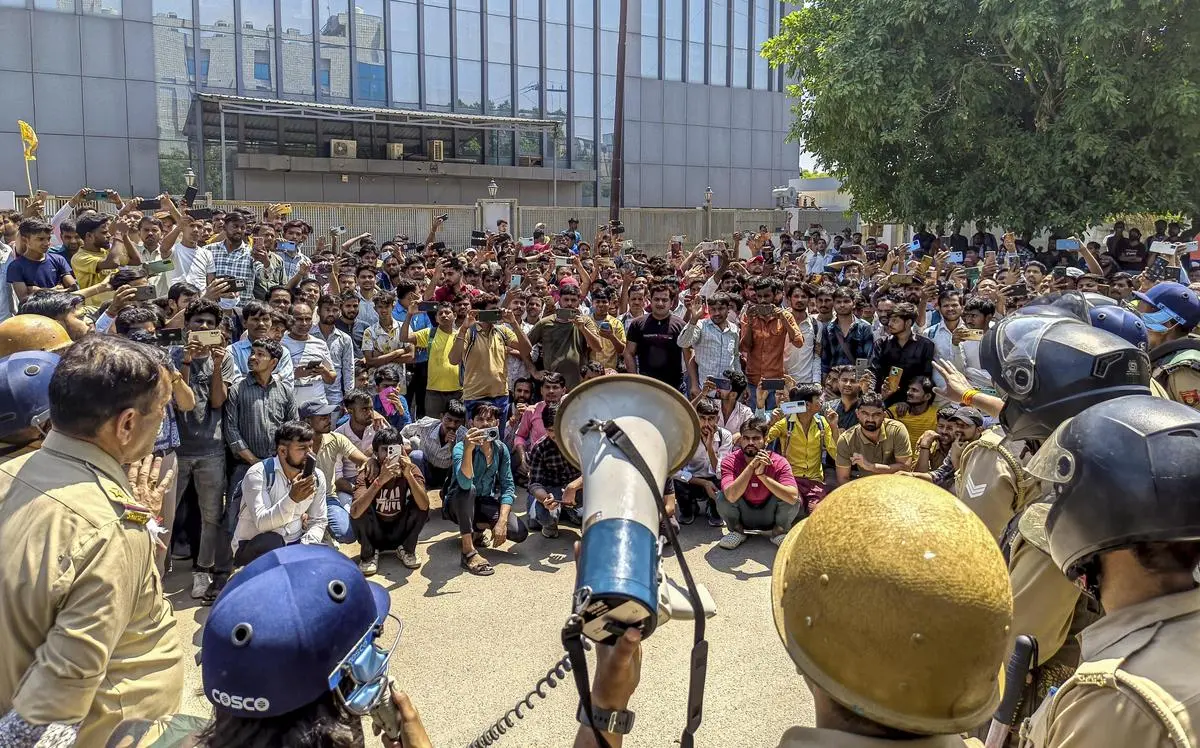
Factory workers protest for higher wages in Noida, Gautam Buddh Nagar, Uttar Pradesh, on April 13, 2026. | Photo Credit: PTI
The message from Manesar is blunt: organise, and you will be crushed; assert your rights, and you will be criminalised; persist, and your suffering will be turned into a warning. The arrests in Noida in April 2026 show that the message remains unchanged.
The villainy of the Labour Codes
The street-level repression in Noida and Manesar is only the visible edge of a deeper, systemic assault. On November 21, 2025, the BJP government brought into force four Labour Codes, subsuming 29 central labour laws built through over a century of worker struggle. These Codes were passed in September 2020 without debate, on a day when opposition MPs were suspended for protesting the farm Bills—an exercise of brute parliamentary majority that sidelined deliberation, tripartite consultation, and federal norms.
The four Codes—the Code on Wages, the Industrial Relations Code, the Code on Social Security, and the Occupational Safety, Health and Working Conditions Code—were presented as “simplification”. In effect, they legalise employer impunity. Arbitrary thresholds exclude large sections of the workforce from basic protections; fixed-term employment is normalised, eroding the very idea of permanence; the right to strike is further restricted; inspections are diluted; and union recognition is made more difficult. What were once violations of labour law have, in many cases, simply been codified into it.
The extent of this rollback is evident in the opposition it drew. Even the Bharatiya Mazdoor Sangh, the BJP’s own trade union affiliate within the Sangh Parivar, objected. The Joint Platform of Central Trade Unions, representing unions across ideological lines, condemned the Codes as a devastating assault on workers’ livelihoods and a regression toward a master–servant framework. This is not rhetorical excess but a considered assessment by institutions with long historical experience of labour law in India. The BJP’s 2014 promise of “acche din” has been realised—but for employers, not for workers.
The Labour Codes did not appear overnight; they are the culmination of a decade of State-level experimentation in BJP-ruled regions. Beginning in 2014, Rajasthan under Vasundhara Raje raised thresholds for the Factories Act, Contract Labour Act, and Industrial Disputes Act, pushing millions of workers outside legal protection. Other BJP-governed States—Uttar Pradesh, Madhya Pradesh, Gujarat, Maharashtra, Haryana, and Karnataka—followed suit, producing what analysts have described as a race to the bottom in labour standards to attract investment. Inter-State competition to offer capital the cheapest and least protected workforce has become central to this model of governance, packaged as “ease of doing business”.
In Uttar Pradesh, this framework bears the imprint of Adityanath. The State, which anchors the industrial belt that includes Noida, has consistently used the police as an instrument of labour control. Striking workers are charged with disturbing public order; supporting activists are cast as conspirators. The message from Lucknow is unambiguous: the State is open for business, and labour is expected to comply.
Criminalisation of class solidarity
In the weeks after April 13, the Noida police widened their dragnet beyond protesting workers to include young activists, students, and even social media users who publicised the uprising. Workers’ advocates have been labelled “masterminds” and “accomplices”, non-bailable warrants issued, and trade union leaders kept under surveillance or house arrest. Rights groups such as Jan Hastakshep have demanded the release of those detained and the withdrawal of cases, but the state machinery continues, largely indifferent to due process.
This repression is not about restoring law and order; it is meant to deter. The arrests are a signal to workers, organisers, and solidarity networks across the National Capital Region that resistance will invite criminalisation. Charges of vandalism, arson, and foreign links function less as legal claims than as tools of intimidation—designed to ensure that when wages stagnate and hours stretch without limit, workers hesitate before taking to the streets.
The Noida uprising is a mirror held up to a decade of BJP rule. What it reflects is an economic model built on cheap, disposable, rightless labour; a political framework that criminalises the poor for asserting constitutionally grounded claims; and a security apparatus that shields employers more than it holds them accountable.
The workers of Noida—like those of Manesar, and those in Faridabad, Surat, Panipat, and Barauni—are not demanding upheaval. They are asking for a living wage, an eight-hour day, and the right to unionise—demands long recognised by the International Labour Organization and embedded in India’s constitutional and democratic tradition. The government’s response, whether in November 2025 or April 2026, has been coercive force.
On April 14, the Uttar Pradesh government announced an interim wage hike of around 21 per cent for Gautam Buddha Nagar and Ghaziabad, raising unskilled monthly wages from Rs.11,313 to Rs.13,690. On April 18, modified minimum wages were approved across the State. Workers responded that the revision still fell well short of Haryana’s rates, and protests continued—joined by domestic workers from April 16. The concession was extracted through assertion, not granted through dialogue.
As the country approached International Workers’ Day 2026, the central question is unavoidable: whose interests does the Indian state serve? The workers of Noida, with injuries and arrests to show for their assertion, have already drawn their conclusion. The rest of the country must decide whether to confront it.
NOTE: The author stands in solidarity with all workers arrested in Noida and Manesar. All those detained must be released unconditionally, and all charges against them must be dropped immediately.
Anand Teltumbde is a former CEO of Petronet India Limited (PIL), a professor at IIT Kharagpur and Goa Institute of Management, a civil rights activist, and the author of over 30 books.
Also Read | Red Shirts in Kanchipuram
Also Read | Iran war: India needs a new migration strategy