

惯性聚合 高效追踪和阅读你感兴趣的博客、新闻、科技资讯
阅读原文 在惯性聚合中打开

推荐订阅源

V
Visual Studio Blog
Recent Announcements
雷峰网
雷峰网
The GitHub Blog
The GitHub Blog
罗磊的独立博客
月光博客
月光博客
J
Java Code Geeks
A
About on SuperTechFans
Microsoft Security Blog
D
Docker
OSCHINA 社区最新新闻
OSCHINA 社区最新新闻
F
Fortinet All Blogs
U
Unit 42
C
Check Point Blog
Martin Fowler
Martin Fowler
有赞技术团队
有赞技术团队
博客园 - 叶小钗
Cyber Security Advisories - MS-ISAC
酷 壳 – CoolShell
酷 壳 – CoolShell
Blog — PlanetScale
Blog — PlanetScale
大猫的无限游戏
大猫的无限游戏
让小产品的独立变现更简单 - ezindie.com
阮一峰的网络日志
阮一峰的网络日志
MyScale Blog
MyScale Blog

Latest BL Data Stories News, Business, Economic Data Stories - BusinessLine | The HinduBusinessLine

Mega IPOs do not always deliver The quick-commerce battle The biggest World Cup yet India is largest source for immigrant founders of US unicorns, but still not shooting for the stars South Korea records high FPI outflows of $69 billion in 2026, followed by India with $26 billion Health insurance coverage crosses 60% of households, NFHS How AT1 bond issuances have hit a rough patch since 2025 Nifty-50 valuation faces test as global capital chases faster earnings growth RBI balance sheet expanded 21% in FY26 led by rising gold valuation Gender parity in government services still a long way away Infrastructure project additions surge in Q4 FY26 led by highway projects RBI records highest-ever dollar sales to defend rupee in FY26 India sees 15% jump in education loans, touches decade-high ₹8.58 lakh crore in FY26 Fuel price hikes renew focus on high state taxes on petrol and diesel Stolen identities fuel cyberattacks Quick-commerce firms spend ₹98-100 per order despite increasing dark stores, says Bernstein research IPL economy AI apps, UPI drive India’s digital shift Gold bars and coins make up 41% of gold demand in January-March 2026 How FIIs and DIIs are taking opposing positions Southern States recorded inflation above national average in April 2026 Gold held by Indian gold ETFs up 79% in the past year India’s forex reserves contract 5% since March, one of the highest among oil importing EMs Tamil Nadu’s winners: Youngest and wealthiest Profile of the whistle brigade SIR impact on close contests: How sub-10,000 margins reshaped the electoral map Indian firms boost global acquisitions to $17.3 billion led by Sun Pharma deal External commercial borrowings fall 25% in FY26 amid currency risks, shift to domestic funding Gaps in financial maturity Palash Rana tops wealth chart in Bengal Phase 2 with ₹104 crore-plus assets
Nari Shakti: What is the share of women in parliament &am...
Aleena Rose Jose & Yashaswani Chauhan · 2026-04-15 · via Latest BL Data Stories News, Business, Economic Data Stories - BusinessLine | The HinduBusinessLine
In most large States, including Maharashtra (8.8 per cent), Gujarat (8.5 per cent), and Karnataka (7.1 per cent), women remained below the 10 per cent threshold

In most large States, including Maharashtra (8.8 per cent), Gujarat (8.5 per cent), and Karnataka (7.1 per cent), women remained below the 10 per cent threshold

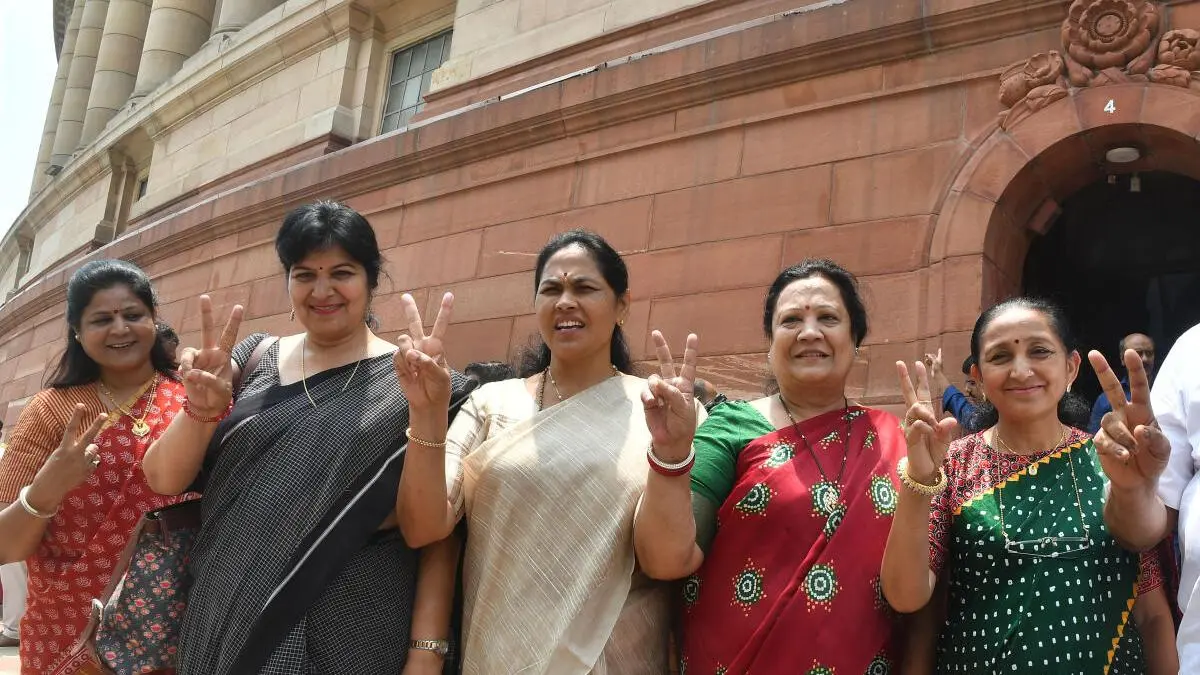
Ahead of a special three-day Parliamentary session to advance the women’s reservation bill, recent election results show that women remain significantly under-represented, both as candidates and as elected lawmakers.

In Parliament, the share of women MPs in the Lok Sabha has risen gradually over the past two decades, though gains remain modest. Women accounted for 7.98 per cent of Lok Sabha MPs in 2004. The proportion increased to 10.7 per cent in 2009, 11.46 per cent in 2014, and peaked at 14.39 per cent in 2019. In 2024, women comprised 13.63 per cent of Lok Sabha MPs.

388 MLAs

Analysis of recent Assembly elections shows that women constituted 9.5 per cent of total MLAs. Of the 4,099 MLAs examined, only 388 were women. The data suggest that even when women contest, their success rate remains limited relative to overall representation.

On the candidature front, the picture is similarly constrained. Only four States/UTs crossed the 13 per cent mark in women’s share among total candidates. Odisha (13.9 per cent) topped the list, followed by Puducherry (13.7 per cent), Delhi (13.7 per cent), and Chhattisgarh (13.1 per cent).

At the lower end, Nagaland recorded the lowest share at 2.2 per cent. Arunachal Pradesh and Jammu & Kashmir were at 4.9 per cent each, while Himachal Pradesh stood at 5.8 per cent.

In most large States, including Maharashtra (8.8 per cent), Gujarat (8.5 per cent), and Karnataka (7.1 per cent), women remained below the 10 per cent threshold.

Party-wise data based on the 18th Lok Sabha and sitting MLAs in current Assemblies show that most major political parties have around 10 per cent women legislators.

The Bharatiya Janata Party has 10.34 per cent women among its MPs and MLAs combined, while the Indian National Congress stands at 9.52 per cent. The All India Trinamool Congress leads with 18.07 per cent. The Telugu Desam Party (13.91 per cent) and the Samajwadi Party (12.58 per cent) are also above the 10 per cent mark.

Women’s representation is significantly higher at the grassroots level due to constitutional mandates. Article 243D provides reservation for women in Panchayats, and 21 States and two UTs have raised this quota to 50 per cent.

As a result, several States report women accounting for over half of elected representatives in Panchayati Raj Institutions (2024), including Uttarakhand (56 per cent), Andhra Pradesh (55.5 per cent), and Chhattisgarh (55 per cent).

In contrast, some regions remain near the one-third mark, such as Uttar Pradesh (33.3 per cent) and Jammu & Kashmir (33.2 per cent).

Aleena Rose Jose is an intern at businessline

Published on April 15, 2026