






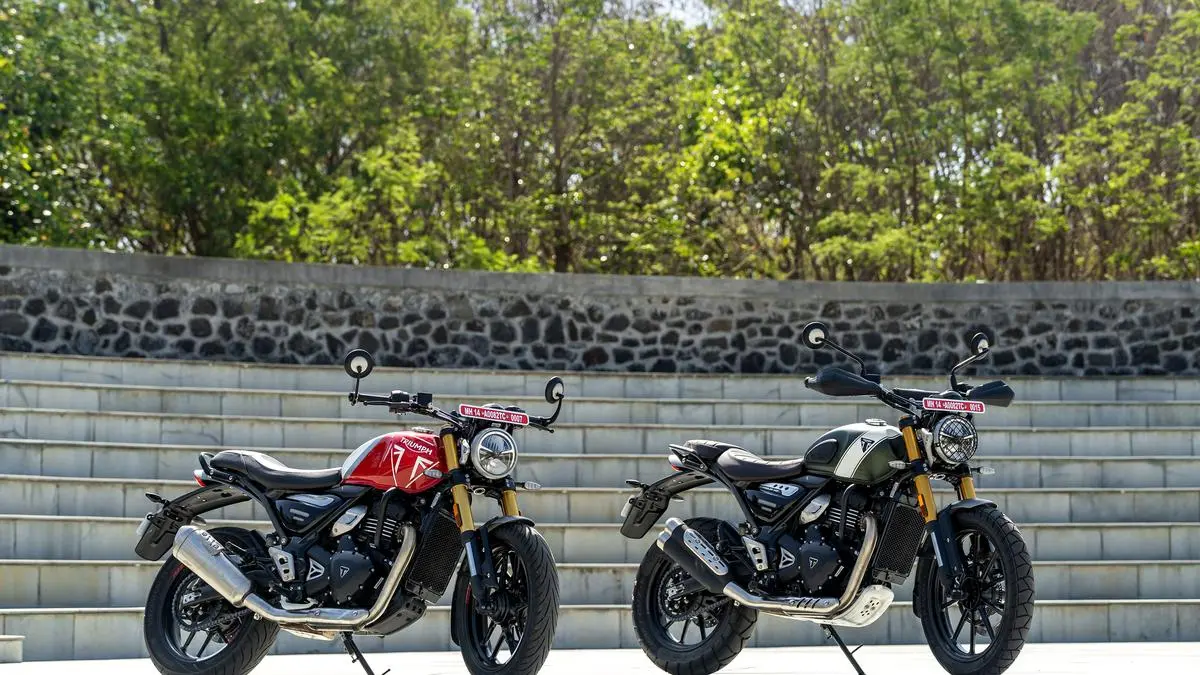
The 349cc engine retains all of its predecessor’s creamy, refined power delivery and most of its power, too! Quality levels are impeccable | Photo Credit: Yash Gawde
I would imagine news of Triumph downsizing its 400cc motorcycles has already reached you by the time you’re reading this. It’s been a much talked-about move of late, all in Bajaj’s interest to slot its range of premium motorcycles into a less-punishing GST slab unlike the one recently levied on motorcycles above 350cc. While the directive itself demands questioning, seeing as motorcycles do the ecosystem huge favours (higher efficiency, lower congestion as compared to cars), how this affects your Triumph aspirations is what I’ll attempt to answer.
What has changed? Not much, to be honest. The engine has lost a bit of its cubic capacity, achieved through a shorter stroke, that being the biggest change of the lot. Subsequently, a minor recalibration of the combustion chamber, timing, fuelling and exhaust was called for, so as to deliver the same feel as on the old engine.
All of these changes have resulted in a small drop in power figures (ranging from 1.9 to 2.9 bhp across the range) and torque output figures (3.6 to 3.8 kg-m), with a similarly narrow step-down in performance figures as well.
For instance, the slowest of the range, the T4 now goes from 0-60 kph in 3.5 seconds (-0.2s) and 0-100 kph in 9.6 seconds (-0.7). The Speed, so far being the quickest of the range, has lost 0.1 seconds (now 3.1s) in the 60-kph dash and 0.7 seconds (8.1s) in the 100-kph sprint. Clearly, not a monumental loss , then — if it can even be called that in the first place. Before we move along, let’s summarise the Triumph range in order of power output for ease of reference. The T4 forms the lowest rung with its 28.6-bhp engine, the Speed and Scrambler are higher up, at 36.4 bhp, and the Thruxton (along with the newly launched Tracker) is the most powerful of the lot, with its 39.4-bhp output.
In terms of pricing, the range now begins at ₹1.95 lakh (T4), going up incrementally to ₹2.30 lakh for the Speed, ₹2.46 lakh for the Tracker, ₹2.59 for the Scrambler X, ₹2.65 lakh for the Thruxton and ₹ 2.89 lakh for the range-topping Scrambler XC. While these are minor price cuts over the now-defunct 400s, it’s equally important to note that Bajaj had so far absorbed the post-GST price hikes, holding back from passing the burden on to buyers. And yes, the 400s will not co-exist with the 350s, although the bikes continue to sport ‘400’ badges in the name of spiritual continuity, I suppose.
Wait a minute, though. You didn’t come here to read a news report, did you? What do these motorcycles feel like? Isn’t that what matters most?
For one, nothing else has changed about them. In other words, all of the Triumphs continue to be the sweet, fun and beautifully put together motorcycles they’ve always been. Triumph took a high-quality approach when it introduced the 400s roughly three years ago and those standards have been maintained across the range. These are really finessed machines, designed and engineered with a level of attention to detail matched by nothing else in their respective classes. Undoubtedly, the Triumphs are the finest of Bajaj’s widespread yield. Yet.
I picked the Speed 400 to set off on a ride with from Bajaj’s Akurdi HQ and, a moment later, entirely forgot I was meant to make notes about the ‘new’ engine’s performance deficit. The Speed 400 is such a snug, intuitive motorcycle to ride, it tends to take your mind off concerns of any manner. Like if you’ve forgotten to turn off the gas stove at home, for instance. It’s sublime and meaty, makes light work of traffic and, equally leisurely highway rides.
Short bursts of speed feel satisfying — if not KTM-esque frightening — and there’s an innate sense of versatility to the Speed that will make it as charming over a mundane commute as it will on a brisk weekend ride. The Vredestein Centauro ST tyres are grippy and communicative, the brakes are strong if not edgily sharp, the steering is spot-on and the comfortable riding geometry (even for a rider of my generous proportions) just make the Speed 400 a no-brainer. It’s a motorcycle truly worthy of the Triumph badge and it sure is the benchmark for naked street single-cylinder motorcycles in the country today.
Performance? Honestly, if you have no reference point of what the old 400 was like, you won’t feel fleeced. It’s a 350 that performs like a 400, whether you’re intent on extracting the maximum out of it or just in the mood for a ride to remember. Those of you who do have a 400 (or have ridden one) might just find a drop in outright acceleration or in roll-ons (say, 30-50 kph), but that’s provided you have recent references or a razor-sharp memory. In any case, nobody really trades laterally — I mean, you won’t trade a 400 for a 350, will you? — and so, for people stepping up from 150cc to sub-250cc motorcycles, the Speed ‘350’ will feel every bit as substantial as you’d expect it to.
I felt underwhelmed on the Scrambler, though, not due to any of its revisions but because it simply isn’t the best version of itself yet. I get the appeal of its taller stance and old-school trail-ready looks, but it simply doesn’t feel as taut as the Speed (or for that matter, even the Thruxton and Tracker; we’ll be riding the latter soon). Sure, it was a fun ride, but I wish I’d stuck to the Speed. Let’s put it this way — the Speed feels like a perfect descendant of the much-larger Speed Twin, but the Scrambler isn’t as nuanced an interpretation of the bigger Triumphs it shares its nameplate with.
Having said that, Triumph’s six-bike range sure is a compelling one. There’s a near-uniform element of longevity to these bikes and each of them, inherently, serve as great customisation platforms, which is good news for when the novelty of riding them in stock form wears off. To return to the question I asked at the very beginning of this story, should your Triumph aspirations suffer as a result of any of this? Absolutely not. There’s your answer!
@TheMotorGram
Published on April 10, 2026
此内容由惯性聚合(RSS阅读器)自动聚合整理,仅供阅读参考。 原文来自 — 版权归原作者所有。