








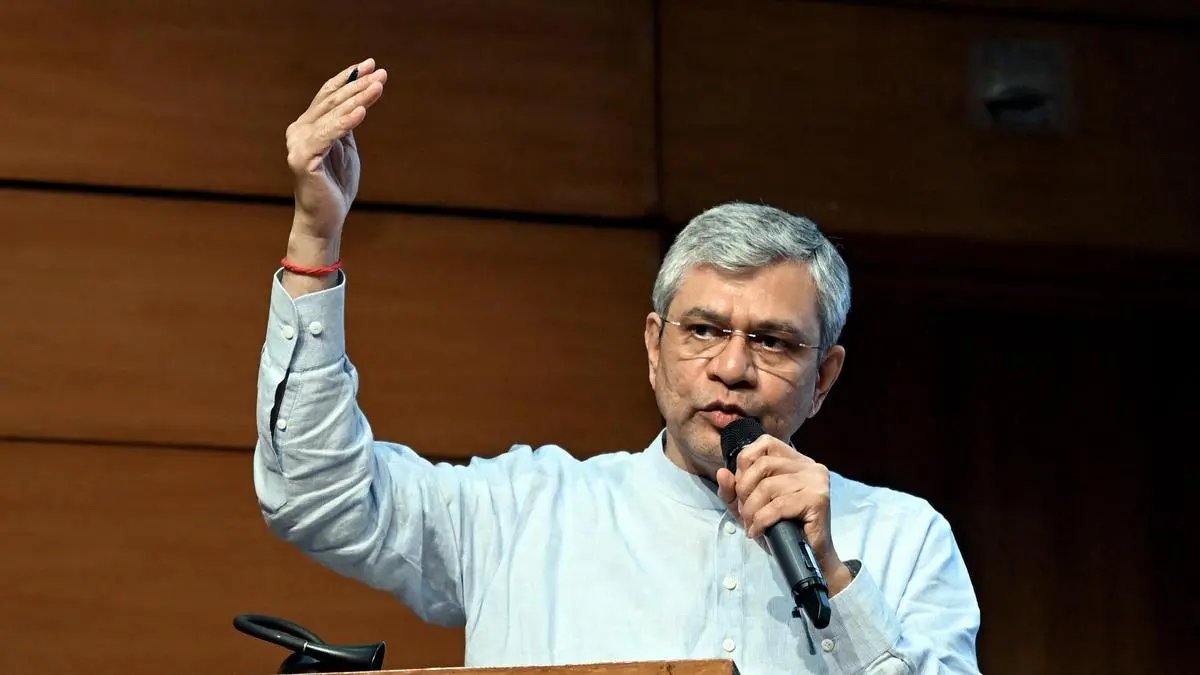
Union IT Minister Ashwini Vaishnaw | Photo Credit: ANI
A high-level inter-ministerial body, AI Governance and Economic Group, headed by Union IT Minister Ashwini Vaishnaw, has been constituted to steer the country's national AI governance strategy, an official statement said on Thursday.
AI Governance and Economic Group (AIGEG) will coordinate policy across ministries, departments and sectoral regulators and oversee cross-sectoral governance issues.
"The AIGEG will operate as the apex inter-ministerial body within India’s AI governance institutional framework. It will be supported by a Technology and Policy Expert Committee (TPEC), which will offer expert advisory to the AIGEG on global developments, emerging technologies, risks, regulation and other evolving priorities relating to AI policy and governance," the statement said.
The inter-ministerial body will be chaired by the union electronics and IT minister Ashwini Vaishnaw whose portfolio spans railways and Information and Broadcasting.
Minister of State for Electronics and IT Jitin Prasada will serve as vice chairperson of AIGEG. The membership brings together senior stakeholders from the government across policy development, science and technology, security and economic affairs.Besides several tasks for AI governance, AIGEG will assess the labour market impacts of AI adoption in advance, and develop mitigation strategies and transition plans that account for informality, skill diversity and regional variations.
AIGEG will work with industry and other stakeholders to develop a roadmap for Al deployment over the next decade, including assessment of job profiles affected, geographical concentration ofimpacts. and the extent of automation and augmentation.
It will classify AI use cases into categories such as "deploy", "pilot" and "defer" based on readiness in terms of data availability, skills, legal frameworks and capacity for labour adjustment.
AIGEG will review existing mechanisms and issue guidelines to ensure that firms are held accountable for compliance with local laws, oversee national initiatives on AI governance across the public and private sector, promote responsible AI innovation and beneficial deployment of AI in key sectors, study the emerging risks of AI, regulatory gaps and the need for legal amendments.
The terms of reference of AIGEG also include development and overseeing India's position and strategy on Al governance.
"The constitution of the AIGEG gives formal effect to institutional recommendations made in India’s AI Governance Guidelines and the Economic Survey," the statement said.
India's AI Governance Guidelines recommend the establishment of an inter-ministerial body to steer a whole-of-government approach to AI governance, with a view to aligning the actions of ministries, departments, regulators and advisory bodies around a coherent national strategy.
The Economic Survey had mentioned the need for a coordinating authority capable of aligning AI deployment with labour realities and social stability priorities.
Published on April 17, 2026
此内容由惯性聚合(RSS阅读器)自动聚合整理,仅供阅读参考。 原文来自 — 版权归原作者所有。