









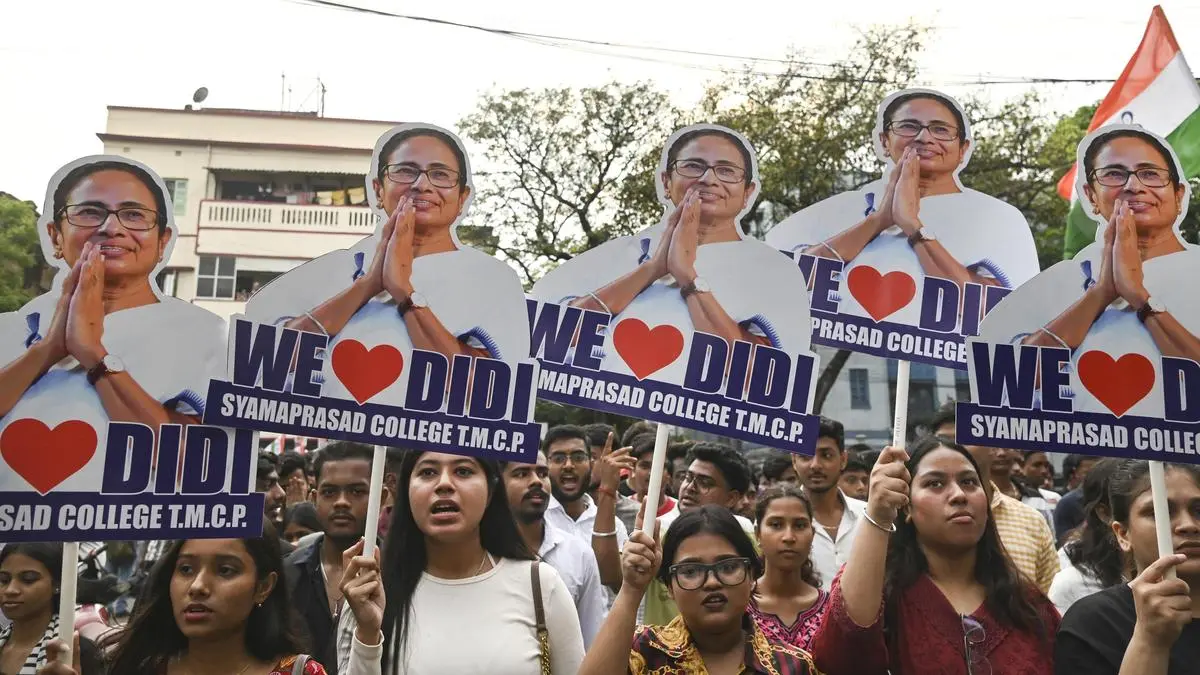
Trinamool Congress (TMC) supporters take part in a rally in support of West Bengal Chief Minister and the party's President Mamata Banerjee as part of an election campaign, ahead of the state Assembly elections, at Bhabanipur, in Kolkata, Thursday | Photo Credit: PTI
The Supreme Court has declared that electors purged from the voter list during the West Bengal Special Intensive Revision, but cleared by Appellate Tribunals by April 21 or April 27 should be allowed to vote in the Assembly polls.
The order by a Bench headed by Chief Justice of India Surya Kant spelt a huge reprieve for citizens whose right to vote was denied in the Special Intensive Revision (SIR) under the ‘logical discrepancy’ category. Over 34 lakh appeals were filed as on April 11.
The court, issuing directions in exercise of its extraordinary constitutional powers under Article 142, ordered the Election Commission to publish a “supplementary revised electoral roll” containing the names of those who won their appeals by April 21, ahead of the first phase of polling in West Bengal on April 23, or by April 27, prior to the second phase on April 29.
“Wherever the Appellate Tribunals are able to decide the appeals by April 21 or April 27, as the case may be, such appellate orders shall be given effect to by issuing a supplementary revised electoral roll, and all necessary consequences with respect to the right to vote shall follow. However, it goes without saying that the mere pendency of appeals preferred by excluded persons before the Appellate Tribunals shall not entitle them to exercise their right to vote,” the court ordered.
However, those whose appeals remain pending before the tribunals would not be allowed to vote. The order is dated April 13, but published on April 16.
On April 13, the court had orally observed that the right to be on the electoral roll and to vote in one’s own country was not only constitutional but sentimental.
It had referred to thousands of voters excluded for “logical discrepancies” and lined up for appeal hearings in West Bengal barely a few days ahead of the Assembly polls.
The court said not all of the 34 lakh and more appeals were filed by those excluded from the electoral roll. A substantial number of appeals were also filed by objectors aggrieved by several inclusions made in the revised electoral rolls.
“All such appeals are required to be adjudicated by the Appellate Tribunals,” the court noted.
The Bench noted that there was no reason why the orders of the Appellate Tribunals, whether of inclusion into or exclusion from the electoral roll, must not be effectuated before the State goes to poll on April 23 or April 29.
The apex court had ordered the constitution of the Appellate Tribunals on March 10, a direction which also made in exercise of its plenary powers under Article 142. The court had directed that the tribunals would be presided over by former Chief Justices and judges of the High Courts of Calcutta and neighbouring States.
The tribunals were intended to provide a mechanism of appeal for individuals whose claims for
inclusion in the electoral roll were rejected by the judicial officers in the objections phase of the SIR. The tribunals would also hear appeals against any inclusions in the electoral roll.
Though ordered to be constituted in early March, the tribunals had only commenced functioning from April 13.
Published on April 16, 2026
此内容由惯性聚合(RSS阅读器)自动聚合整理,仅供阅读参考。 原文来自 — 版权归原作者所有。