


惯性聚合 高效追踪和阅读你感兴趣的博客、新闻、科技资讯
阅读原文 在惯性聚合中打开

推荐订阅源

Microsoft Azure Blog
Engineering at Meta
Engineering at Meta
A
About on SuperTechFans
T
The Blog of Author Tim Ferriss
I
InfoQ
博客园_首页
G
Google Developers Blog
爱范儿
爱范儿
Last Week in AI
Last Week in AI
量子位
阮一峰的网络日志
阮一峰的网络日志
雷峰网
雷峰网
酷 壳 – CoolShell
酷 壳 – CoolShell
Vercel News
Vercel News
Cyber Security Advisories - MS-ISAC
GbyAI
GbyAI
月光博客
月光博客
The GitHub Blog
The GitHub Blog
V
Visual Studio Blog
N
Netflix TechBlog - Medium
freeCodeCamp Programming Tutorials: Python, JavaScript, Git & More
博客园 - 司徒正美
OSCHINA 社区最新新闻
OSCHINA 社区最新新闻
博客园 - 聂微东

Stock Market Today, Stock Market Live News Update | The HinduBusinessLine

GMDC shares surge 18% to 52-week high on heavy trading volumes HDBFS shares jump 12% post Q4 results, brokerages see steady growth Sensex, Nifty open higher on US-Iran peace deal hopes, lower oil Indian stocks heading for promising opening on Thursday 12 Stocks to watch: Tejas Networks, Rubicon, GHV Infra, Brigade, John Cockeril, Fino Payments Emerging markets investing legend Mark Mobius dies at 89 SEBI signs MoU with DoT to curb securities market fraud Goldman Sachs, Morgan Stanley buy Delhivery stake worth Rs 186 crore Gold surge lifts ETFs, jewellery stocks remain mixed Q4 Results Highlights Today: Elecon Engineering PAT declines, ICICI Lombard net profit rises 7%, HDB Financial shares gain ahead of Q4 results today, Reliance Industrial Infra, GTPL Hathway, Tejas Networks to announce Q4 results today, ICICI Prudential Life, Anand Rathi Share rise NSE active clients fall 7% to 4.57 crore in FY26 Datamatics powers Mumbai Metro Lines 2B & 9 with AFC, mobile ticketing Jewellery IPOs worth ₹3,840 crore delayed amid weak market sentiment India’s MTF book declines in March as market volatility hits leveraged trades 360 ONE Asset raises ₹2,000 crore for PIPE strategy targeting listed companies Asian stocks gain and oil falls on hopes of renewed US-Iran talks Stock markets shut for Ambedkar Jayanti; Sensex, Nifty 50 were down nearly 1% at close on Monday Just Dial Q4 profit falls 36% to ₹100 cr, revenue sees modest growth LIC board approves 1-for-1 bonus issue Jyoti CNC shares slump 15% after France probe into subsidiary Nifty slides 208 points as US-Iran talks collapse, crude tops $100 MFs invest more as market crash, cash holdings hit 16-month low Global downgrades unwind India’s premium, cap market upside ICICI Prudential AMC Q4 profit rises 10% to ₹763 crore, AUM up 25% Om Power Transmission IPO subscribed 3.33 times on final day Broker’s call: Anand Rathi Wealth (Neutral) Broker’s call: Paytm (Outperform) Pakistan Stock Exchange plunges 5,000 points after US-Iran talks fail Citius TransNet Investment Trust's ₹1,105-cr IPO to open on Apr 17 Dalal Street midday: Sensex, Nifty down nearly 1%, Reliance, Eicher among top laggards, auto, oil Stocks weigh
SEBI weighs uniform regime for options strike prices
2026-04-29 · via Stock Market Today, Stock Market Live News Update | The HinduBusinessLine
The move follows concerns around the way strike prices are currently introduced and managed, particularly during periods of sharp intraday price movement. 

The move follows concerns around the way strike prices are currently introduced and managed, particularly during periods of sharp intraday price movement.  | Photo Credit: ANI

The Securities and Exchange Board of India (SEBI) is evaluating a proposal to introduce a uniform framework for managing options strike prices, including the possibility of allowing exchanges to add new strikes during market hours, according to people aware of the discussions.

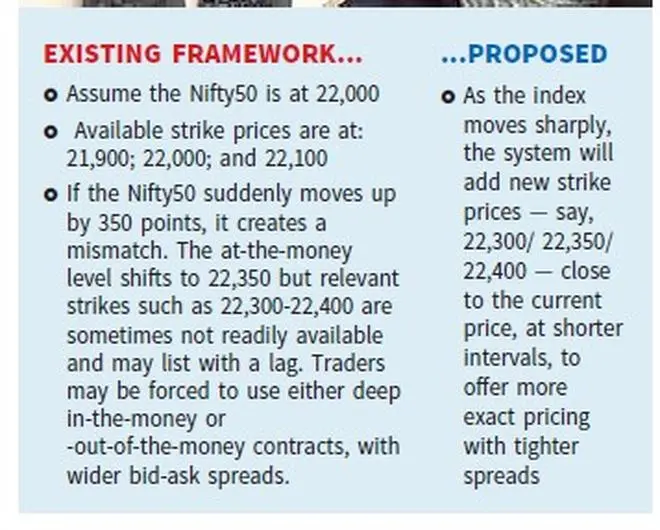
The move follows concerns around the way strike prices are currently introduced and managed, particularly during periods of sharp intraday price movement. The system is not always equipped to handle sudden price swings and the gap between available pre-defined strike prices and prevailing market prices may be too wide to allow efficient hedging. New strikes that are added are usually implemented with a lag.

A strike price is the fixed level at which an options contract can be exercised. The availability of a range of strikes and liquidity allows traders to take positions based on their market view or hedge existing exposures.

Uniform framework

The uniform framework may allow exchanges to introduce new strike prices during market hours, especially in the direction of sharp movements in the underlying asset. The idea is to not require any system modifications by brokers or market participants during live trading to avoid operational disruptions.

“Most of the time, especially around at-the-money (ATM) strikes, the market is fairly liquid and trades smoothly. But when the move is very sharp and sudden, prices can sometimes jump rather than move tick by tick,” said Feroze Azeez, Joint CEO at Anand Rathi Wealth.
“In those moments, you might see what traders casually call “phantom prices”, where the last traded price is visible, but execution at that exact level is not always possible,” he said.

During sharp intraday movements, trading interest typically shifts towards strike prices closer to the prevailing level of the underlying. However, the addition of such strikes may take time under existing mechanisms, even as a number of far-off strikes continue to remain listed, an exchange source said.

Strike prices

Market participants said that in most conditions, trading remains concentrated around actively used strike prices. “In such situations, if an out-of-the-money strike that fits the usual trading criterion is not available, traders typically shift to at-the-money or in-the-money options to ride the move,” said Anand James, Chief Market Strategist at Geojit Investments.

In fast markets, traders need to allow for some slippage or be ready to manage positions more actively rather than relying entirely on very tight stop losses.

At present, SEBI’s regulatory framework primarily covers long-dated index options, while other segments, including stock, currency and commodity options, follow exchange-specific practices, leading to differences in how strike prices are introduced and managed. An email sent to SEBI did not elicit a response.

While exchanges have their own rules for adding strike prices, the proposed framework will make it uniform across exchanges. It has been discussed with exchanges and intermediaries and will also be reviewed periodically through market participants, the source said.

Published on April 28, 2026