


惯性聚合 高效追踪和阅读你感兴趣的博客、新闻、科技资讯
阅读原文 在惯性聚合中打开

推荐订阅源

IT之家
IT之家
L
LangChain Blog
博客园 - 聂微东
奇客Solidot–传递最新科技情报
奇客Solidot–传递最新科技情报
GbyAI
GbyAI
博客园_首页
OSCHINA 社区最新新闻
OSCHINA 社区最新新闻
酷 壳 – CoolShell
酷 壳 – CoolShell
D
Docker
V
V2EX
月光博客
月光博客
Recent Commits to openclaw:main
S
SegmentFault 最新的问题
雷峰网
雷峰网
Stack Overflow Blog
Stack Overflow Blog
Cyberwarzone
Cyberwarzone
P
Privacy International News Feed
Spread Privacy
Spread Privacy
Project Zero
Project Zero
腾讯CDC
Engineering at Meta
Engineering at Meta
T
Tenable Blog
aimingoo的专栏
aimingoo的专栏
钛媒体:引领未来商业与生活新知
钛媒体:引领未来商业与生活新知
Jina AI
Jina AI
大猫的无限游戏
大猫的无限游戏
量子位
Blog — PlanetScale
Blog — PlanetScale
D
DataBreaches.Net
T
Troy Hunt's Blog
H
Hackread – Cybersecurity News, Data Breaches, AI and More
美团技术团队
N
News and Events Feed by Topic
T
Tor Project blog
H
Help Net Security
www.infosecurity-magazine.com
Last Week in AI
Last Week in AI
S
Security Affairs
小众软件
小众软件
Scott Helme
Scott Helme
云风的 BLOG
云风的 BLOG
Apple Machine Learning Research
Vercel News
Vercel News
人人都是产品经理
人人都是产品经理
PCI Perspectives
PCI Perspectives
TaoSecurity Blog
TaoSecurity Blog
博客园 - 叶小钗
V
Visual Studio Blog
The Cloudflare Blog
Recent Announcements

... eeNews Europe

Molex Teramount deal targets co-packaged optics NVIDIA and ServiceNow extend AI governance from desktops to data centres Faraday Future launches Physical AI robotics institute with BIBS SiTime targets AI data centers with sub-nanosecond timing chip System Check: Should engineers learn analog? Decoupled by Design: How Gateworks and NXP are rethinking edge AI architecture NVIDIA and Corning partner on AI photonics expansion GCT taps satellite partner to speed 5G rollout Sodankylä supersite to support ESA Earth observation SiTime posts 88% revenue growth on AI infrastructure demand Infrared LEDs support in-cabin sensing for vehicle safety Anthropic compute deal taps SpaceXAI Colossus 1 Quantum Brilliance CEO Mark Luo on deployable quantum systems and the future of diamond-based computing SEMI Summit spotlights Europe’s chiplet and packaging push AI data center infrastructure drives Pennsylvania energy expansion NXP CoreRide gains Vector software support for SDV platforms Elektor Lab Talk covers Red Pitaya and reconfigurable test gear SEMI names Julie Rogers to lead ESD Alliance ASML CEO backs joint call for Europe tech competitiveness push FlexIC RFID inlays bring NFC to paper packaging ROHM targets smart rings with ultra-compact NFC wireless power chipset China silicon wafers push boosts Eswin capacity ESD Alliance outlook spotlights agentic AI in chip design AI robotics sales growth rises as Faraday Future expands into education Microchip expands dsPIC33A controllers for AI data center power sensiBel MEMS microphone heads to Silex production SEMI: Global silicon wafer shipments jump 13% on AI demand AI drives photonics innovation Advantech adds Intel Core Series 3 to edge AI systems NI CHESS enables software-driven RF channel emulation into aerospace testing Forsee Power battery system powers new electric fire pump Advantech brings agentic AI to Jetson Thor edge platforms Rohde & Schwarz adds Pulsar signal simulation for LEO navigation UL Solutions builds new testing lab in Germany IonQ and Florida LambdaRail roll out US quantum-safe network initiative Tower Semiconductor and Axiro push high-efficiency SiGe for next-gen radar TSMC SoIC roadmap targets 2029 chip stacking Robotics development platform links EBV ecosystem for system design onsemi and Geely expand SiC collaboration for next-gen EV platforms Satellite connected cattle collars expand remote ranching SK hynix begins mass production of 192GB AI server memory 2Trust.AI and Carahsoft partner to scale AI governance for public sector Cerebras IPO filing revives AI chipmaker’s market push Omdia raises 2026 semiconductor forecast to 62.7% IQM to deploy Japan’s first enterprise quantum computer at TOYO TTM Technologies announces 2026 Investor Day event MATCH Act targets chip tool exports to China Musk teams with Intel for Terafab plans Siemens and TSMC expand AI-driven chip design collaboration Altilium EV battery recycling expands with new investment round Marvell acquires Polariton for optical scaling Credo to unveil AI interconnect solutions at TSMC 2026 Symposium Gartner projects IT spending at $6.31 Trillion in 2026 on AI surge Quectel expands IoT reach in Brazil with Vermont partnership Autonomous material handling stack links Thoro and Orbbec ROHM advances SiC MOSFETs for high-temperature power systems ST targets wide-voltage precision with new op amps NVIDIA and Google Cloud target physical AI factories OE-A publishes 10th edition of “Roadmap for Flexible and Printed Electronics” HCLTech FY26 revenue rises 3.9% as Advanced AI demand accelerates Infineon joins European quantum pilot lines for quantum chips Iran network backdoors claim hits Cisco, Juniper, Fortinet CVD Equipment advances SiC cystal growth with university collaboration EU unlocks €63M to accelerate AI in health and safety GTT targets AI networking growth with 2026 strategy Apple CEO transition as Tim Cook hands over to John Ternus Race Rock sign clamp gets TxDOT approval SEMI forum targets Europe’s semiconductor strategy Smartphone memory shortage to cut 2026 shipments: IDC Vector adds charging communication security tests to CANoe EV package Elektor to host EEI #59 on DIY synths and the Formant Nordic Semiconductor appoints Jo Uthus as EVP of Marketing and Developer Experience ADIOS first order tops $1 million as supply risks rise AMD partners with France to power AI research and exascale supercomputing EU updates tech licensing competition rules for the data era AECC rolls out data first architecture for automotive services Infineon rad-hard semiconductors validated in Artemis II mission Chinese chip tool makers hit record 2025 revenues UK experiment studies microgravity effects using worms on the ISS TSMC Q1 revenue tops $35.9bn on strong 3nm demand NVIDIA launches Ising AI models to accelerate quantum computing ASML reports €8.8bn Q1 revenue Zephyr RTOS 4.4 adds WireGuard, Wi-Fi Direct and OpenRISC Key quantum innovations covered by eeNews Europe MIT underwater robot teaming targets cable inspection Intel and Google expand AI infrastructure partnership SEALSQ and Kaynes advance India’s PQC chip hub Intel to reacquire 49% share of Ireland fab joint venture Intel names Aparna Bawa as Chief Legal & People Officer Stryten launches E-Series AGM batteries for telecom and utility reliability GaN gate drivers integrate protection for motion control and power systems System Check: are engineering certificates worth it? Pasqal partners with True Nexus on quantum food protein design Rigetti launches 108-qubit quantum system Undersea cable security drives UK warning to Russia The race to secure data Low-RDS(on) MOSFETs in automotive power systems SiFive funding backs datacentre CPU push Eclipse hawkBit 1.0 released for open-source IoT software updates Intel and SambaNova target agentic AI inference with Xeon 6
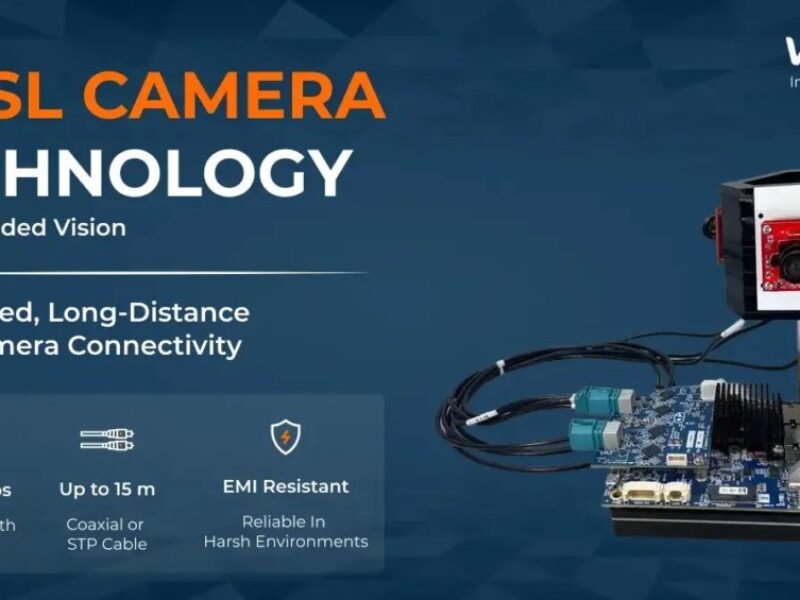
Vadzo publishes GMSL camera guide for embedded vision
2026-04-09 · via ... eeNews Europe

Vadzo publishes GMSL camera guide for embedded vision

News |

By Asma Adhimi


Vadzo Imaging has published a new technical guide explaining how GMSL (Gigabit Multimedia Serial Link) camera technology works and why it is increasingly used in embedded vision systems that require long-distance, high-bandwidth image transmission. The guide targets engineers designing systems where cameras must operate far from processors without compromising image integrity or latency.

For eeNews Europe readers working in automotive, robotics, industrial automation, and medical electronics, the topic is particularly relevant as embedded vision systems become more distributed and data-heavy. Understanding how to move uncompressed video reliably across longer cable runs is a growing challenge in system architecture.

Why GMSL matters in embedded vision

According to Vadzo Imaging, many engineers still choose camera interfaces primarily based on bandwidth, often overlooking other constraints such as cable length, electromagnetic interference (EMI), and latency requirements. Traditional interfaces each have limitations: MIPI CSI-2 works well in compact designs and USB typically performs best over distances under a meter.

GMSL was designed specifically for applications where the camera must sit several meters away from the processing unit. These situations occur frequently in vehicles, robotic systems, factory equipment, and medical devices. In these environments, reliable transmission of uncompressed video data over long cables becomes a critical system design factor.

The guide focuses on the SerDes (serializer/deserializer) architecture that underpins GMSL camera systems. On the camera side, a serializer converts parallel pixel data from the image sensor into a high-speed serial stream, reducing the number of wires required and enabling the signal to travel further without degradation. At the processor end, a deserializer reconstructs the data stream and applies error correction during transmission.

The resulting latency can be extremely low. In GMSL1 systems, typical end-to-end latency is under one microsecond, making the technology suitable for applications such as advanced driver-assistance systems (ADAS) and high-speed industrial inspection.

Cable design and signal integrity

Another section of the guide explores practical design considerations around cabling and connectors. Vadzo highlights the importance of selecting the correct cable type depending on the operating environment.

Coaxial cable provides strong EMI protection, and automotive systems widely use it where cameras operate near motors, ignition systems, and high-voltage power lines. Shielded twisted-pair (STP) cables offer a lighter and more flexible option in environments with moderate EMI exposure, such as medical equipment housings.

Connector termination is also a critical factor. Automotive deployments commonly use FAKRA or HSD connectors, and improper termination can cause signal reflections at high data rates. Even when the correct cable is selected, poor connector termination can still degrade image quality in production systems.

Evolution from GMSL to GMSL3

The guide also compares the three generations of the technology. GMSL1 supports data rates up to 3.125 Gbps, sufficient for 1080p60 uncompressed video. GMSL2 increases bandwidth to 6 Gbps and adds improved error correction and bidirectional data transmission over cable lengths of up to 15 meters.

The latest generation, GMSL3, pushes forward-channel bandwidth to 12 Gbps and enables aggregation of multiple 4K video streams over a single cable. This capability is increasingly relevant in autonomous vehicle perception systems and complex industrial machine vision installations, where reducing cable harness complexity can improve both reliability and cost.

Vadzo Imaging says the guide also outlines deployment scenarios across automotive ADAS, robotics, industrial automation, medical imaging, agriculture machinery, and multi-camera broadcasting setups. The company’s own GMSL camera portfolio supports both GMSL2 and GMSL3 interfaces and includes features such as Power over Coax, bidirectional control, and configurations designed for high-EMI environments.

If you enjoyed this article, you will like the following ones: don't miss them by subscribing to :

   eeNews on Google News


Linked Articles