




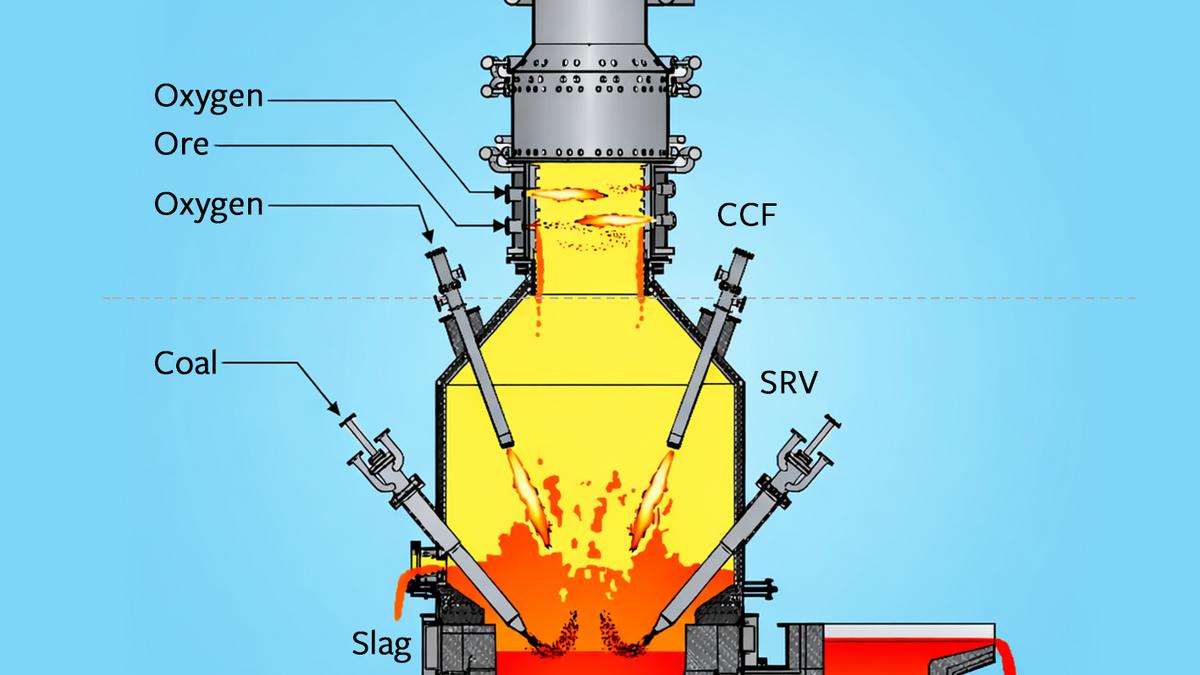
HIsarna furnace for steel making
It costs about a billion dollars (₹9,000 crore) to set up a steel plant with a capacity of one million tonnes. But Tata Steel is planning one at Jamshedpur for roughly ₹4,000 crore.
This is magic made possible by an entirely new steel-making process — HIsarna. Tata Steel had a big hand in its development and now owns the patent.
HIsarna has the potential to revolutionise steel making — once perfected in a commercial plant, it is expected to elbow out all other conventional methods of steel making, such as blast furnace or electric arc furnace.
Its advantages are striking. First, it eliminates two unavoidable steps in traditional steel-making processes — coke-making and the agglomeration of iron ore (into sinter or pellets). That alone knocks off chunks of capital cost. Second, HIsarna doesn’t care about ore quality — low-grade iron ore, abundantly available in eastern India, works just as well. Third, carbon dioxide emissions are estimated to be about 20 per cent lower than in a conventional plant of comparable size. Moreover, the carbon dioxide stream is relatively pure, making carbon capture easier and cheaper, without any need for separation from other flue gases.
How does HIsarna achieve this? The answer lies in its architecture.
Leaving aside the minutiae, the HIsarna furnace has two chambers, one above the other. Powdered iron ore is injected into the top chamber, where it spirals downward. The spiralling keeps it longer in the chamber, which is essential. The powder injection is also the technology’s biggest challenge: The iron ore particles must neither fly out nor fall straight through.
Non-coking coal is injected into the lower, smelting vessel. Oxygen is introduced at multiple points. The coal reacts with oxygen to produce carbon monoxide (CO), which rises to the top chamber. There it meets oxygen again, burns into carbon dioxide, and releases intense heat. This heat melts the ore, which then drips into the lower chamber.
Iron ore (ferric oxide or Fe₂O₃) must be reduced — its oxygen removed — to yield iron. In HIsarna, this happens in two stages. In the upper chamber, ferric oxide is partly reduced to ferrous oxide (FeO) as it encounters the rising CO and injected oxygen; the heat generated also melts the ore. The molten ferrous oxide then falls into the lower chamber, where it reacts with the carbon in coal. The oxygen bonds with carbon, leaving behind molten iron. The outputs are liquid iron and a relatively pure stream of carbon dioxide.
The process can use low-grade ore, which would otherwise be discarded. The plant footprint is about half that of a comparable blast furnace setup. The slag can go straight into a cement kiln, unlike the steel-making slag. Taken together, these factors could lower operating costs by around 10 per cent, according to Subodh Pandey, Vice-President (Technology, R&D, NMB and Graphene) at Tata Steel. The HIsarna plant in Jamshedpur is expected to go on stream by 2030.
How did Tata Steel get here? “Perseverance,” says Pandey — and there’s a story behind that.
The idea of a new steel-making route was first pursued in Europe under the Ultra-Low CO₂ Steelmaking (ULCOS) initiative, a consortium of 48 companies. One of them was Koninklijke Hoogovens, which later merged with British Steel to form Corus Group and was acquired by Tata Steel in 2007.
The construction of a pilot plant in the Netherlands began in 2010, followed by years of trials. Rio Tinto, the British-Australian mining major, joined in 2011, bringing its HIsmelt technology (the bottom chamber). Tata Steel acquired the technology from Rio Tinto in 2017.
Initially, there were many setbacks — refractories failed, operations proved unstable — and most partners lost interest. In 2021, Tata Steel, along with US company Nucor, revived the effort with new operating protocols. The results improved. “We have reached higher operating capacity than originally planned: 14 tonnes of ore per hour against 12 tonnes,” Pandey says.
Perseverance paid off for Tata Steel — in results and in patents. For Nucor, which largely produces steel from scrap, HIsarna offers a route to higher-end products that are not easily made via scrap. Nucor holds rights to build a HIsarna plant in the US, subject to a licence fee — and intends to do so.
Published on April 20, 2026
此内容由惯性聚合(RSS阅读器)自动聚合整理,仅供阅读参考。 原文来自 — 版权归原作者所有。