






Serving tech enthusiasts for over 25 years.
TechSpot means tech analysis and advice you can trust.
Looking ahead: The idea of a car that appears to swallow light rather than reflect it has lingered on the fringes of materials science for years. Now, a group of researchers says it has taken a step toward that goal with a new composite coating that combines extreme light absorption with practical durability.
A team at Nipsea Group, working through its Color Technology and core R&D unit in Shanghai, has developed what it describes as an "ultra-black coating" capable of absorbing roughly 99.9% of visible light. The material is clearly inspired by Vantablack, the carbon nanotube coating that makes objects look almost flat and featureless.
That visual effect has been demonstrated before, most notably when BMW applied Vantablack to a 2019 X6 concept vehicle. The automaker said at the time that "a surface coated in Vantablack loses its defining features to the human eye, with objects appearing two-dimensional," adding that the effect "can be interpreted by the brain as staring into a hole or even a void."
Despite the attention, coatings like Vantablack have remained impractical for production vehicles, in part because of problems with adhesion, durability, and the difficulty of scaling up production.
The Nipsea team is trying to get around those limitations by changing how the material is structured, instead of relying only on pure carbon nanotube arrays. Their approach combines carbon black with carbon nanotubes, taking advantage of a natural pi-interaction between the two. That interaction helps the particles line up into a connected structure that traps light more effectively.
In a paper in Matter & Light, the researchers describe the material as having a "unique structural light-trapping morphology," and say it absorbs more light than a standard carbon black coating. Instead of reflecting light off a surface, the structure repeatedly scatters and absorbs it within the coating.
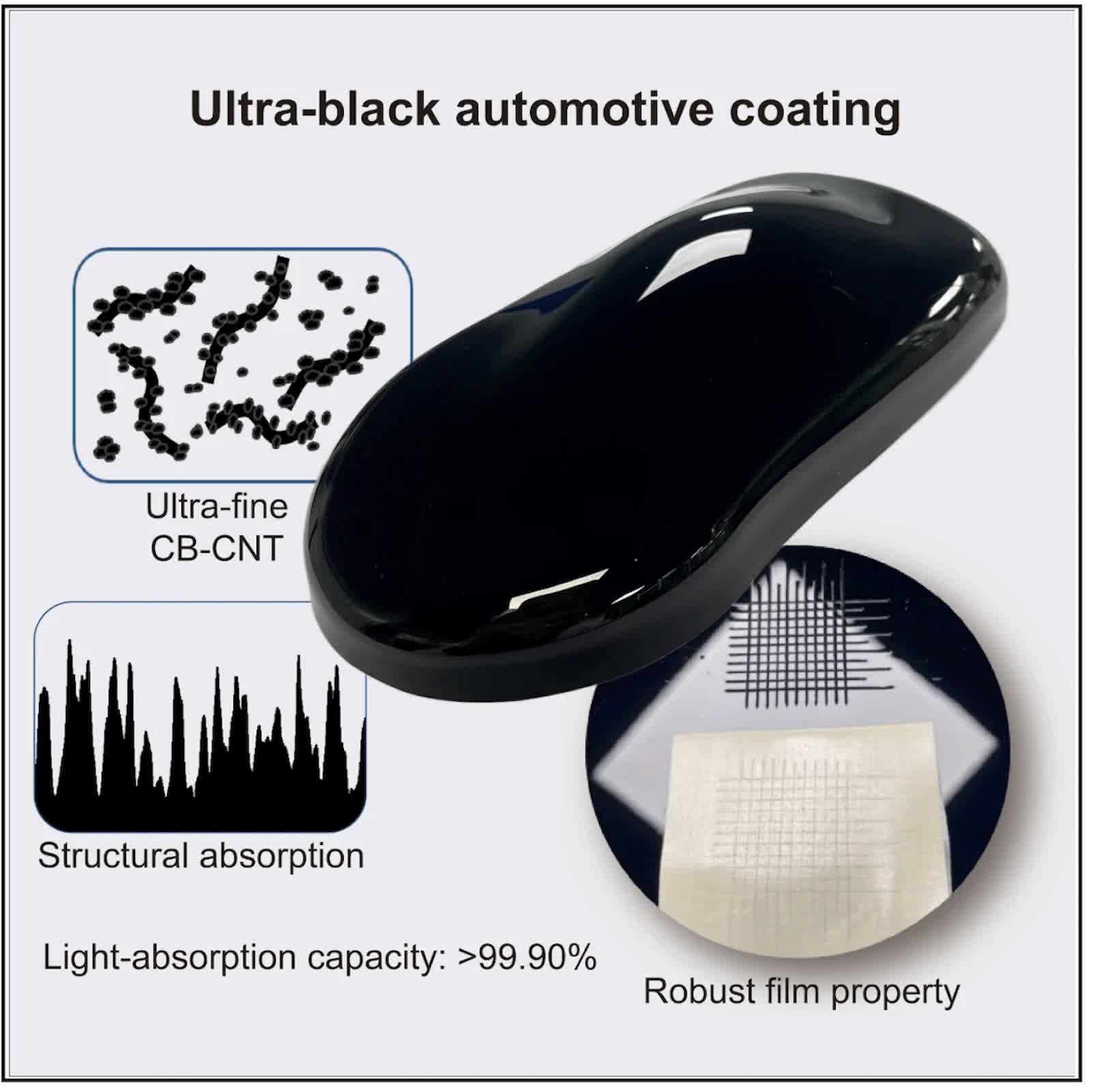
In terms of performance, the material approaches the optical characteristics of more specialized nanotube systems. The researchers note that vertically aligned carbon nanotube arrays can achieve reflectance as low as 0.04%, with Vantablack at about 0.05%.
Their composite coating measures around 0.08% reflectance across the visible spectrum. The reflectance is higher, but the tradeoff is better stability and more practical use.
Durability has been a persistent issue with nanotube-heavy coatings, particularly when it comes to adhesion and environmental resistance. To test those factors, the team exposed coated panels to prolonged heat and moisture. One sample sat in a 40°C water bath for 10 days, while another was subjected to 95% humidity for two weeks. According to the researchers, the coated panels showed "no significant visual paint defects" and passed a standard adhesion test.
There is also the question of how such a coating would function on an actual vehicle. Ultra-black surfaces can obscure contours and design details to the point where objects lose visual depth, something BMW acknowledged when it said the effect can "blot out virtually all the design details and highlights." That has implications not just for styling, but potentially for visibility.
To address that, the Nipsea team added a glossy overcoat in its automotive tests. The goal was to reintroduce enough reflectivity to preserve the perception of shape, while maintaining most of the underlying light-absorbing properties.
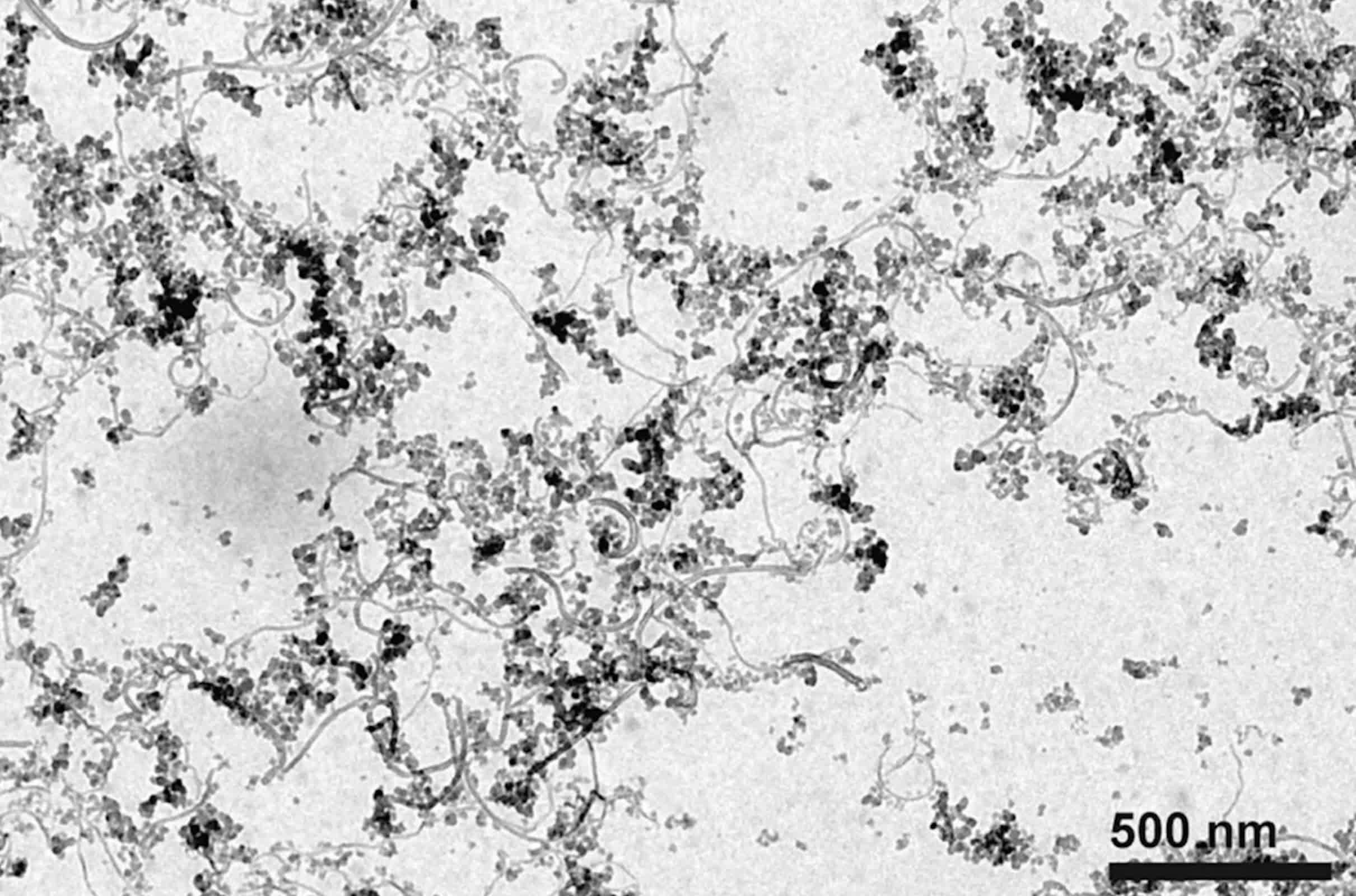
A transmission electron microscopy image shows the carbon black and carbon nanotube paint mixture that creates the ultra-dark, "optical black hole" effect
The commercial angle is tied to demand in the luxury segment, particularly in China. "In China, car color has become a key selling point," said Nipsea research chemist Zhiwei Liu. "Deep black finishes have long been the premium choice and signature color for luxury cars due to their elegant appearance, powerful visual impact, and luxurious undertone."
Even with those advances, the coating is not ready for production. Scaling nanomaterial-based systems remains a challenge, especially when consistency and cost come into play. "[There] is still room for improvements in practical processability of carbon-nanotube-containing nanomaterials," Liu said.
For now, the work signals incremental progress rather than a near-term product. It points to a shift from ultra-black coatings as lab curiosities toward materials that can actually survive in everyday use.
此内容由惯性聚合(RSS阅读器)自动聚合整理,仅供阅读参考。 原文来自 — 版权归原作者所有。