







AI agents have made their way into virtually every layer of your environment. They run in the apps your employees adopt, on the endpoints where agents execute code, as users with access privileges those agents borrow, and in the cloud workloads that scale them. The platform that you trust to secure your endpoints is already already covering where AI operates today.
Here is the through-line that makes this one problem instead of four. Every AI attack starts as an interaction and ends as an action. A prompt gets manipulated, an agent gets tricked, and the damage lands on a host, reaches into an identity, or moves through the cloud. The tools that treat each surface as a separate product hand you fragments. SentinelOne treats them as one chain.
Employee AI use is where the risk quietly enters. Your people are already using AI tools you never sanctioned, through browser, IDE, and API-connected apps and agentic AI tools. SentinelOne discovers that shadow AI use across browsers, IDEs, and copilots, highlights which tools and models are in play and governs it with policy. It keeps confidential data, PII, and secrets from reaching untrusted models, and it stops prompt injection and jailbreaks aimed at the tools you build. Legacy DLP reads patterns; this reads context, which is the only way to catch an attack aimed at AI systems that behave in a non-deterministic way.
The agent layer is where AI stops advising and starts acting. An employee’s prompt sends text. An agent sends commands, holds credentials, calls APIs, and chain actions without a human approving each step. That makes them non-human identities with standing access. SentinelOne governs that access. It inventories the agents and MCP servers already operating and scores what each one can reach and holds every agent to the privileges its task requires. Then it inspects the tool calls themselves, so an injected instruction gets blocked at the moment it would execute. What gets executed lands in a searchable record, and the same enforcement doubles as a kill switch.
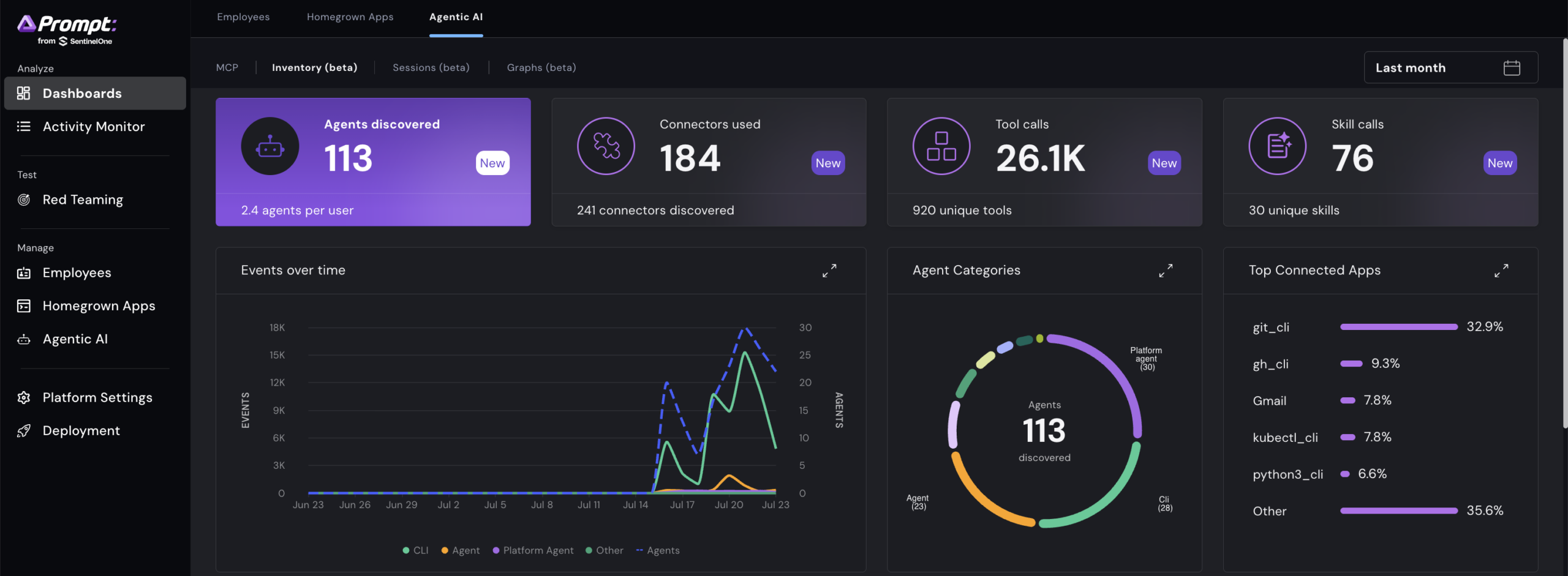
While governance decides what an agent is allowed to do, the endpoint is where you find out what it actually did.
The endpoint is where agents execute. This is the frontier, and where SentinelOne has protected customers for over a decade. Our behavioral engine judges what a process does, not what it claims to be. That is how we caught QUIETVAULT – malware that spins up AI agents in “yolo” mode to exfiltrate secrets to GitHub. It is how we autonomously stopped the LiteLLM supply chain attack, where adversaries weaponized the Claude CLI to install a malicious payload. It is how we surfaced a DLL side-loading attack hidden inside an AI tool installer. Real detections, on the endpoint, today. Agents run on the host, and so do we.
The identity is where a hijacked agent runs next. Picture an employee’s AI coding agent that gets hijacked mid-task. It spawns a shell and reaches for cached credentials and cloud session tokens, trying to stop being a process and start being the user. That pivot to identity is what unlocks lateral movement, and it is where most AI attacks are headed. SentinelOne meets the move. It secures human and non-human identities alike, and seeds the environment with decoy credentials and honeytokens no legitimate user ever touches. The instant the hijacked agent grabs one, the trap trips, and Identity responds by forcing an MFA re-challenge, disabling the account, or isolating the host. Authorization at login is not enough. Access gets validated against behavior and pulled at runtime.
The cloud is where AI workloads scale. Consider an internal AI agent running in a Kubernetes cluster with standing access to a customer database. Security teams keep asking the same question about deployments like this. Where is the model connecting, and who is it talking to? SentinelOne answers with eBPF-native runtime protection that judges how the workload actually behaves, and flags the moment that inference service reaches an endpoint it has never touched before. It covers the control plane the deployment depends on, the secrets it reads, the pipelines it runs through, and the data it can access. Defending the AI you build takes more than watching it, it takes action on the workload in real time.
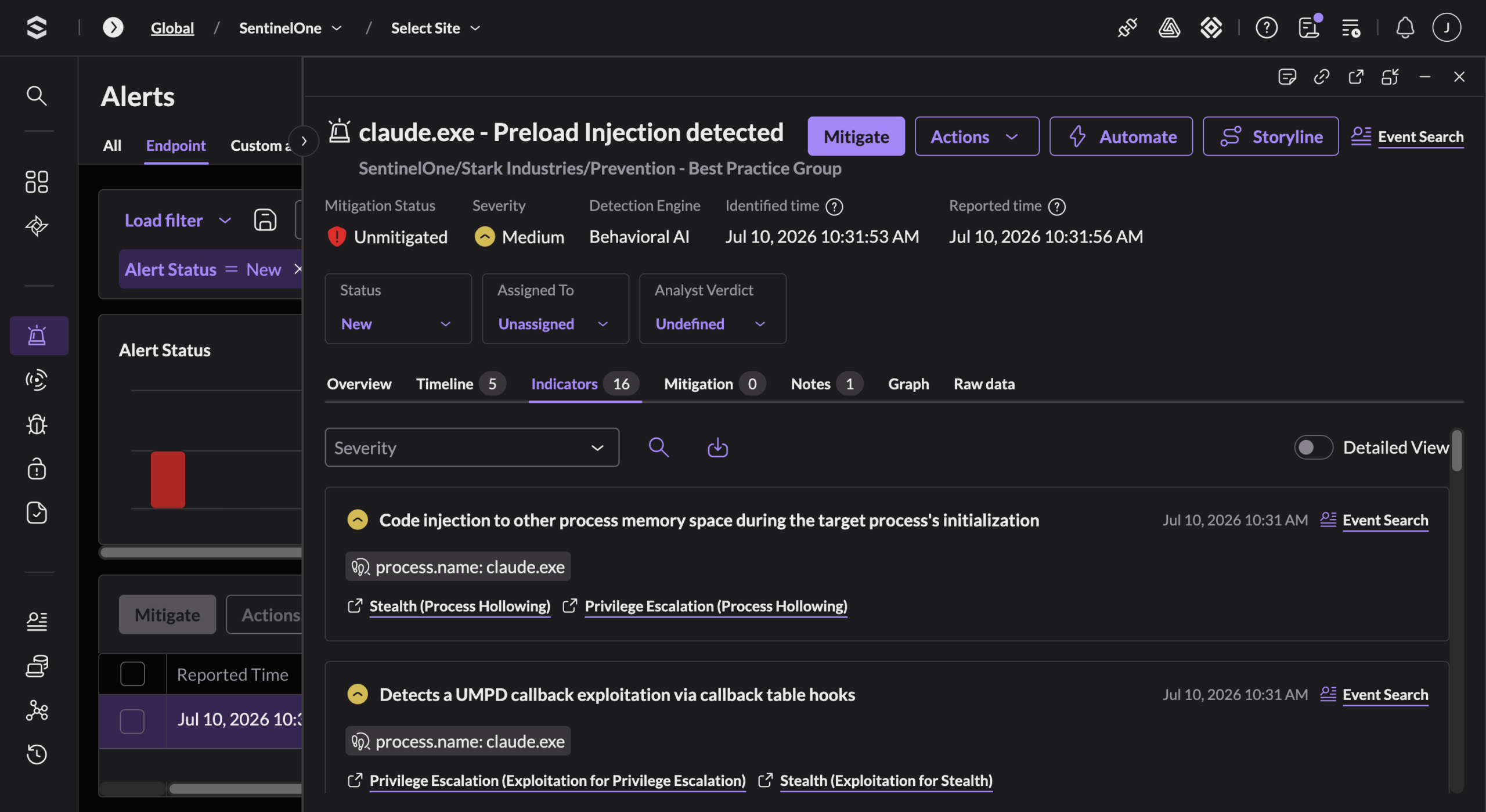
Each of these surfaces matters on its own. What closes the kill chain is following an attack across them without losing it at the handoff. This is where a single platform earns its keep. AI telemetry already streams into the Singularity™ Data Lake, alongside the endpoint data the platform has correlated for years. As identity and cloud signals join that same view, an analyst follows one attack from first prompt to final action, without stitching logs across six tools at two in the morning. A manipulated prompt, the process it spawns, the credential it reaches for, and the cloud resource it targets read as one story rather than six disconnected alerts.
Detection that only watches is observation. Runtime action is protection. When the Singularity Platform acts, autonomous response blocks the execution, rolls back the change, and revokes the access at the point of impact, without a human relaying orders between consoles. This is the difference between whether an attack is stopped or just gets logged.
That is the case for securing AI inside a platform built for autonomous runtime response. We are not adding a console to chase AI, we are extending the one already deployed where your agents run.
When evaluating AI security, ask yourself three things.
SentinelOne protects the surfaces where AI runs today. This includes the apps your employees use, the agents they deploy, the endpoints where agents execute, the identities they borrow, and the cloud where they scale. One platform, built for autonomous response. While AI has changed the attack, it does not have to change your architecture.
See it for yourself. Talk to our team about securing AI across your endpoints, identities, cloud, and the AI apps your employees already use, all from the platform you run today. Contact SentinelOne today.
Third-Party Trademark Disclaimer:
All third-party product names, logos, and brands mentioned in this publication are the property of their respective owners and are for identification purposes only. Use of these names, logos, and brands does not imply affiliation, endorsement, sponsorship, or association with the third-party.
此内容由惯性聚合(RSS阅读器)自动聚合整理,仅供阅读参考。 原文来自 — 版权归原作者所有。