









A guest post by rhodey on 26 Mar 2013
Spring Break Of Code, Day Two
“I am torn on how best to introduce myself out of context like this, the idea of rattling off facts from my resume is my first instinct, but that seems terribly conventional. With the goal of introducing myself and the entirety of my character, my second (highly unconventional) instinct is to link you to my online dating profile with the prayer that such an action would be taken in the desired context. Through my indecision I hope to explain who I am and why I would like to travel across the country to be involved with the Institute for Disruptive Studies. So here goes…”
Looking back, the message reads a bit formal and robotic, but it caught the attention of the Institute for Disruptive Studies nonetheless; specifically Moxie’s. I went on to disclose my OkCupid profile, here however I will not be so bold.
A couple months passed with sparse contact throughout, until the announcing of Whisper System’s Spring Break of Code. I’d had more than enough of the Vermont Winter, incompetent college administrators, and silent, eventless nights, so in undeniable desperation I sent in my application. Applicants were asked to submit a proposal describing the work they’d be doing while in Maui, my idea was something along the lines of GeoFencing.
I arrived at our beach house in Maui around 4:00PM and was almost immediately forced into work on my GeoFencing application.
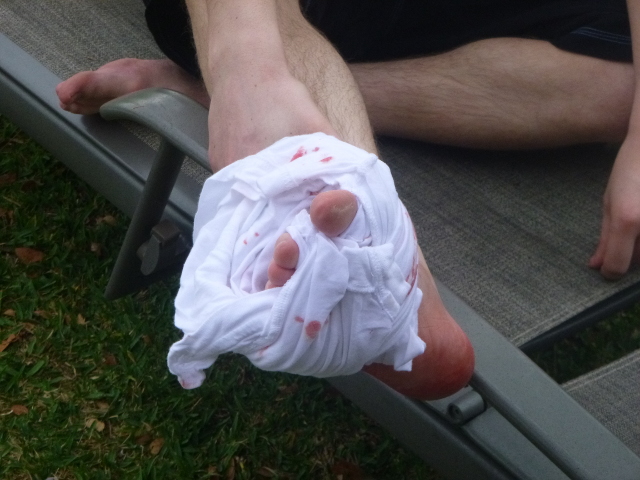 Amateur surfing at low tide.
With my right foot and left hand out of commission there wasn’t much (anything) to do other than familiarize myself with the Android development environment and mend my wounds. With future scale in mind, I quickly discovered a brand-new class of databases, Spatial Databases–databases optimized to store and query data related to objects in space, including points, lines and polygons (Wikipedia). Given Android’s default database implementation of SQLite, and SpatiaLite’s turn-key Android support, implementing SpatiaLite was an easy choice.
Eventually I’d like to switch to Open Street Maps, but for now at least, in my lacking Android experience I’m developing on the Google Maps Android V2 API. The basic idea of my SBoC proposal was to define environments as “trusted” or “hostile” and have client phones react accordingly. For example, a phone inside a police station may wipe its call and message history, and then, using its microphone, begin espionage.
 Relaxing inside the (presumably) trusted hammock polygon.
It took me awhile to discover Action Bar Sherlock, and awhile more to switch out my hacked-together fragment layout. In the end though, there really isn’t any better path to take. Now, with my 90% complete UI, what’s left is to implement a couple POC actions and trigger them on the enter or exit of polygons. Oh, and wait for this super glue on my foot to scab off and hopefully give way to sealed skin.
Lahaina, Maui, Hawaii, United States
25 March 2013
此内容由惯性聚合(RSS阅读器)自动聚合整理,仅供阅读参考。 原文来自 — 版权归原作者所有。
