

惯性聚合 高效追踪和阅读你感兴趣的博客、新闻、科技资讯
阅读原文 在惯性聚合中打开

推荐订阅源

S
Security Affairs
freeCodeCamp Programming Tutorials: Python, JavaScript, Git & More
CTFtime.org: upcoming CTF events
Jina AI
Jina AI
P
Palo Alto Networks Blog
GbyAI
GbyAI
大猫的无限游戏
大猫的无限游戏
A
Arctic Wolf
Hugging Face - Blog
Hugging Face - Blog
小众软件
小众软件
Y
Y Combinator Blog
T
The Blog of Author Tim Ferriss
Blog — PlanetScale
Blog — PlanetScale
S
Schneier on Security
V
Vulnerabilities – Threatpost
C
Cybersecurity and Infrastructure Security Agency CISA
雷峰网
雷峰网
T
Tenable Blog
人人都是产品经理
人人都是产品经理
T
Tor Project blog
C
Cyber Attacks, Cyber Crime and Cyber Security
AWS News Blog
AWS News Blog
Microsoft Security Blog
J
Java Code Geeks
Scott Helme
Scott Helme
SecWiki News
SecWiki News
C
CERT Recently Published Vulnerability Notes
Recorded Future
Recorded Future
I
InfoQ
Security Archives - TechRepublic
Help Net Security
Help Net Security
Cloudbric
Cloudbric
C
Check Point Blog
Engineering at Meta
Engineering at Meta
TaoSecurity Blog
TaoSecurity Blog
B
Blog
Cyber Security Advisories - MS-ISAC
博客园_首页
N
News and Events Feed by Topic
云风的 BLOG
云风的 BLOG
MyScale Blog
MyScale Blog
腾讯CDC
量子位
Application and Cybersecurity Blog
K
Kaspersky official blog
Vercel News
Vercel News
F
Full Disclosure
T
Troy Hunt's Blog
Forbes - Security
Forbes - Security
S
Security @ Cisco Blogs

博客园 - 阿飞外传

ruby-core 简单rails开发环境 关于MDA的长期等待 graduated 语言内实例表示机制 类型信息隐藏 MOF自描述 图模式-续 符号软件工程(SSE) next MDA? Algebra operator declaration 's UML profile 应用元建模读书笔记 再谈实例化和图转换 EclipseUML2.0::Class的接口 主题与模型 MDA轮廓 UML::Element的代数规范 UML::InstanceValue是元类吗 MDA is a big reflection i need a job CGN的IP之父访谈的两句话 A sample of writing a loop in Action Semantic codes
Is MOF the kernel language of MDA langs family
阿飞外传 · 2005-08-21 · via 博客园 - 阿飞外传

Fig.2.4 shows a segment extracted from the book Concepts, Techniques, and Models of Computer Programming(ctmCP)
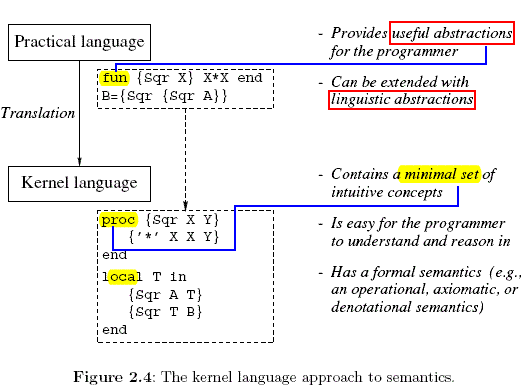
To seperate the Practical lang (P, PL) from the Kernel lang (K, KL),  we can use a namespace liked mechanism to rewrite the PL prog as follows:  
P::fun K::{ P::Sqr P::X K::} P::X K::* P::X K::end
P::B K::= K::{ P::Sqr K::{ P::Sqr P::A K::} K::}

Above shows that the constructions of KL can be  reused in a PL prog.
 
if PL is UML and KL is MOF:

1) how are MOF first-class concepts reused in UML, is an instance of MOF subset of an instance of UML?

2) how is an instance of UML translated into an instance of MOF?

3) how is an instance of MOF running and the result is still an instance of MOF?

4) if HUTN is a text lang for MOF, how is a HUTN prog running and the result can still  be described by HUTN?

Although the second question is partially solved by UML2MOF(a sub-tool of MDR), but i think the new abstractions of UML, such as Action, Message, Event are thrown away by UML2MOF.  That is to say that NO MOF first-class concepts are corresponding to them, such as the translation from an instance of UML::Message to an instance of MOF::Class will lose the meaning of UML::Message. This is key problem of MDA langs family.

This also give us a  tip: using what formalism (MOF,UML,CWM) to describe a grammar of a target lang is NOT the key concern, we can use any metamodel to describe the grammar, but can we give the real meaning to the target lang?