
惯性聚合 高效追踪和阅读你感兴趣的博客、新闻、科技资讯
阅读原文 在惯性聚合中打开

推荐订阅源

让小产品的独立变现更简单 - ezindie.com
MyScale Blog
MyScale Blog
U
Unit 42
M
MIT News - Artificial intelligence
小众软件
小众软件
P
Proofpoint News Feed
雷峰网
雷峰网
L
LangChain Blog
S
SegmentFault 最新的问题
腾讯CDC
F
Fortinet All Blogs
A
About on SuperTechFans
WordPress大学
WordPress大学
Vercel News
Vercel News
奇客Solidot–传递最新科技情报
奇客Solidot–传递最新科技情报
G
Google Developers Blog
大猫的无限游戏
大猫的无限游戏
OSCHINA 社区最新新闻
OSCHINA 社区最新新闻
D
Docker
N
Netflix TechBlog - Medium
Apple Machine Learning Research
Recent Announcements
D
DataBreaches.Net
Stack Overflow Blog
Stack Overflow Blog

Futurism

It's Looking Like Tesla's Cybercab Might Actually Be Illegal to Sell Cybercabs Are Taking Psychotic Routes That Turn Tiny Trips Around the Neighborhood Into Hour-Long Nightmares Tesla Investors Disturbed by Cybercab's Obvious Lack of Progress Oops! Many Tesla Cybercabs Actually Do Have Steering Wheels, Undercutting a Core Promise Lawyers Already Lining Up to Defend Victims of Cybercab Crashes Deranged Stalker Seizes Control of Woman's Tesla Software to Terrorize Her While Driving There's a Huge Economic Problem With Tesla's Cybercabs Tesla's Glitchy Cybercab Accidentally Lets Passengers Access Controls to Manually Drive the Car Using Virtual Joystick on In-Vehicle Screen Amazon Cargo Jet Crashes Just Feet From Parking Lot Full of Tesla Cybercabs, Killing Five It Turns Out That Drivers Absolutely Detest Those Giant Touchscreens They Put in Cars Now The People Maintaining Waymo's Self-Driving Cars Are Being Treated Horribly, Insider Claims Uber Abruptly Ends Operations in Africa, Abandoning Drivers and Riders Mid-Trip Tesla Driver Killed After Self-Driving Mode Stops in the Middle of a Highway Researchers Alarmed as GPS Readings Suddenly Veer Off by 33 Feet, Enough to Crash Self-Driving Cars Airline Defends Decision to Fly Two Full Sized Passenger Jets So Close to a Packed Stadium That They Nearly Grazed the Roof Uber Drivers Say Waymo Robotaxis Are Driving Down Their Pay Tesla "Ambassador" Melts Down Over "Horrible" Robotaxi Ride, Says He Had to Call an Uber After Total Self-Driving Failure Teslas Are Still Driving Into Oncoming Freight Trains Former Lyft Drivers Now Doing Menial Tasks for Their Waymo Overlords China Recalls Nearly Three Million Teslas Over Unsafe Door Handles Tesla Is Giving Up on Solar Roof Tiles as Elon Musk Leans Into Fossil Fuels Paramedics Now Rolling Up to Medical Emergencies in Flying Hovercraft Government Spending on Mass Transit Would Be Incredible for Small Towns, Study Finds Tesla Robotaxi With No Driver Spotted Smashing Through Traffic Barriers AI Billionaires Are So Greedy That They're Supercharging Sales of Yachts and Private Jets Hackers Created a Device That Can Take Over a Boeing 737 Jet's Autopilot Without Anyone Noticing Driver Pulls Up Directly to Firehouse When His Tesla Inexplicably Bursts Into Flames Transportation Secretary Announces That the Air Traffic Controller Crisis Is History Now That He's Hired Thousands of Epic Gamers Flock's Secret Surveillance Plan Will Make You Gasp Tesla Explosion Sends Injured Firefighters to the Hospital
There's Pretty Much No Good Way to Fight an Electric Vehi...
Joe Wilkins · 2026-08-17 · via Futurism

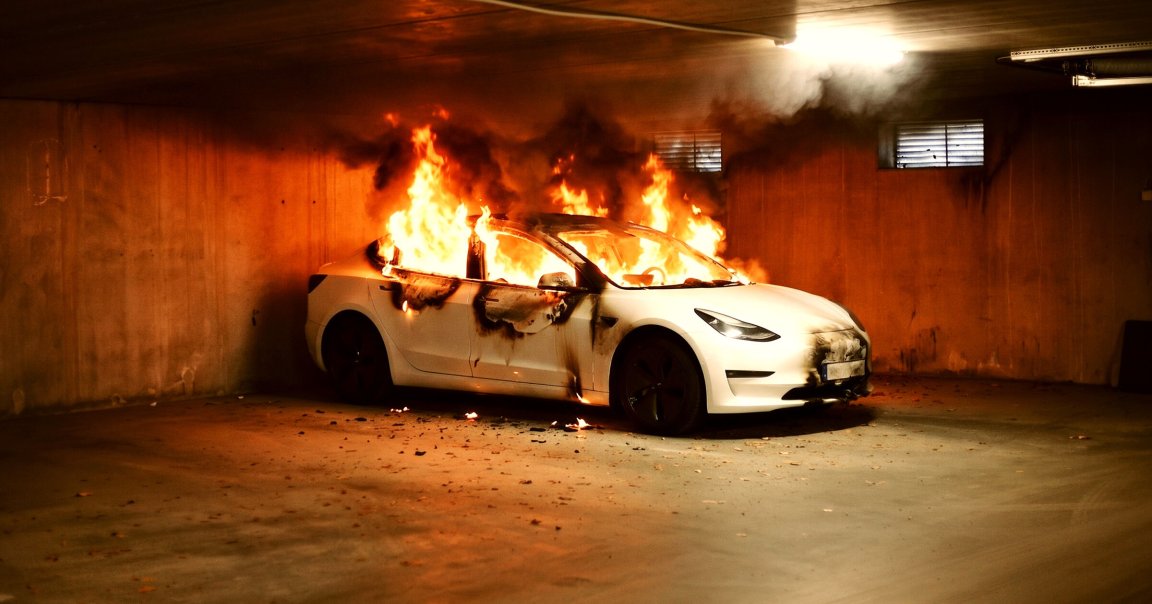
A photo showing an EV on fire inside a parking garage.

Shutterstock / Futurism

Sign up to see the future, today

Can’t-miss innovations from the bleeding edge of science and tech

Electric vehicles offer plenty of benefits. There’s the instant torque, savings on fuel — and, of course, they’re much kinder to mother Earth.

Yet compared to vehicles powered by internal combustion engines, EVs come with a key disadvantage drivers hope they never have to experience: they’re much more dangerous when they catch on fire. (An important caveat, though, is that they catch on fire less often than gas-powered vehicles.)

When they go up in flames, the lithium-ion batteries in EVs are much more difficult for emergency responders to extinguish than standard combustion engines. That’s thanks to a phenomenon known as thermal runaway, basically an accelerating chain reaction fueled by the chemicals found in their cells.

As EVs have exploded in popularity over the last decade, fire fighters have tried all sorts of tactics to control thermal runaway in lithium-ion cells, from hulking submersion containers to chemical mixtures in water to massive wet blankets.

Yet one exhaustive study finds that, for all the experimenting, there really is no better way to extinguish a burning EV than the tried-and-true firehose.

The report, conducted by the UL Research Institutes’ Fire Safety Research Institute, analyzed some 18 experimental burns, nine of which were treated with various suppression tactics. While the 150-page report has plenty of insights about EV fires, its core finding is that innovations like vehicle blankets and chemical additives are no match for the quenching power of thousands of gallons of water.

That’s not to say that a straight-on hose attack is a fantastic choice to fight EV fires, however, but rather the best of a set of weak options. Basically, once thermal runaway kicks off — usually the result of overheating, punctures, or overcharging — water becomes a means to control flames, but is powerless to stop the combustion process itself.

As the report authors write, “applying copious amounts of water to the battery enclosure is wasteful and will not stop thermal runaway.”

And though water is the best tool we know of at this point, its use may inadvertently cause un-ignited cells to erupt. “Likewise, introducing water into an uninvolved battery may increase (re-)ignition risk,” the report explains.

Unfortunately, that means incidents like the 2024 Tesla Semi fire — where firefighters closed a freeway for 15 hours, using 50,000 gallons of water to quell the horrific blaze — are really a best case scenario, at least for the foreseeable future.

More on EVs: You’ll Gasp When You Hear How Many Chinese EVs You Can Buy For the Price of a Single US Car