








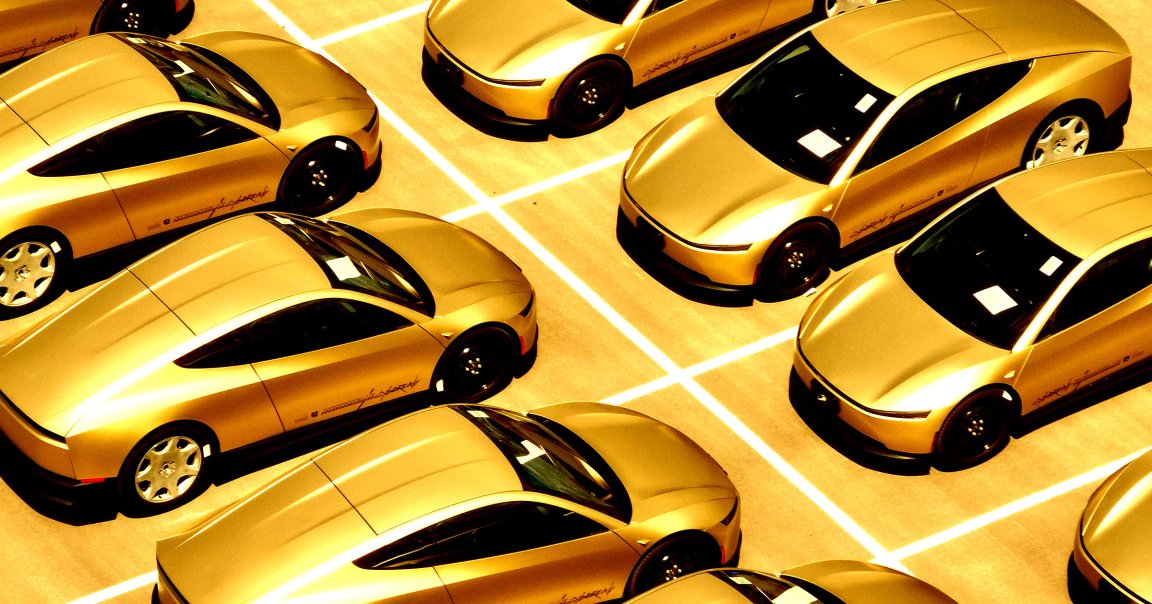
Tesla’s flashy unveiling of its Cybercab robotaxi in 2024 left some glaring questions unanswered.
The sleek, gold-colored coupé impressed with a futuristic design, but baffled onlookers with its cramped two-seat interior, lack of a charging port, and a dubious, far-too-good-to-be-true $30,000 price tag.
Just under two years later, the first Cybercabs are starting to hit the streets in Austin, Texas — and Tesla is just itching to sell you one. Last week, the EV maker started handing out a “Robotaxi interest form,” as Electrek reported at the time, in an apparent effort attract would-be entrepreneurs willing to buy an entire fleet of the unusual vehicles.
Put simply, the idea is to share revenue from ride income with Tesla while the vehicles operate on the carmaker’s network, using its self-driving tech.
It’s part of a much broader plan. For many years, Tesla CEO Elon Musk has promised that its Full Self-Driving-enabled vehicles, including the Cybercab, could effectively turn into an appreciating money-printing machine, allowing owners to sit on their couch and magically watch the money roll in.
As early as 2018, Musk promised investors that he saw the “future as kind of a shared electric autonomy, so that you’d be able to do ride-hailing or share the car any way,” likening it to “some combination of like Uber, Lyft, and Airbnb.”
But there are plenty of reasons businesspeople should hesitate before takeing Tesla up on the offer of operating a Robotaxi fleet, as Electrek‘s Fred Lambert argued in a compelling essay this week.
Basically, he pointed out, “if running a fleet of Cybercabs were actually profitable, Tesla wouldn’t sell you a single one.” It’s like claiming you’ve found an infinite money glitch — and then instead of quietly profiting off it, selling a get-rich-quick book on how to do it yourself.
There are also looming technical questions. Musk’s lofty promises of a vehicle that completes ride-hailing requests autonomously while also appreciating in value has little, if any, bearing with reality in 2026. To the contrary, the EV maker’s offerings are among some of the fastest depreciating vehicles on the market today.
Then there’s the questionable value proposition. Tesla controls the entire network, the self-driving software, and prices. It even “sets the split,” as Lambert argues. Instead, fleet owners are stuck eating the “capital cost and the depreciation, while Tesla keeps the software margin and its cut of every fare.”
In other words, “you don’t own a business in that arrangement. You own the downside.”
It’s a dubious business opportunity closely reminiscent of Tesla’s infamous FSD advanced driver assistance software. Owners once shelled out a massive $15,000 — before it became exclusively a $99 a month subscription — to access a feature that’s still a complete disaster, leading to fatal collisions and terrifying close calls even after many years of development.
Not only are they spending the equivalent of a small car on faulty software, they’re willing to shoulder the risk as well. Tesla has a long track record of trying to wriggle out of lawsuits arising from these accidents, arguing it was the driver’s fault for engaging the software and not paying attention.
Much like its regular lineup of FSD-enabled vehicles, Tesla’s Cybercab relies entirely on a camera-based autonomous driving system, an approach that experts say is fundamentally flawed.
Nonetheless, as the Austin American-Statesman reports, local investors in Austin are chomping at the opportunity to run their own Cybercab fleet.
Meanwhile, regulators from the National Highway Traffic Safety Administration are watching closely. The agency opened a probe into the Tesla, questioning that its new Cybercab “meets all applicable Federal Motor Vehicle Safety Standards.”
More on the Cybercab: Tesla’s Glitchy Cybercab Accidentally Lets Passengers Access Controls to Manually Drive the Car Using Virtual Joystick on In-Vehicle Screen