


惯性聚合 高效追踪和阅读你感兴趣的博客、新闻、科技资讯
阅读原文 在惯性聚合中打开

推荐订阅源

G
Google Developers Blog
小众软件
小众软件
The Cloudflare Blog
S
SegmentFault 最新的问题
美团技术团队
freeCodeCamp Programming Tutorials: Python, JavaScript, Git & More
让小产品的独立变现更简单 - ezindie.com
阮一峰的网络日志
阮一峰的网络日志
博客园 - 聂微东
V
Visual Studio Blog
奇客Solidot–传递最新科技情报
奇客Solidot–传递最新科技情报
雷峰网
雷峰网
WordPress大学
WordPress大学
T
Tailwind CSS Blog
腾讯CDC
人人都是产品经理
人人都是产品经理
月光博客
月光博客
Microsoft Azure Blog
M
MIT News - Artificial intelligence
D
DataBreaches.Net
Apple Machine Learning Research
P
Proofpoint News Feed
J
Java Code Geeks
宝玉的分享
宝玉的分享

Futurism

Light Pollution is Causing Fish to Live Miserable, Bitter Lives, Researchers Find Massive Data Center Cooks Nearby Residents Alive Amidst Deadly Heatwave We've Blown So Far Past a Doomer 2014 Climate Project That It's Scary All But Five US States Are Currently Experiencing Droughts Government Scientists Fired by Trump Launch New Website for Sharing Climate Data Mass Deaths Attributed to Brutal Heat Wave Trump's Reflecting Pool Is No Match for the AlgaeBTQ Agenda Scientists Say New Method Turns Coffee Grounds Into High-Potency Renewable Fuel Illinois Is Getting Battered by Freak Tornadoes Musk Furious After SpaceX Stock Gets Worst Possible Report Card Volunteer Under Investigation for Cleaning Polluted River Without a License, Faces Two Years in Prison Weather So Brutal That Dean Passes Out at College Graduation Out-of-Control Icebergs Are Wreaking Havoc on the Oceans The Funniest Possible Thing Happened After Trump Painted the Lincoln Reflecting Pool Blue Scientists Detected Strange Rumbling Beneath Utah Almost 50 Years Ago. They Just Figured Out What It Was Earth's Underground Fungus Network Is So Gigantic That If You Stretched It Out, It Would Reach to Other Star Systems Scientists Horrified as Huge Heatwave Hits Antarctica Autonomous Robots Confirmed to Have Killed Human Soldiers The El Niño Situation Is Looking Absolutely Brutal Fish Already Cooking Alive Across the US Ahead of Blistering Summer Heat Temperatures Soaring So High That Trump’s UFC Fighters May Just Collapse in the Heat Solar Just Produced More Electricity Than Coal for the First Time in the History of the United States California Primed for Apocalyptic Earthquake, Geological Research Finds Scientists Detect Massive Structure Under Antarctica New Study Finds Something Horrible Contaminating Half of California’s Water Remember How Sucking Carbon Out of the Air Was Going to Save the Planet? We Have Terrible News Trump Desperately Pumps Money Into Dying Coal Industry AI Will Consume as Much Water as a Billion People By 2030, UN Report Estimates Kevin O’Leary Pleads With Locals to Allow His Massive Data Center If He Shrinks It Down to the Size of One Manhattan People Are Not Happy About Google’s Plan to Release Millions of Bioengineered Mosquitoes Into the Wild
The Moon Astronauts Brought Along USB Stick-Sized Living ...
2026-04-03 · via Futurism

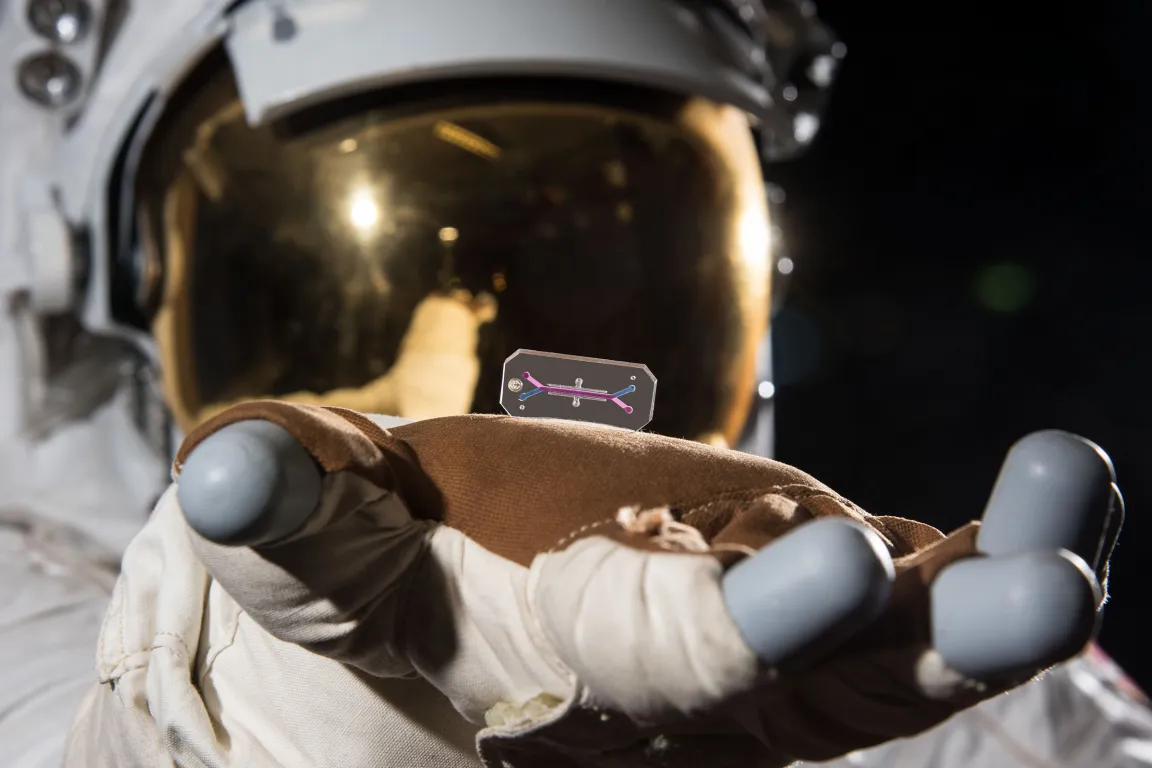
An astronaut wearing a white spacesuit and gold-tinted helmet visor is holding a small, rectangular transparent chip with colored lines and dots on it, resting on the gloved hand. The background is dark, suggesting space.

Josh Valcarcel / NASA

Sign up to see the future, today

Can’t-miss innovations from the bleeding edge of science and tech

Beyond their snazzy flight suits and mango peach smoothies, the crew of NASA’s Artemis II mission is packing something unusual: living mini-organs grown from their own bones.

That bizarre cargo is traveling alongside astronauts Reid Wiseman, Victor Glover, Christina Koch, and Jeremy Hansen, whose 10-day journey will take them around the back side of the Moon and then home again, in the process traveling farther from the Earth than any previous humans.

According to space publication Supercluster, the astronauts are carrying “completely functional” organ chips: organelles composed of bone marrow made from each astronauts’ cells.

In a highly complicated space mission, the justification for taking these organ chips is actually pretty straightforward. In leaving the protection of the Earth’s atmosphere, the four travelers expose themselves to heaps of solar and cosmic radiation. That radiation environment will present a unique window into the kind of dangers future astronauts will face in the dark reaches of space, so researchers are taking as many samples as they can get.

Mini organs aren’t new — scientists have been messing around with them since 2013 — but the decision to map them to their human counterparts in a space mission is.

“This is the first time we’re going to have crew with their matched organ chips,” David Chou, principal investigator of the chip experiment told SC. Having the humans and their micro organs side by side on the same voyage, he says, will enable scientists to compare the two biological materials against each other.

By using bone marrow cells — which are particularly vulnerable to radiation — to produce the chips, researchers are “maximizing the chance that we’ll see biologic differences, as opposed to modeling the skin or something else,” Chuo said.

For good measure, NASA also kicked duplicates of the astronauts’ organ chips up to the International Space Station, in order to compare deep space radiation with low earth orbit radiation over the same period. While they may seem small — and they are, at about the size of a USB stick — data provided by the chips could offer a major leap in our understanding of how the human body reacts to deep space, and at minimal cost, not to mention risk to human beings.

“Being able to understand how a broader representation of the public would respond to spaceflight is something you could do with organ chips much more cost-effectively,” Chou told SC. “You can make hundreds of these and send them up.”

More on NASA: Scientists Investigating Whether Object NASA Is Approaching Is Core of Destroyed Planet