






http://www.sihey.com/zsyl/pw/
https://weibo.com/6982934722/Kmsb7ji0h
https://baijiahao.baidu.com/s?id=1797361676791226486&wfr=spider&for=pc
当心间是中国传统木构建筑中面阔方向(长边)的中央开间,宋代称“当心间”,现代多称“明间”。
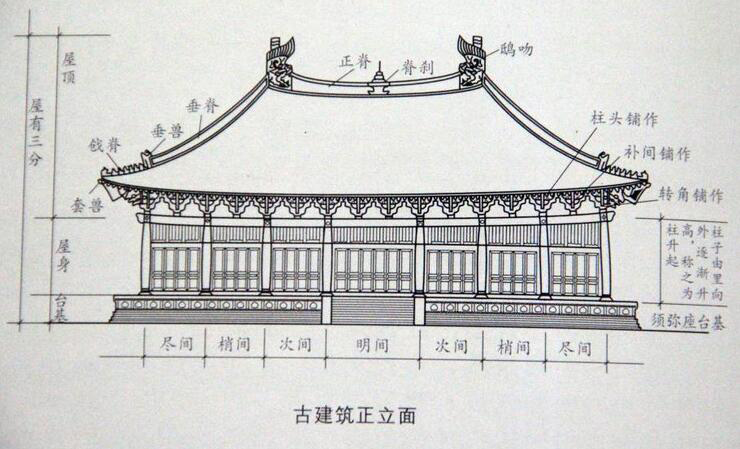
生出:是古建筑大木作翼角部分的特殊处理方法,即从仰视或俯视平面看,翼角两侧的翼角飞椽,从正身椽的第一根算起,呈一条缓缓斜出的曲线。清式建筑称之为“斜出”,宋式建筑称“生出”。这种做法于唐代初见端倪,宋《营造法式》做了具体规定。以后各时期的古建筑,其“生出”成为翼角的固定做法,各代沿用不辍,至明清时期“生出”逐渐加大。
升起:宋,辽建筑的檐柱由当心间向两端升高,因此檐口呈一条缓和的曲线。
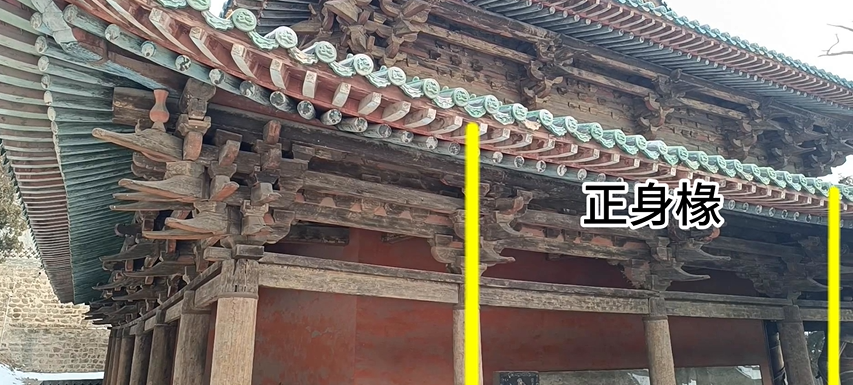
正身椽:https://www.bilibili.com/video/BV11y411z7eR/?vd_source=5d8ef6adb8b86320e8b68f9153bd7369

Roof in Shape of 卍 (Wan Zi Ding)
Some interfaces or roofs of ancient Chinese architecture has adopted the shape of 卍 which is similar to Chinese word "wan". A large amount of auspicious words in Chinese contain the word "wan" which is believed to bring good luck.

Chinese Hipped Roof (Wu Dian Ding)
As early as the pre-Qin period, there has been Chinese hipped roofs. This kind of roof was often used in royal construction projects, large monasteries and temples. The roof reflects the ancient Chinese concepts of "a square earth and spherical heavens" and "unification of human and nature".

Flat Top(Ping Ding)
Flat top means that the roof of the building is flat. Such flat tops were often applied onto buildings in northwest, southwest and north regions in China where the climate is dry and rainless.

Joined Roof (Gou Lian Da Ding)
It refers to a roof joined by two or more pieces. With such a rooftop, interior space can be enlarged without raising the overall height of the building.

Paraboloid Roof (Juan Peng Ding)
The paraboloid roof is one of the Han Chinese architecture styles stemming from ancient times. The roof has fluent lines in harmonic structure which are often seen in garden architecture. Palatial architectures of Emperor Kangxi's Summer Mountain Resort in Chengde also adopted the paraboloid roof.

Open Plat Roof (Lu Ding)
The top of such roofs are flat, surrounded by four main ridges. It is common to see the roof in Jin and Yuan Dynasty architecture which are mainly applied to the top openings of pavilions in imperial temples. Lu Ding refers to those open tops of pavilion in ancient times.

Chessboard Roof (Qi Pan Xin Wu Mian Ding)
A house with such a roof is shaped like a chessboard.

Paraboloid Suspension Roof (Juan Peng Xuan Shan Ding)
The paraboloid suspension roof is a type of overhanging gable roof without main ridges. Such roofs have soft lines and beautiful images, especially the single-eave paraboloid suspension roof which is commonly seen in garden architectures known for their delicacy and graceful flavor.

Overhanging Gable Roof (Xuan Shan Ding)
The overhanging gable roof, another type of Chinese ancient architecture styles, has been spread to Japan, North Korea and Vietnam. It is a general form of architecture in east Asia and has only been used for civilian buildings in ancient times.
此内容由惯性聚合(RSS阅读器)自动聚合整理,仅供阅读参考。 原文来自 — 版权归原作者所有。