



惯性聚合 高效追踪和阅读你感兴趣的博客、新闻、科技资讯
阅读原文 在惯性聚合中打开

推荐订阅源

D
Docker
U
Unit 42
Google DeepMind News
B
Blog RSS Feed
S
SegmentFault 最新的问题
阮一峰的网络日志
阮一峰的网络日志
雷峰网
雷峰网
Microsoft Security Blog
爱范儿
爱范儿
Cyber Security Advisories - MS-ISAC
博客园_首页
Apple Machine Learning Research
罗磊的独立博客
GbyAI
GbyAI
Stack Overflow Blog
Stack Overflow Blog
Martin Fowler
Martin Fowler
宝玉的分享
宝玉的分享
L
LangChain Blog
Engineering at Meta
Engineering at Meta
量子位
有赞技术团队
有赞技术团队
博客园 - 【当耐特】
A
About on SuperTechFans
Y
Y Combinator Blog

Tech - South China Morning Post

Multinational pharmaceutical companies to benefit from new China guidelines: analysts Hong Kong IPOs lure mainland China insurers seeking higher returns Hong Kong lawmaker swipes at US lack of ‘clarity’ as city eyes crypto lead China’s Hesai adds colour to lidar to help EVs level up in self-driving ‘State-of-the-art’ models can struggle with basic office work, says AI executive Opinion | As AI evolves, school syllabuses must evolve with it Winner of second Beijing robot half-marathon smashes human world record by 6 minutes Asia’s supply chains could give it edge over US in AI race: Granite Asia’s Foo Chinese software firms defy ‘SaaSpocalypse’ with strategic AI partnerships Huawei retains lead in China smartphones, Apple shipments surge in first quarter China’s drug makers are speeding up – will AI be their secret weapon? Hong Kong seen leading Asia in push to scale stablecoins, HSBC says ByteDance, Tencent step up AI talent battle amid reports of DeepSeek loss White House and Anthropic CEO discuss working together amid Mythos AI fears Chinese LED chipmaker’s purchase of Dutch firm collapses after US opposition How Amazon uses closer China supply ties to counter tariffs, Shein and Temu ‘Horrible’ for US if DeepSeek AI models run on Huawei chips: Nvidia CEO Chinese platforms fined 3.6b yuan over ‘ghost’ takeaways amid cutthroat rivalry Manycore, one of Hangzhou’s ‘Six Little Dragons’, surges on Hong Kong IPO debut How the rise of AI agents could finally make China’s open-source models pay ‘Buy what they can, steal what they can’t’: US lawmakers slam China’s AI tactics China’s lithium giant Ganfeng sees profit jump as EV, ESS battery demand soars Chinese tech giants, AI ‘godmother’ Li Fei-Fei race into world models Black market workarounds scale up for Claude as Anthropic tightens ID checks TSMC targets over 30% revenue surge in 2026, ramps up capex amid AI boom BrainCo’s brain-computer interface wows at HSBC summit with mind-controlled hand Chinese investors cheer Tesla’s AI chip progress, boosting shares of suppliers ASML boosts 2026 sales forecast despite shrinking China sales China’s EV battery giant CATL to set up mining arm to secure supply chain From ‘probing minds’ to verified account: how Musk’s stance on TikTok shifted
Lightelligence on track with IPO plans as China’s AI phot...
2026-04-15 · via Tech - South China Morning Post

Silicon photonic computing chips – long overlooked in the artificial intelligence hardware stack – are emerging as a new focal point in mainland China’s semiconductor push, as domestic companies move towards public listings amid intensifying US-China competition and surging demand for next-generation computing infrastructure.

Shanghai-based Lightelligence, the first company globally to achieve large-scale deployment of hybrid optical-electronic computing, passed its Hong Kong listing hearing on Monday, advancing plans for an initial public offering (IPO) expected to raise between US$300 million and US$400 million. That puts the company on track to become the first AI photonics chipmaker to list in Hong Kong.

The listing is set to be one of the largest in the city this year, testing investor sentiment amid US-China tech tensions, though Lightelligence said its business was not subject to US export control restrictions.

The rapid buildout of hyperscale AI clusters is fuelling demand for high-speed, low-latency interconnect technologies, with research firm Frost & Sullivan forecasting the global AI computing and interconnect market to grow at a 27 per cent compound annual rate to 2031.

Optical computing, once seen as niche, is gaining relevance as AI systems scale, with photons used to transmit and process information instead of traditional electronic pathways, helping to reduce latency, bandwidth and power constraints in data centres. Optical interconnect uses photonics to enable high-speed, low-latency data transfer between chips and systems such as graphics processing units (GPUs) and central processing units.
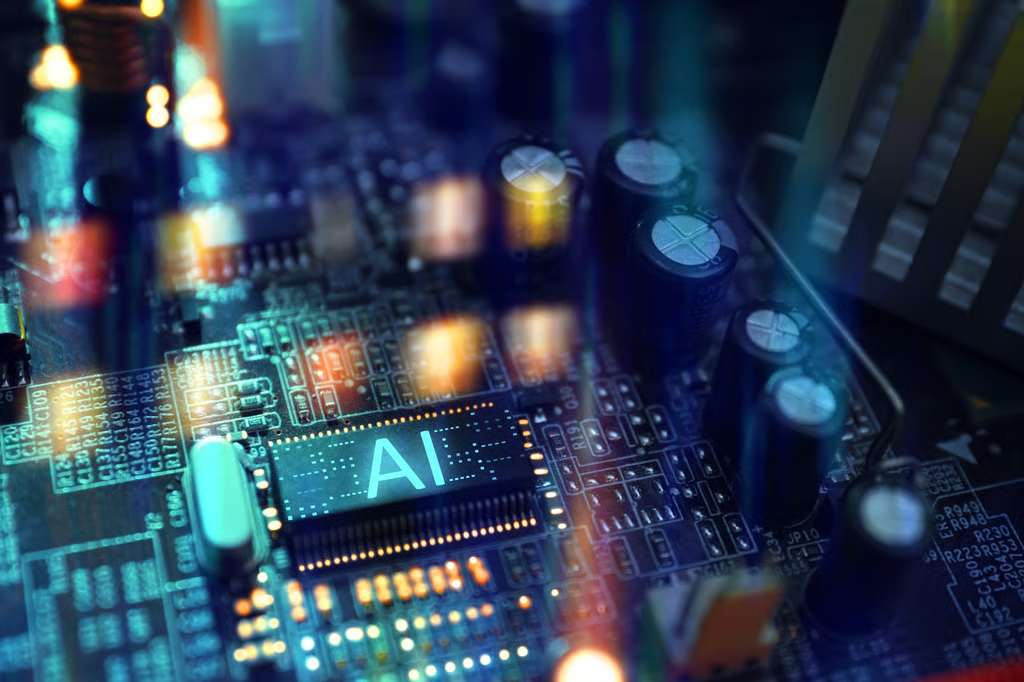
Chinese companies are moving towards public listings amid intensifying US-China competition and surging demand for next-generation computing infrastructure. Photo: Shutterstock Images

Chinese companies are moving towards public listings amid intensifying US-China competition and surging demand for next-generation computing infrastructure. Photo: Shutterstock Images

Lightelligence focuses on hybrid optical-electronic computing, with operations spanning optical interconnects and optical computing. The company described its technology as a complement to GPUs rather than a replacement, targeting bottlenecks in data transmission and matrix computation within AI systems.