



惯性聚合 高效追踪和阅读你感兴趣的博客、新闻、科技资讯
阅读原文 在惯性聚合中打开

推荐订阅源

D
Docker
U
Unit 42
Google DeepMind News
B
Blog RSS Feed
S
SegmentFault 最新的问题
阮一峰的网络日志
阮一峰的网络日志
雷峰网
雷峰网
Microsoft Security Blog
爱范儿
爱范儿
Cyber Security Advisories - MS-ISAC
博客园_首页
Apple Machine Learning Research
罗磊的独立博客
GbyAI
GbyAI
Stack Overflow Blog
Stack Overflow Blog
Martin Fowler
Martin Fowler
宝玉的分享
宝玉的分享
L
LangChain Blog
Engineering at Meta
Engineering at Meta
量子位
有赞技术团队
有赞技术团队
博客园 - 【当耐特】
A
About on SuperTechFans
Y
Y Combinator Blog

Tech - South China Morning Post

Multinational pharmaceutical companies to benefit from new China guidelines: analysts Hong Kong IPOs lure mainland China insurers seeking higher returns Hong Kong lawmaker swipes at US lack of ‘clarity’ as city eyes crypto lead China’s Hesai adds colour to lidar to help EVs level up in self-driving ‘State-of-the-art’ models can struggle with basic office work, says AI executive Opinion | As AI evolves, school syllabuses must evolve with it Winner of second Beijing robot half-marathon smashes human world record by 6 minutes Asia’s supply chains could give it edge over US in AI race: Granite Asia’s Foo Chinese software firms defy ‘SaaSpocalypse’ with strategic AI partnerships Huawei retains lead in China smartphones, Apple shipments surge in first quarter China’s drug makers are speeding up – will AI be their secret weapon? Hong Kong seen leading Asia in push to scale stablecoins, HSBC says ByteDance, Tencent step up AI talent battle amid reports of DeepSeek loss White House and Anthropic CEO discuss working together amid Mythos AI fears Chinese LED chipmaker’s purchase of Dutch firm collapses after US opposition How Amazon uses closer China supply ties to counter tariffs, Shein and Temu ‘Horrible’ for US if DeepSeek AI models run on Huawei chips: Nvidia CEO Chinese platforms fined 3.6b yuan over ‘ghost’ takeaways amid cutthroat rivalry Manycore, one of Hangzhou’s ‘Six Little Dragons’, surges on Hong Kong IPO debut How the rise of AI agents could finally make China’s open-source models pay ‘Buy what they can, steal what they can’t’: US lawmakers slam China’s AI tactics China’s lithium giant Ganfeng sees profit jump as EV, ESS battery demand soars Chinese tech giants, AI ‘godmother’ Li Fei-Fei race into world models Black market workarounds scale up for Claude as Anthropic tightens ID checks TSMC targets over 30% revenue surge in 2026, ramps up capex amid AI boom BrainCo’s brain-computer interface wows at HSBC summit with mind-controlled hand Chinese investors cheer Tesla’s AI chip progress, boosting shares of suppliers ASML boosts 2026 sales forecast despite shrinking China sales China’s EV battery giant CATL to set up mining arm to secure supply chain From ‘probing minds’ to verified account: how Musk’s stance on TikTok shifted
Anthropic’s AI code leak ignites frenzy among Chinese dev...
Ben Jiang · 2026-04-02 · via Tech - South China Morning Post

Less than a year after US artificial intelligence start-up Anthropic called out China as an “adversarial nation” and vowed to restrict the country’s access to its technologies, the company inadvertently released coding secrets, triggering a frenzy among Chinese developers.

The leak occured after an Anthropic employee accidentally included the modified source code of Claude Code, the company’s sensational AI coding tool popular among developers worldwide, in a file within a software package hosted online.

The source code – running more than 512,000 lines and buried deep in the software package – was spotted and decrypted by software engineer and cybersecurity researcher Shou Chaofan on Tuesday, who then posted it on X.com. By Thursday, it had more than 33 million views, drawing attention across the tech community globally and in China.

Like Microsoft-backed OpenAI and Alphabet’s Google, Anthropic has not made its services available in mainland China, citing national security concerns. As a result, China is one of a handful of countries, along with Russia, North Korea, Afghanistan, Iran and Cuba, that cannot use Claude chatbots and AI models.
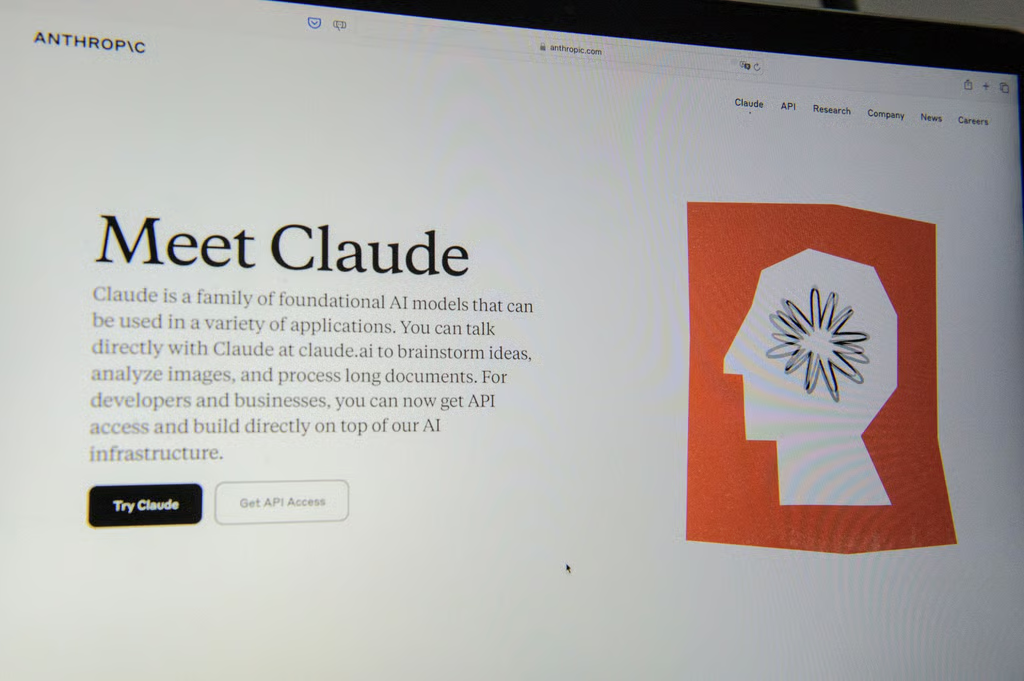
This illustration picture shows a computer screen displaying the Anthropic website in San Francisco, May 13, 2024. Photo: dpa

This illustration picture shows a computer screen displaying the Anthropic website in San Francisco, May 13, 2024. Photo: dpa

Despite the restrictions, Chinese developers appear to be highly enthusiastic about Anthropic’s AI models as well as Claude Code, thanks to their advanced coding capabilities that automate programming tasks, from writing code to debugging, while boosting development efficiency, even though they have to access the service via virtual private networks.