


惯性聚合 高效追踪和阅读你感兴趣的博客、新闻、科技资讯
阅读原文 在惯性聚合中打开

推荐订阅源

V
Visual Studio Blog
D
DataBreaches.Net
博客园 - 三生石上(FineUI控件)
博客园_首页
T
Tailwind CSS Blog
美团技术团队
Hugging Face - Blog
Hugging Face - Blog
博客园 - 叶小钗
大猫的无限游戏
大猫的无限游戏
OSCHINA 社区最新新闻
OSCHINA 社区最新新闻
云风的 BLOG
云风的 BLOG
奇客Solidot–传递最新科技情报
奇客Solidot–传递最新科技情报
博客园 - 聂微东
S
SegmentFault 最新的问题
小众软件
小众软件
酷 壳 – CoolShell
酷 壳 – CoolShell
N
Netflix TechBlog - Medium
Jina AI
Jina AI
WordPress大学
WordPress大学
U
Unit 42
J
Java Code Geeks
Blog — PlanetScale
Blog — PlanetScale
钛媒体:引领未来商业与生活新知
钛媒体:引领未来商业与生活新知
The Cloudflare Blog

Coco Feng - South China Morning Post

Shein clears Hong Kong IPO hurdle as valuation halves to below US$50b: sources Chinese state-owned firms set up chip funds for long-term innovation Breaking | Shein receives approval for Hong Kong IPO from Chinese regulators Game-changer? Why China is finally letting its AI firms buy the Nvidia H200 Why Alibaba shares just scored their strongest gains in Hong Kong this year China records most new unicorn start-ups in 5 years as AI and robotics boom Final insurance frontier: Hong Kong sees opening in mainland China’s space boom How a Chinese physical AI start-up’s new paradigm bypasses US road maps Dishing the dirt: official media alleges smear tactics in delivery battle Zhipu AI market cap tops HK$1 trillion after GLM-5.2 release Chinese AI improves forecasts as Hong Kong braces for super typhoons Alibaba and JD.com targeted in smear campaign ahead of shopping festival Who pays when rockets explode? China rushes to insure SpaceX’s rivals Microsoft cuts hundreds of mainland cloud jobs, as China, US tighten data laws Huawei chips refine DeepSeek model in leap for China’s AI self-reliance Part boat, part plane, part sci-fi: China debuts consumer watercraft China just beat Nvidia on a global robotics ranking. Is a new tech war brewing? Want to save the planet? Stop being so polite to AI chatbots Alibaba elevates tech chief Wu Zeming to elite committee amid AI push Mainland Chinese locked out of Computex Taipei amid cross-strait tensions ‘Arms race’: why investors can’t let go of robotic hand developers in China Kuaishou beats estimates as Kling AI video tool’s revenue jumps 300% Huawei’s workaround for US chip curbs faces hurdles on road to self-reliance China told the solar industry to cut capacity. Firms built new factories anyway China unveils first humanoid robot for household chores, ready as early as 2027 China’s Moonshot AI moves to unwind offshore structure in IPO pursuit: sources Trump, Xi weigh AI ‘guard rails’ as Nvidia chip exports hang in the balance Alibaba shares surge 7% in Hong Kong as firm accelerates pivot to AI Why are Chinese stock markets hitting record highs ahead of Trump’s visit? Nvidia’s Jensen Huang joins Trump’s trip to China at last minute
From gala spectacle to job scare: Chinese workers confron...
Ji Siqi,Coco Feng,Xinyi Wu · 2026-02-28 · via Coco Feng - South China Morning Post

On a day typically considered one of the happiest on the calendar for Chinese workers – the eve of Chinese New Year, when families gather for dinner in the midst of an extended public holiday – the annual Spring Festival Gala, the world’s most-watched television programme, left some in the viewing audience with a sense of profound disillusionment.

As a troupe of humanoid robots break-danced, flipped, swung swords and performed comedy sketches at the gala, domestic AI brands occupied the show’s highly sought advertising slots with unprecedented frequency. The display of China’s tech prowess left many of the programme’s roughly 677 million viewers deep in thought – weighing not joy or curiosity about the country’s progress, but the fear of being displaced.

They took to social media, where they were not reserved in sharing their trepidation. “I feel one step closer to losing my job,” wrote one. “It’s here to take away the jobs of hardworking people,” said another. One even saw the threat reaching outside the office: “Dancers and performers will be the first to lose their jobs.”

The artificial intelligence scare was not limited to China. A week after the gala, a report from little-known US firm Citrini Research on how AI advancements would lead to mass unemployment and economic recession triggered a major sell-off on Wall Street.

Although these worries are growing amid the technology’s rapid advancement in China, industry insiders point out that AI is already creating a large number of new jobs and that the country’s economy – with an expansive public sector – appears better positioned to withstand potential disruptions.

Still, displacement was indeed happening, and how Chinese workers, employers and policymakers adjusted to the new reality would determine whether AI was ultimately a helpful assistant for humans or led to their downfall, they added.
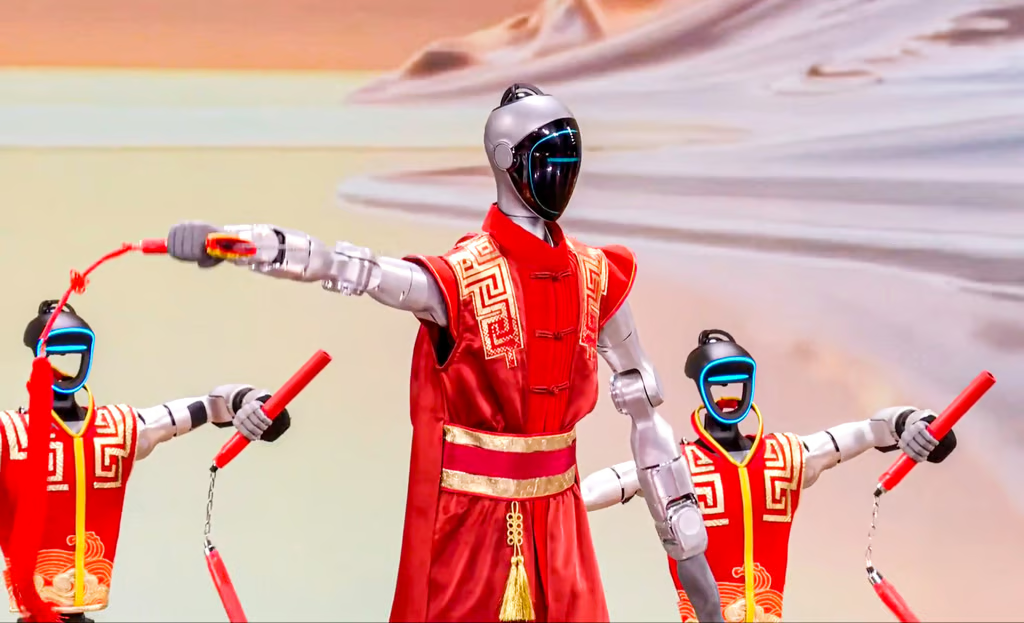
Humanoid robots perform during China Central Television’s Spring Festival Gala on February 16. Photo: Handout

Humanoid robots perform during China Central Television’s Spring Festival Gala on February 16. Photo: Handout

The creators of AI are now among those who may bear the brunt. Software engineers in China’s technology sector were already struggling with “the curse of 35”, a term to describe tech and corporate employees at risk of being laid off once they reach that age. With AI, the deadline seems to be arriving even earlier.

With a decade of experience as a software engineer working for a Chinese tech giant in Beijing, David Chen said many of his peers were feeling anxious because their expertise was primarily in coding. Now 80 per cent of his coding work is performed by AI, and a task that used to take three days can now be completed in two or three hours. As the work efficiency grows, so does the workload, because he has more features to work on for each app update.