











If you spent any part of this past week fueled by cold brew, rapid keystrokes, and late-night problem-solving, you already know: our recent YubiKey 5.8 Hackathon was an absolute blast!
From the second the clock started ticking to the final project submissions, the energy across our Slack channels and 24-hour live stream was off the charts. We had developers dive into building with the new YubiKey 5.8 firmware, pushing the boundaries of CTAP 2.3, ARKG (Asynchronous Remote Key Generation, also called previewSign) and PPUAT (Persistent PIN/UV Auth Token).
Building cutting-edge cryptographic applications under time constraints is tough, but doing it alongside a passionate community makes all the difference. Between intense debugging sessions – like resolving HID transport permissions or setting up custom FIDO2 RP IDs—we made sure to prioritize essential brain breaks.]
Participants took time off from code to compete in Amanda Shultz’s (Manager of Program Management) ‘Real or Fake Tech Lighting Trivia’ Madan Abuja’s (Senior Director of Global Talent Acquisition) ‘interactive presentation on Unconscious Bias’, and technical discussions with Yubico engineers.
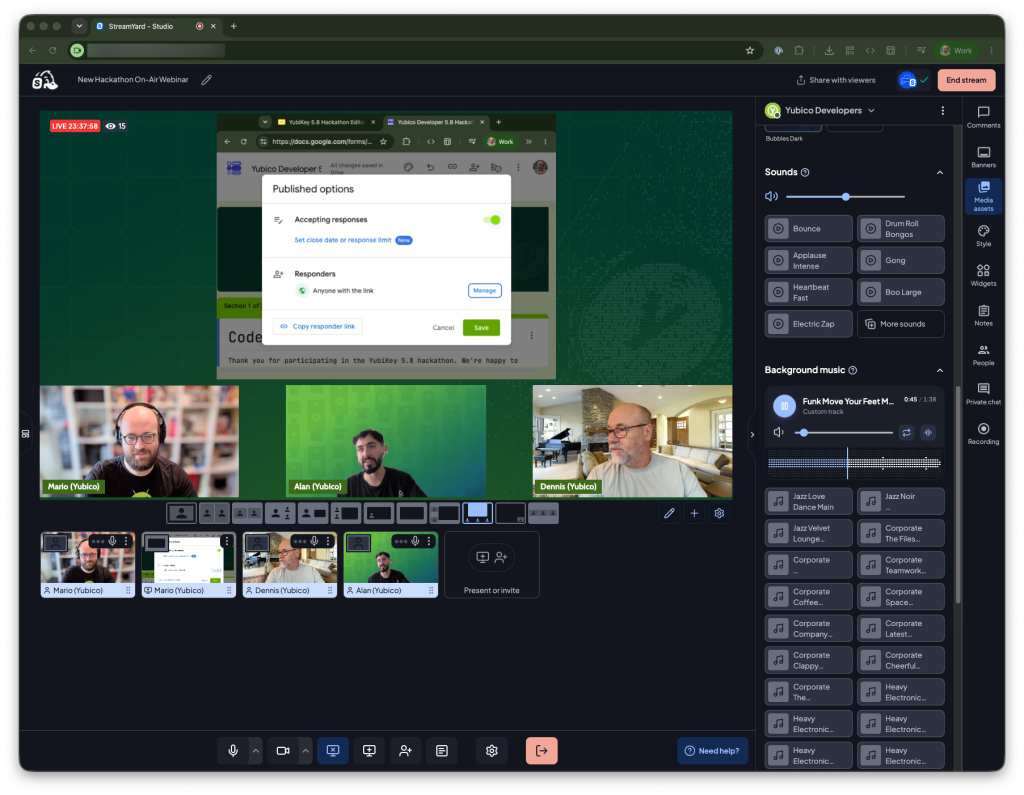
Some of the best insights didn’t come from the official stage – they happened in chatter, pull requests, and breakout channels. Hear directly from the developers that attended – below are three key technical themes participated in during the event:
A massive trend among projects like Digital-Hanko, Sentinel, TriageCore Signed Intent, and IntentLock was using YubiKey 5.8 to place a human-in-the-loop for autonomous AI agents. Instead of giving agents blank-check API keys, developers used previewSign to require a physical tap before an agent could execute high-risk operations like transferring money or modifying databases.
“Before the event, I mainly viewed YubiKeys as reliable devices for login security… Building changed my view by showing that a YubiKey can also serve as a hardware-backed approval boundary for sensitive AI agent actions.”
Developers quickly realized the power of raw signing over arbitrary payload digests. By hashing canonical request data (payee, amount, action, nonce), projects like ActionSeal and SpendGuard proved that altering a single byte after human approval causes signature verification to fail.
“previewSign is authorization, and the surrounding language is not… An authentication assertion asserts this key is present. A previewSign signature asserts this key approved these exact canonical bytes.”
Through Asynchronous Remote Key Generation (ARKG), developers derived fresh, mathematically unlinkable public keys offline without requiring a physical tap for every single credential. Projects like Sybil-Bounded Swarm demonstrated how a single touch can load an entire fleet’s hardware-backed authority for an epoch while preserving total verifier privacy.
“ARKG offline derivation is the real unlock. Deriving thousands of mutually-unlinkable P-256 keys from one seed with zero touches is genuinely new in 5.8 and it’s what lets a swarm be private and accountable at once.”
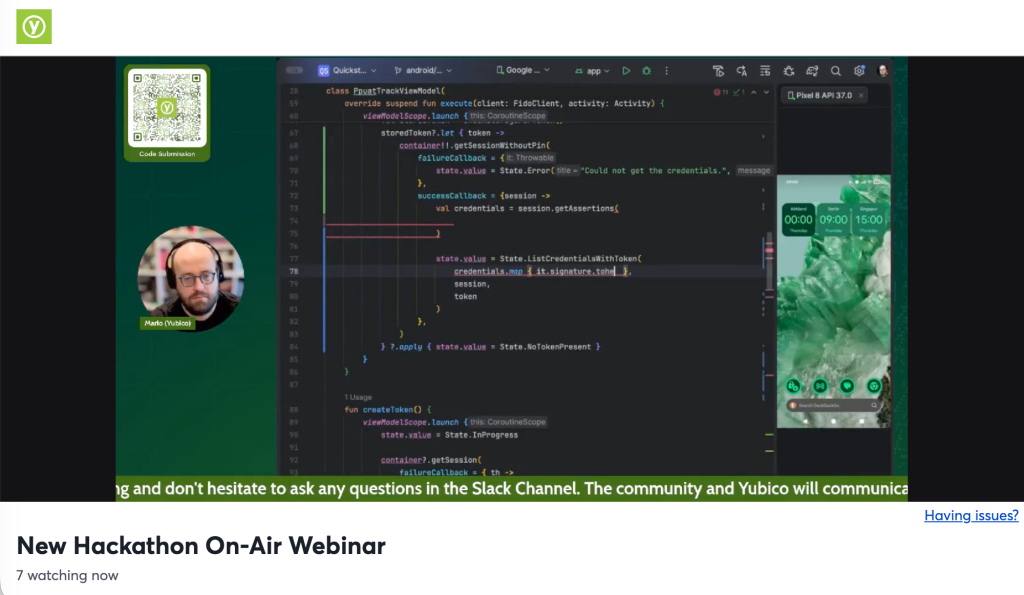
Bridging the gap: YubiKey 5.8 launch docs and repos are now live
Many of the submitted projects took direct advantage of features available in the new YubiKey 5.8 firmware release. Developers built applications across iOS, Android, macOS, .NET/Windows, Python, Rust, Go, and Node.js:
Whether you want to streamline passkey UX, explore CTAP 2.3 specs, or start raw signing using standard COSE P-256 keys, our updated documentation has you covered.
👉Explore the YubiKey 5.8 Developer Documentation & SDKs and the GitHub repository
A huge thank you to everyone who participated in our recent hackathon! The creativity, technical depth, and focus on real-world security challenges blew us away. While every project brought something unique to the table, two implementations stood out for their practical impact on cryptographic security and identity protection.
Here are our top winners and their groundbreaking projects:
Alex Seigler — hackathon-arkg-demo
Focus: Hardware Key Recovery & Disaster Management
Losing a hardware security key like a YubiKey is every security-conscious user’s worst nightmare. Alex took this head-on with hackathon-arkg-demo, demonstrating an elegant, reliable recovery flow using a backup key combined with ARKG (Asynchronous Remote Key Generation).
Why It Won:
Tim Myers — Keybound
Focus: Browser Defense & Cookie Theft Mitigation
Session hijacking and cookie stealing remain among the most dangerous web attack vectors today. Tim’s project, Keybound, delivers a winning security architecture designed to lock down browser session tokens using ARKG principles.
Why It Won:
The hackathon may be over, but the momentum is just getting started. Our upcoming webinar on August 13 at 8am PT will showcase real-world code breakdowns directly from the builders and learn from the impressive projects created. Below are some key highlights of what to expect during the webinar:
Don’t miss out – be sure to register for the official post-hackathon webinar here.
A massive thank you to everyone who participated, built, mentored, and cheered us on! We can’t wait to see what you build next with YubiKey 5.8. If you would like to stay tuned for our developer notifications visit us here: https://www.yubico.com/why-yubico/for-developers/
此内容由惯性聚合(RSS阅读器)自动聚合整理,仅供阅读参考。 原文来自 — 版权归原作者所有。