





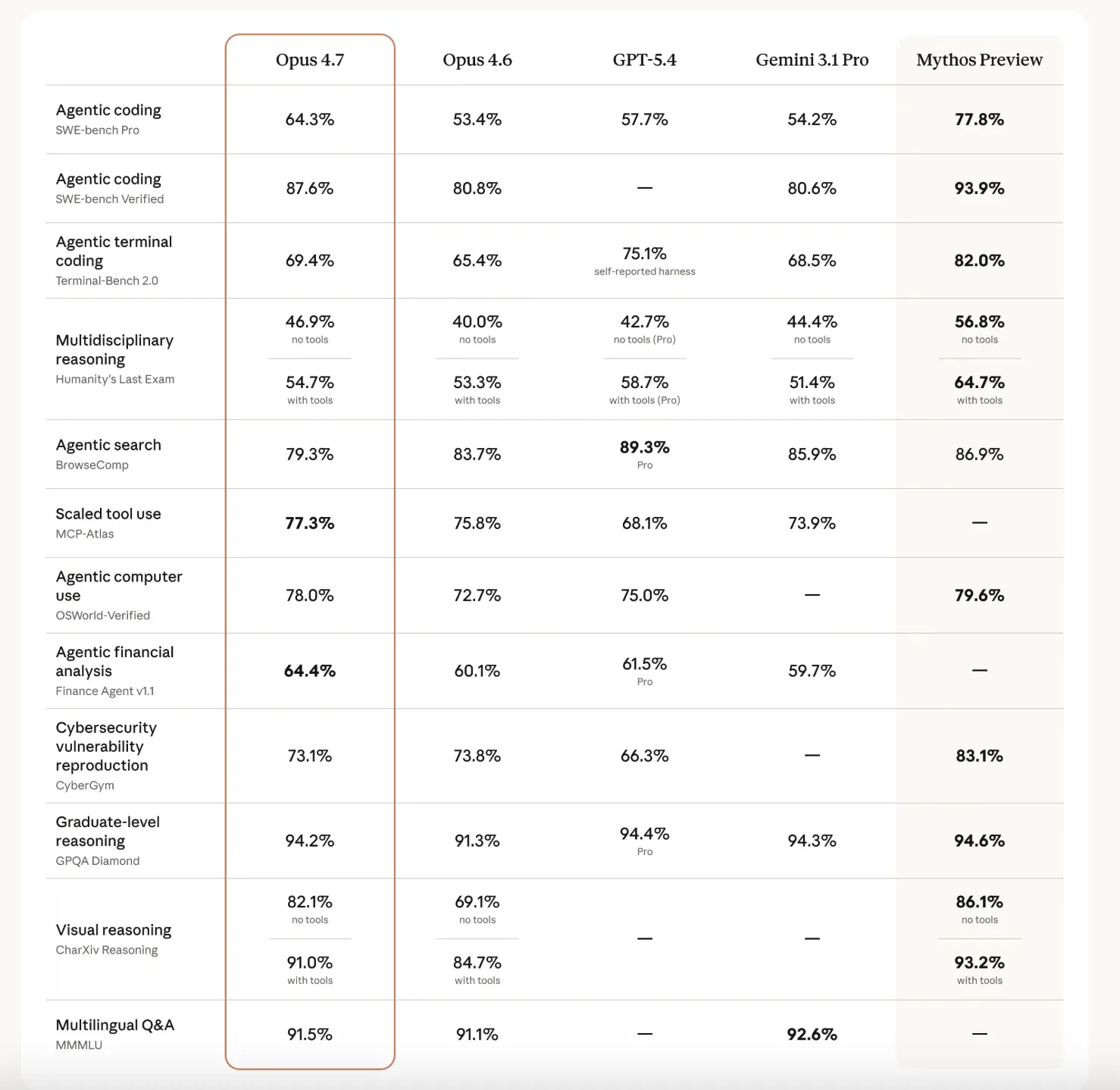
Anthropic has launched Claude Opus 4.7, it’s latest frontier model and a direct successor to Claude Opus 4.6. The release is positioned as a focused improvement rather than a full generational leap, but the gains it delivers are substantial in the areas that matter most to developers building real-world AI-powered applications: agentic software engineering, multimodal reasoning, and long-running autonomous task execution.
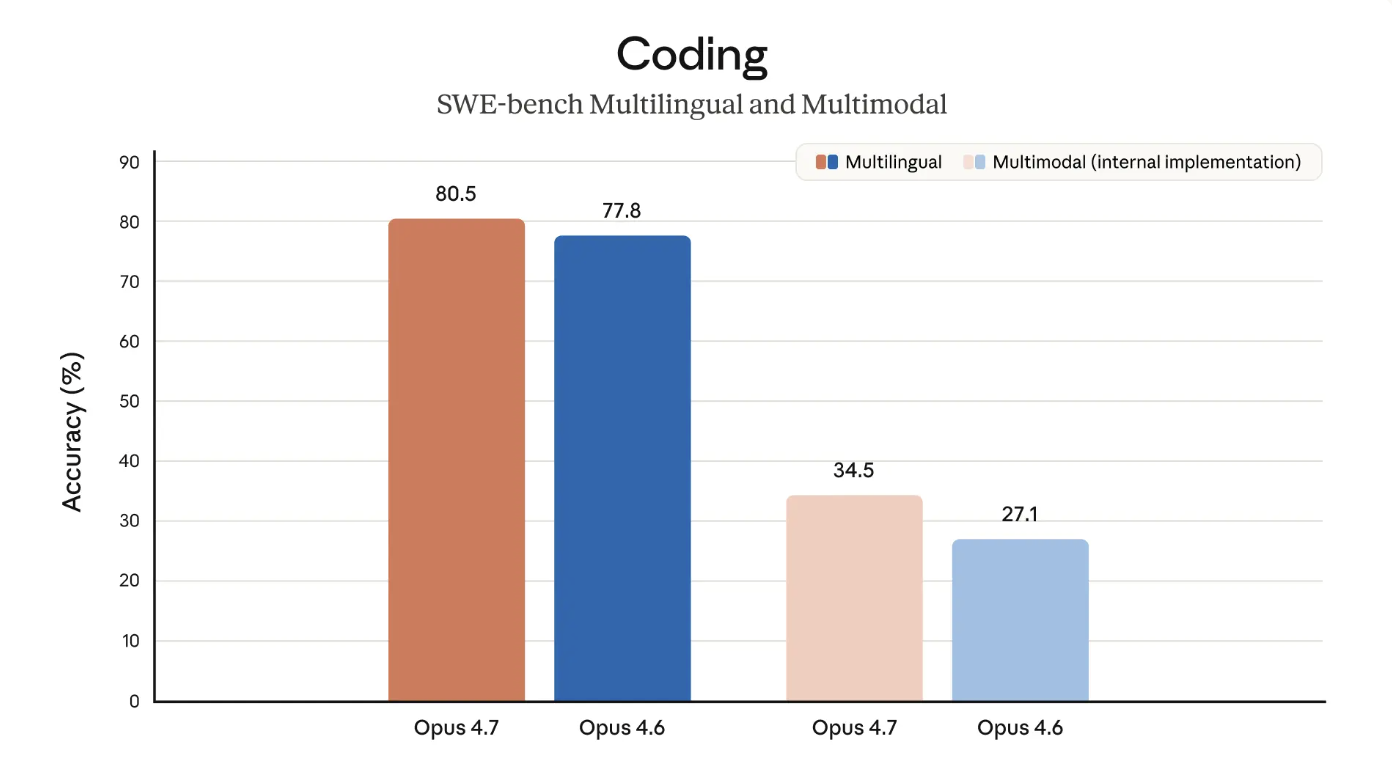
Anthropic maintains a model family with tiers — Haiku (fast and lightweight), Sonnet (balanced), and Opus (highest capability). Opus 4.7 sits at the top of this stack, below only the newly previewed Claude Mythos, which Anthropic has kept in a restricted release.
Opus 4.7 represents a notable improvement on Opus 4.6 in advanced software engineering, with particular gains on the most difficult tasks. Crucially, users report being able to hand off their hardest coding work — the kind that previously needed close supervision — to Opus 4.7 with confidence, as it handles complex, long-running tasks with rigor and consistency, pays precise attention to instructions, and devises ways to verify its own outputs before reporting back.
The model verifying its own outputs is a meaningful behavioral shift. Earlier models often produced results without internal sanity checks; Opus 4.7 appears to close that loop autonomously, which has significant implications for CI/CD pipelines and multi-step agentic workflows.
Early testers have put some sharp numbers on the coding improvements. On a 93-task coding benchmark, Opus 4.7 lifted resolution by 13% over Opus 4.6, including four tasks that neither Opus 4.6 nor Sonnet 4.6 could solve. On CursorBench — a widely-used developer evaluation harness — Opus 4.7 cleared 70% versus Opus 4.6 at 58%. And for complex multi-step workflows, one tester observed a 14% gain over Opus 4.6 at fewer tokens and a third of the tool errors — and notably, Opus 4.7 was the first model to pass their implicit-need tests, continuing to execute through tool failures that used to stop Opus cold.
One of the most technically concrete upgrades in Opus 4.7 is its multimodal capability. Opus 4.7 can now accept images up to 2,576 pixels on the long edge (~3.75 megapixels), more than three times as many pixels as prior Claude models. Many real-world applications — from computer-use agents reading dense UI screenshots to data extraction from complex engineering diagrams — fail not because the model lacks reasoning ability, but because it can’t resolve fine visual detail. This opens up a wealth of multimodal uses that depend on fine visual detail: computer-use agents reading dense screenshots, data extractions from complex diagrams, and work that needs pixel-perfect references.
The impact in production has already been dramatic. One tester working on computer-use workflows reported that Opus 4.7 scored 98.5% on their visual-acuity benchmark versus 54.5% for Opus 4.6 — effectively eliminating their single biggest Opus pain point.
This is a model-level change rather than an API parameter, so images users send to Claude will simply be processed at higher fidelity — though because higher-resolution images consume more tokens, users who don’t require the extra detail can downsample images before sending them to the model.
xhigh, Plus Task BudgetsDevelopers working with the Claude API will notice two new levers for controlling compute spend.
xhigh (‘extra high’) effort level between high and max, giving users finer control over the tradeoff between reasoning and latency on hard problems. In Claude Code, Anthropic team has raised the default effort level to xhigh for all plans. When testing Opus 4.7 for coding and agentic use cases, Anthropic recommends starting with high or xhigh effort./ultrareview and Auto Mode for Max UsersTwo new Claude Code features ship alongside Opus 4.7 that are worth flagging for devs who use it as part of their development workflow. The new /ultrareview slash command produces a dedicated review session that reads through changes and flags bugs and design issues that a careful reviewer would catch. Anthropic is giving Pro and Max Claude Code users three free ultrareviews to try it out. Think of it as a senior engineer review pass on demand — useful before merging complex PRs or shipping to production.
Additionally, auto mode has been extended to Max users. Auto mode is a new permissions option where Claude makes decisions on your behalf, meaning that you can run longer tasks with fewer interruptions — and with less risk than if you had chosen to skip all permissions. This is particularly valuable for agents executing multi-step tasks overnight or across large codebases.
A less-discussed but operationally significant improvement is how Opus 4.7 handles memory. Opus 4.7 is better at using file system-based memory — it remembers important notes across long, multi-session work and uses them to move on to new tasks that, as a result, need less up-front context. On third-party benchmarks, the model also achieved state-of-the-art results on GDPval-AA, a third-party evaluation of economically valuable knowledge work across finance, legal, and other domains.
xhigh effort level and task budgets give developers precise control over the reasoning-vs-latency tradeoff and token spend — critical levers for running cost-efficient multi-step agent pipelines in production./ultrareview slash command for on-demand deep code review, and auto mode — now extended to Max users — which lets agents run longer tasks with fewer interruptions.Check out the Technical details here. Also, feel free to follow us on Twitter and don’t forget to join our 130k+ ML SubReddit and Subscribe to our Newsletter. Wait! are you on telegram? now you can join us on telegram as well.
Need to partner with us for promoting your GitHub Repo OR Hugging Face Page OR Product Release OR Webinar etc.? Connect with us
此内容由惯性聚合(RSS阅读器)自动聚合整理,仅供阅读参考。 原文来自 — 版权归原作者所有。