





The Pentagon is searching for new ways to protect military satellite communications from electronic attacks in space. MIT Lincoln Laboratory engineers are now developing a lightweight antenna system designed to keep U.S. forces connected even during heavy jamming attempts.
The prototype was built for proliferated low-Earth orbit, or pLEO, where large constellations of smaller satellites require compact and power-efficient hardware. Researchers say the antenna could deliver advanced beamforming capabilities while using far less power than conventional systems.
Modern military satellites increasingly rely on adaptive antenna arrays that can rapidly redirect signals and block interference. Those systems help operators maintain links during hostile jamming attempts.
However, traditional phased-array antennas consume large amounts of power and require complex hardware. MIT Lincoln Laboratory’s answer is a scanning reflectarray antenna called Hosted Nimble Beamforming Anti-Jam Reflectarray, or HoNi BAJR.
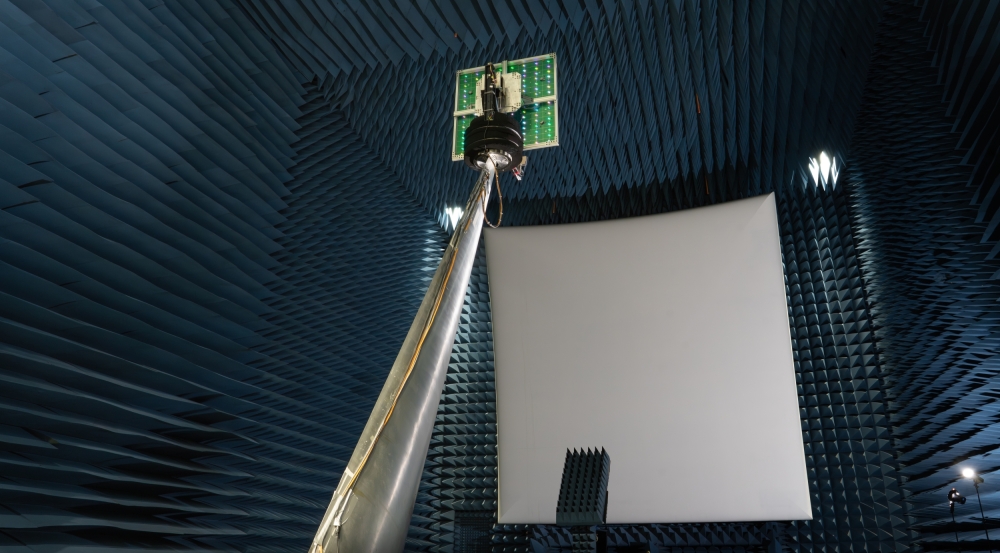
Instead of using amplifiers across every antenna element, the design relies on a reflective surface with individually controlled elements. Incoming signals bounce off the surface and shift phase before traveling toward a separate feed antenna.
That process shapes and steers the beam while reducing hardware complexity. Engineers estimate the reflectarray design cuts power consumption by roughly 95% compared with traditional array systems.
The smaller footprint also allows the antenna to fit on compact satellite platforms commonly used in pLEO constellations. Researchers believe that advantage could make the technology attractive for future military satellite constellations.
Michael Craton, a technical staff member in the laboratory’s Tactical Satellite Communications Group, said future military satellite networks need scalable systems with lower size, weight, power, and cost requirements.
“We want to think about ways we can achieve exquisite performance using less expensive hardware,” Craton said. He added that the team also wants to prepare for emerging threats before they become operational problems.
The HoNi BAJR system focuses heavily on anti-jamming performance. Adaptive arrays normally counter interference by creating “nulls,” which suppress signals coming from hostile directions.
During testing at the laboratory’s RF Systems Testing Facility, the prototype demonstrated wide-angle scanning capability. Researchers also confirmed the antenna could split beams between multiple users with minimal signal degradation.
The team pushed further by developing broader interference suppression zones rather than targeting single jamming points. Engineers attempted this by reshaping beam side lobes to reduce interference across wider regions.
That approach produced mixed results during early testing because small signal variations affected side-lobe control. Researchers believe improved calibration methods could solve much of the instability.
Calibration now stands as one of the project’s biggest technical hurdles. Unlike conventional phased arrays, scanning reflectarrays lack extensive operational history in military satellite systems.
Engineers still need to determine how to precisely measure and compensate for signal distortions across the antenna. Researchers say accurate calibration will improve beam steering, interference suppression, and overall system performance.
The laboratory also continues studying where reflectarrays fit best within future military architectures. Early findings suggest the technology works well in scheduled beam operations, power-limited spacecraft, and environments with persistent but less dynamic interference.
“Designing hardware is always a challenge,” Craton said. “But figuring out how to fit the technology into a complete and functional system that meets mission needs is the hardest part.”
Future work will refine beamforming techniques, improve calibration procedures, and explore operational use cases for the antenna technology.
Aamir is a seasoned tech journalist with experience at Exhibit Magazine, Republic World, and PR Newswire. With a deep love for all things tech and science, he has spent years decoding the latest innovations and exploring how they shape industries, lifestyles, and the future of humanity.
此内容由惯性聚合(RSS阅读器)自动聚合整理,仅供阅读参考。 原文来自 — 版权归原作者所有。