





Engineers at the University of California San Diego have built a tiny optical component measuring just six millimeters in diameter for telescopes.
Developed in collaboration with BAE Systems Space & Mission Systems, the device could simplify space exploration hardware. It promises to slash mission costs while vastly improving the ability to monitor dangerous space weather.
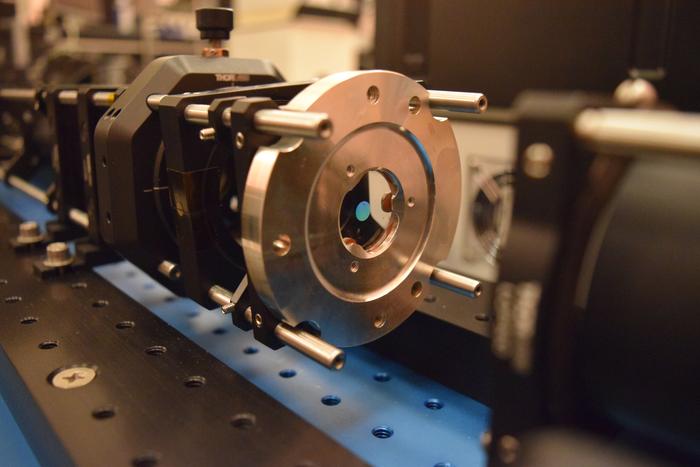
A metasurface is an advanced class of nanotechnology consisting of a flat optical component engineered with microscopic, nanoscale structures.
Using these nanostructures, the device can manipulate light — such as splitting and controlling its polarization channels simultaneously — in unique ways that conventional glass lenses and mirrors physically cannot.
Until now, this tech was mostly an academic parlor trick. “Most academic work on metasurfaces has remained at the proof-of-concept stage,” said Noah Rubin, the study’s senior author and an engineering professor at UC San Diego.
Rubin’s team took the concept out of the lab. Their industry partners at BAE Systems subjected the tiny lens to brutal vibration and extreme temperature testing.
It passed. The nanotech was officially space-qualified.
“We’re excited for the possibility to deploy our technology in space,” Rubin said. “I think this is a very nice example of where fundamental academic research actually can translate to something with real potential for space exploration and science.”
The sun’s magnetic fields are often studied to predict massive solar eruptions, such as coronal mass ejections, that send charged particles toward Earth.
For this, polarization, or the vibration direction of incoming sunlight, is analyzed.
Existing space telescopes use a different approach to do this. These take an image, mechanically rotate an optical component, and take another image. And then digitally stitching them together.
This process is slow and vulnerable to the slightest jitters. As spacecraft vibrate, even a tiny nudge between exposures can completely blur delicate solar data.
To stop this, NASA has to build incredibly complex, expensive stabilization systems. “These systems often cost far more than the telescope itself,” Rubin noted.
The new six-millimeter metasurface eliminates the moving parts entirely.
It splits incoming sunlight into several different polarization paths at the exact same time. Instead of a slow sequence of photos, the telescope captures all the magnetic data simultaneously in a single snapshot.
“With these faster frame rates, we can observe phenomena that were too quick for previous instruments to capture,” said Lisa Li, the study’s first author.
To prove the device could actually do real science, the researchers integrated it into a custom telescope and traveled to the Dunn Solar Telescope in New Mexico.
The setup was a contrast of epic proportions. Sunlight hit a mirror at the top of a 136-foot tower, traveled 228 feet underground, and was reflected back to the surface. There, it passed through the team’s tiny six-millimeter component.
The microscopic lens successfully mapped the intense magnetic fields inside active sunspots. When the team compared their data to observations from NASA’s massive, orbiting Solar Dynamics Observatory, the results were nearly identical.
The tiny lens performed just as well as a giant satellite.
Now, the team is setting its sights on the launchpad. Backed by five years of development and funding from NASA, the researchers have submitted a formal proposal for a mission concept study.
If selected, their tiny six-millimeter eye could soon be riding a rocket into space — proving that sometimes, the biggest breakthroughs come in the smallest packages.
The paper was published on June 10 in Science Advances.

Get the latest in engineering, tech, space & science - delivered daily to your inbox.
Mrigakshi is a science journalist who enjoys writing about space exploration, biology, and technological innovations. Her work has been featured in well-known publications including Nature India, Supercluster, The Weather Channel and Astronomy magazine. If you have pitches in mind, please do not hesitate to email her.
此内容由惯性聚合(RSS阅读器)自动聚合整理,仅供阅读参考。 原文来自 — 版权归原作者所有。