






For a while now, software engineering has undergone a profound, fundamental shift: Where we once wrote most lines of code by hand, we now ask AI coding assistants and agents to generate large swaths of code for us. But AI needs supervision, so it is we, the humans, who must read the generated code, clean it up, and verify that it does what we want it to do. And because AI has a limited view of the greater context in which the code it generates must operate, it is we who define the system architecture, design the boundaries between services, and ensure the overall safety and reliability of our production environments.
In this paradigm, the things that matter most in our developer tools are shifting, too.
Historically, developers measured the productivity of a programming language largely by how easy it is to write. But when a coding agent can generate hundreds of lines of syntactically valid code in seconds, the rate at which a human can write code is no longer very important. What matters now is reviewing, verifying, and maintaining that code once it's already written.
In other words, AI is increasingly your teammate—a bit of a maverick, but a teammate all the same. What matters most is how we work together as a team.
As it happens, considerations around team-driven development are what led Rob Pike, Robert Griesemer, and Ken Thompson to create the Go programming language at Google more than twenty years ago. As other languages rapidly added features and sought to expand the number of ways to express program logic, Go focused on a larger vision: language design in the service of software engineering.
Software engineering is not the same thing as programming. Where programming is about solving a problem by writing code and then running it, software engineering is the act of collaborating with others to design and implement a durable system that evolves over time. Programming is a part of software engineering, but just a part.
Language design in the service of software engineering requires not just a language, but an end-to-end platform with tooling all around the software development life cycle. It requires opinionated simplicity so whole teams can structure, format, and test their code the same way. It requires strong compatibility guarantees so that the code you write today will not only still work in ten years, it will still be good code in ten years. It requires a strong ecosystem, with a global system for dependency management that can scale with your teams. And it requires that it does all these things with sensible, robust security considerations and tools woven throughout.
Together, these elements are the foundation for scalable, long-term teamwork, enabling us to build systems that remain maintainable many years after the original author has moved on. Now that AI is on the team, this foundation matters more than ever.
One of the things that most distinguishes Go is that it is not just a language, it’s a platform. From the start, Go has shipped with a robust, end-to-end toolchain with touchpoints all across the software development life cycle. Out of the box, the Go platform provides a built-in formatter, test framework, dependency management, and advanced security tools—all accessible directly from the standard toolchain. This platform, combined with a comprehensive standard library that eliminates the need for complex external frameworks, provides an unparalleled baseline of consistency.
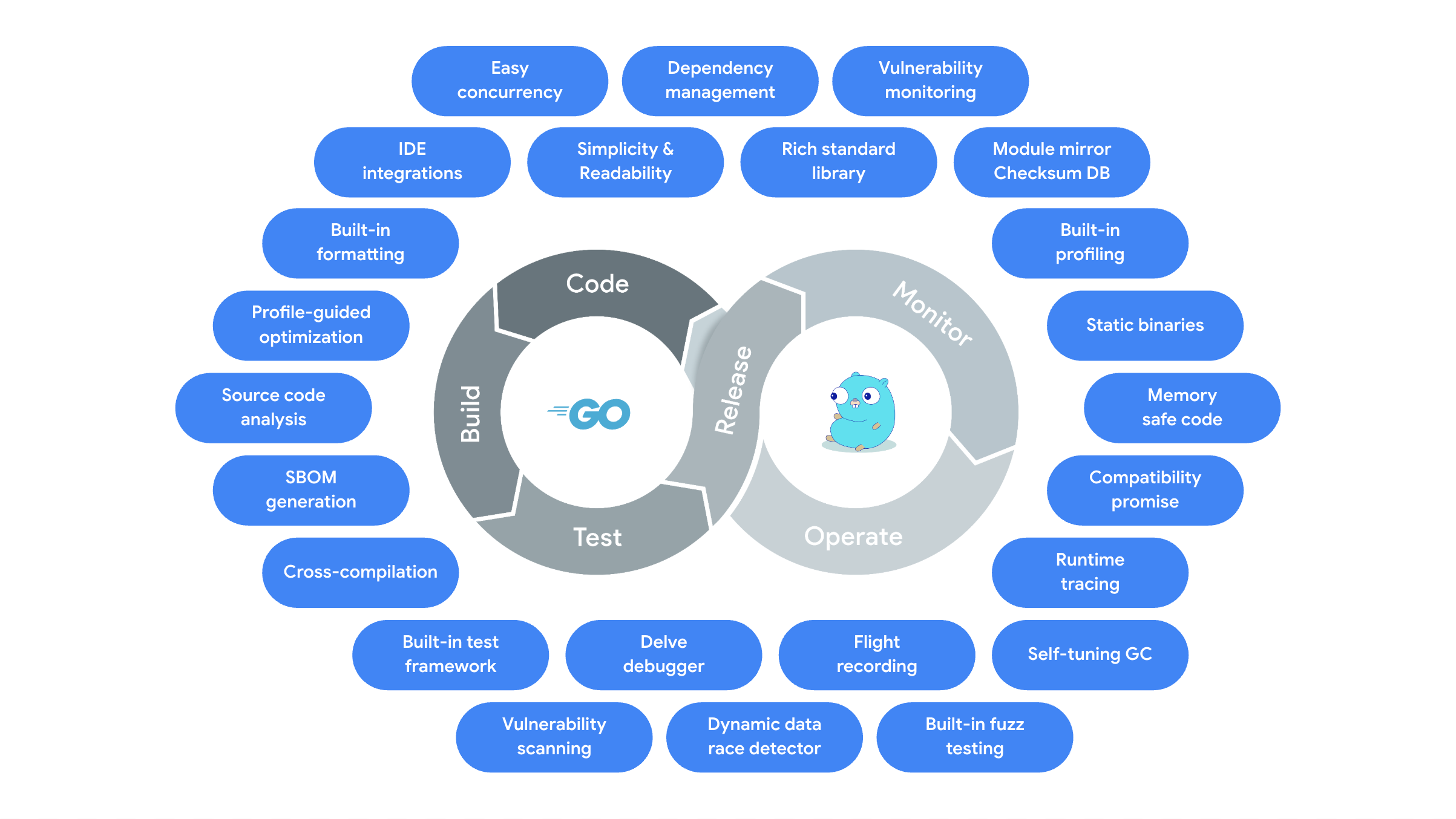
Go is a platform with developer touchpoints all across the software development life cycle.
These features and tools were originally built to empower humans, but it turns out that AI and humans have surprisingly similar needs. When an AI agent is asked to refactor code iteratively without external validation, its performance can quickly degrade—much like a human refactoring by hand. A first pass might be 95% correct, but successive passes compound the error rate and pollute the context window, dropping accuracy while increasing token costs. But with Go, AI models can leverage the platform’s end-to-end toolchain to operate on Go code faster, cheaper, and more reliably, producing higher-quality, more secure, and more correct code.
This integrated tooling has a second, less obvious benefit: ecosystem-wide coherence. Because the vast majority of Go developers utilize the same core tools, the entire community moves together uniformly, adopting major language enhancements seamlessly across runtimes, IDEs, and package ecosystems all at once. This unified approach is strengthened by Go’s standard library, which creates further coherence across projects by reducing variance in program logic and promoting repetitive, predictable idioms that developers and AI both can more quickly understand. This structural uniformity not only helps human teams maintain large codebases but also creates cleaner, more standardized training data for LLMs.
Another of Go’s distinguishing characteristics is that it prioritizes readability over writability. Rob, Robert, and Ken recognized that developers spend far more time reading existing code than they do typing it out. In a human-only world, this design philosophy manifests as a culture that prizes simplicity over cleverness and explicitly rejects the syntactic magic that other languages celebrate. Gophers often speak of how they love that they can never tell who on their team wrote a particular piece of code—it all looks the same.
In the era of AI-driven development, this read-first philosophy transforms into a force multiplier. Where individual developers might have historically favored syntax brevity, implicit typing, and clever shortcuts that accelerate prototyping, agent ergonomics—and the corresponding human verification loop—demand the exact opposite: predictability, explicitness, and rigid structure. With AI, the rate-limiting bottleneck of the software development life cycle shifts entirely from generation to verification. If a language offers a dozen different ways to express the same logic, an AI model will inevitably generate a fragmented, haphazardly stylized hodgepodge of syntax. For the human reviewer, verifying that code becomes an exhausting exercise in deciphering intent.
Go solves this through unyielding consistency. By enforcing a single, standardized format via the built-in gofmt tool and offering a language design that intentionally limits complex abstractions, Go ensures that all code—whether written by a senior engineer, a junior contributor, or an LLM—looks the same. When the syntax is entirely predictable, a human developer can spot a hallucinated API call, a logic flaw, or a security vulnerability more quickly. And, because this standardization extends to the open-source Go ecosystem, models are trained on standardized data, making them better at generating correct, idiomatic Go code in fewer shots.
Ultimately, a language that is clear for humans is inherently clear for AI models. As AI continues to accelerate the volume of code we produce, Go’s commitment to readability ensures that we can scale our systems without losing our ability to understand, verify, and safely maintain them.
But readability and developer productivity are only half the battle. A language can be as readable and productive as we like, but if the resulting application is fragile, insecure, or unpredictable under load, it has no place in production.
In Go, the first line of defense is Go’s static type system, which serves as an automated safety net for agentic code. LLMs frequently struggle with structural boundaries and type coherence across files, leading to hallucinated properties and silent, ticking bugs. In dynamically-typed languages like Python, these hallucinations often slip past basic syntax checks and only crash the system at runtime under specific production workloads. In Go, the compiler rejects these errors immediately. If an AI agent attempts to use a non-existent method, pass an incorrect type, or leave a variable uninitialized, the code simply will not compile. Paired with Go’s signature compilation speed—orders of magnitude faster than Java, C#, Rust, and other compiled, production-grade languages—the agent can iteratively refine and fix its own syntax and type errors in a highly efficient self-correction loop, delivering syntactically correct code before a human teammate ever reviews it.
Beyond the compiler, Go’s “batteries-included” philosophy solves a critical security risk inherent to AI-generated code: the software supply chain. When asked to implement a feature, LLMs rely on their training data, which often leads them to suggest stale, unmaintained, or even malicious third-party dependencies. Go’s comprehensive standard library naturally guides AI models to use optimized, secure, and officially maintained packages instead of pulling in external dependencies. This dramatically reduces the surface area for supply-chain vulnerabilities and keeps the codebase lean and maintainable.
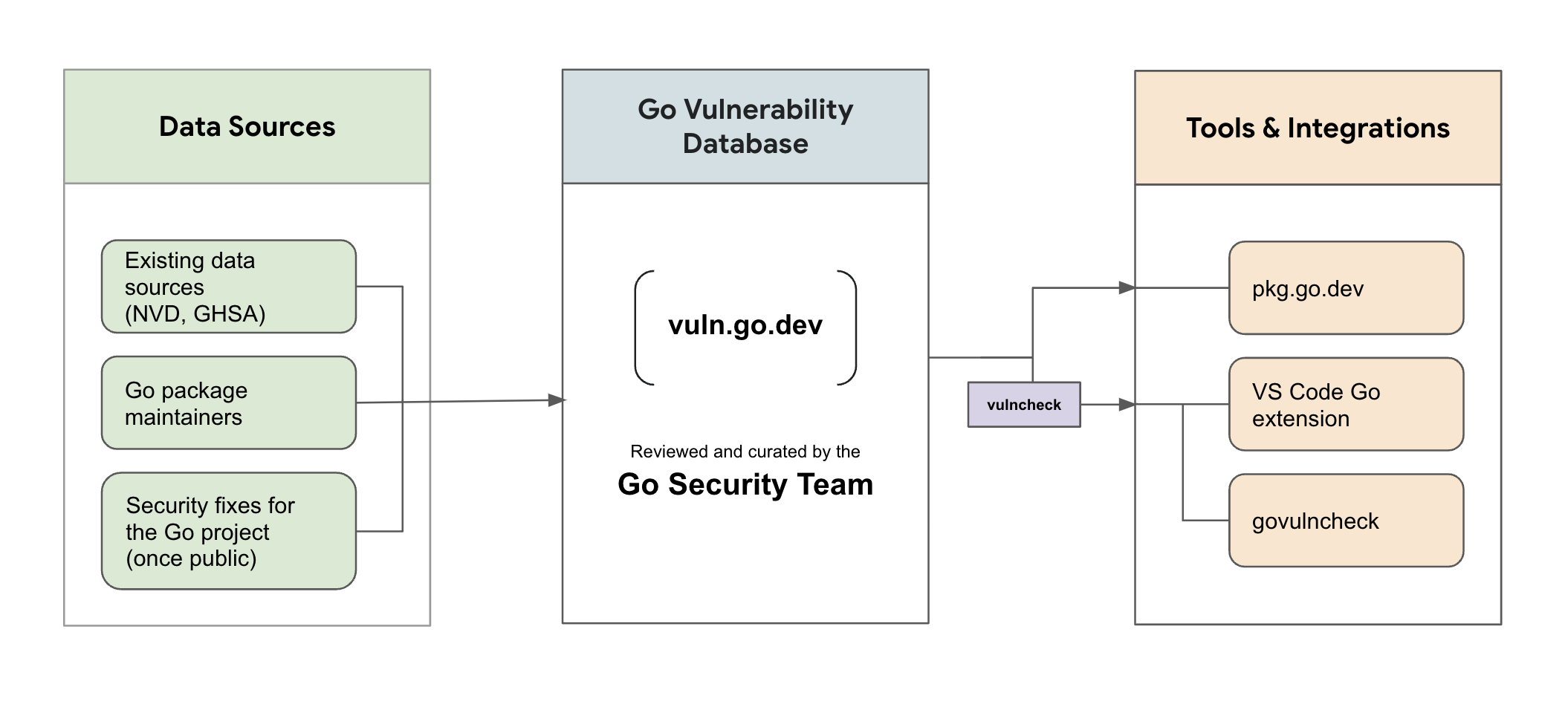
Go’s vulnerability management system reduces noise by only surfacing vulnerabilities in functions that your code is actually calling.
When external dependencies are required, Go’s platform infrastructure guarantees integrity. Checksums and cached copies of every module ever imported into any Go program are recorded in the Go checksum database and module mirror, preventing man-in-the-middle attacks and eliminating the risk of disappearing or silently altered dependencies. Furthermore, Go’s vulnerability database and integrated vulnerability scanning tool, govulncheck, track known vulnerabilities across these dependencies and flag code that invokes vulnerable symbols. This provides low-noise, highly actionable feedback that both human reviewers and AI can use to patch vulnerabilities with precision.
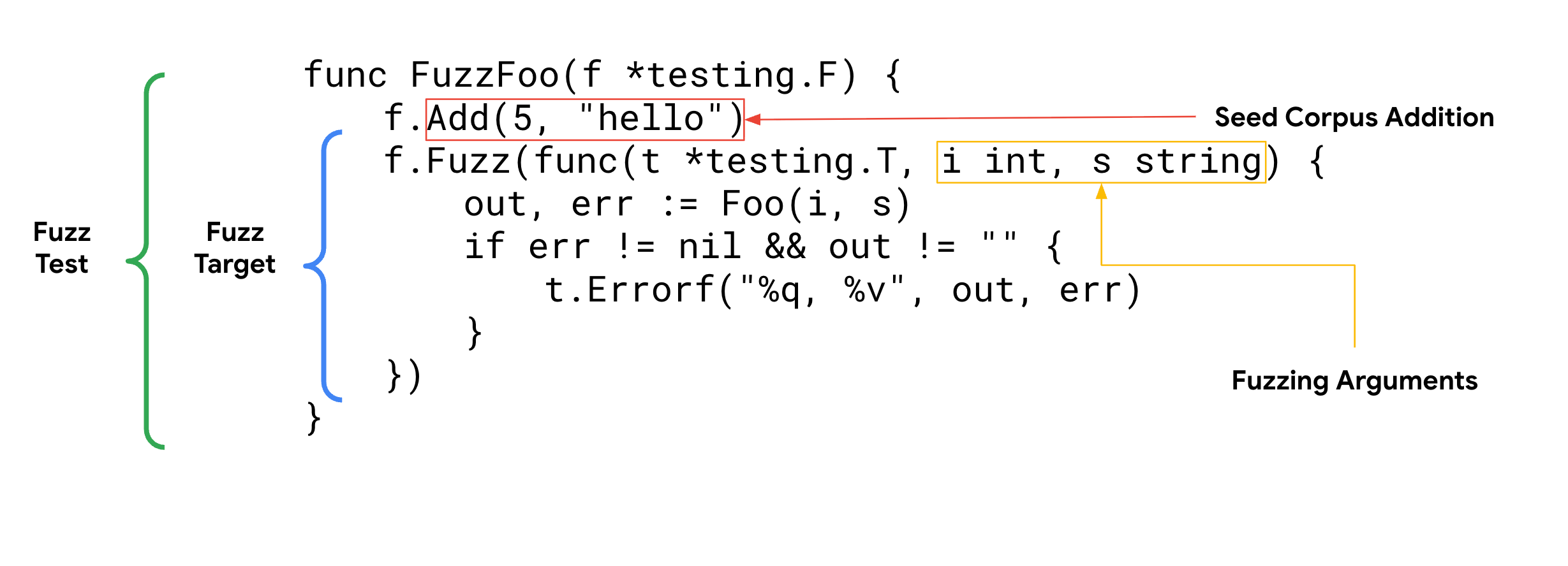
Fuzzing is a type of automated testing which continuously manipulates inputs to a program to find bugs.
Finally, Go's built-in test framework and native fuzz testing tools provide a standardized, rigorous sandbox for continuous validation. Rather than relying on a patchwork of external testing tools and frameworks, Go developers—and their AI teammates—can use the native toolchain to write and run robust tests. By running fuzz tests to expose hidden boundary-case bugs, the AI can iteratively harden its own logic against random, unpredictable inputs. The result is a highly reliable software development life cycle where code is thoroughly hardened before it is put into production.
While readable code gets you to production and reliable code keeps you there today, the true measure of a software system is its maintainability on Day 2 and beyond. Codebases are living systems; they naturally decay, accumulate technical debt, and must constantly adapt to changing requirements. When human developers were the sole authors of software, this maintenance burden was a predictable part of your operational cost. But when autonomous AI agents can generate hundreds of pull requests and refactor entire services on a whim, the rate of codebase evolution and the potential for architectural drift accelerates tremendously.
Go’s primary answer to this acceleration lies in its famous compatibility promise. In Go, compatibility is not just convenience, it is a critical security and operational requirement. Because of the compatibility promise, code written fifteen years ago for Go 1.0 will compile and run on the latest Go toolchain without change. And, because Go is committed to never breaking backward compatibility (there will never be a Go 2.0!), Go code will never break. Instead, as the Go compiler and runtime get better, your code gets better, too, with no changes required: just upgrade, recompile, and reap the benefits.
This long-term durability is even better when paired with Go’s operational portability. Go compiles directly to a single, static binary with zero system dependencies. As autonomous AI agents increasingly operate as system administrators—spinning up microservices, executing scripts, and interacting with environments through command-line interfaces—this self-contained design becomes more important than ever. And because the Go compiler can cross-compile across operating systems and system architectures, these AI agents can easily build binaries for all possible targets, as needed, without complex build systems.
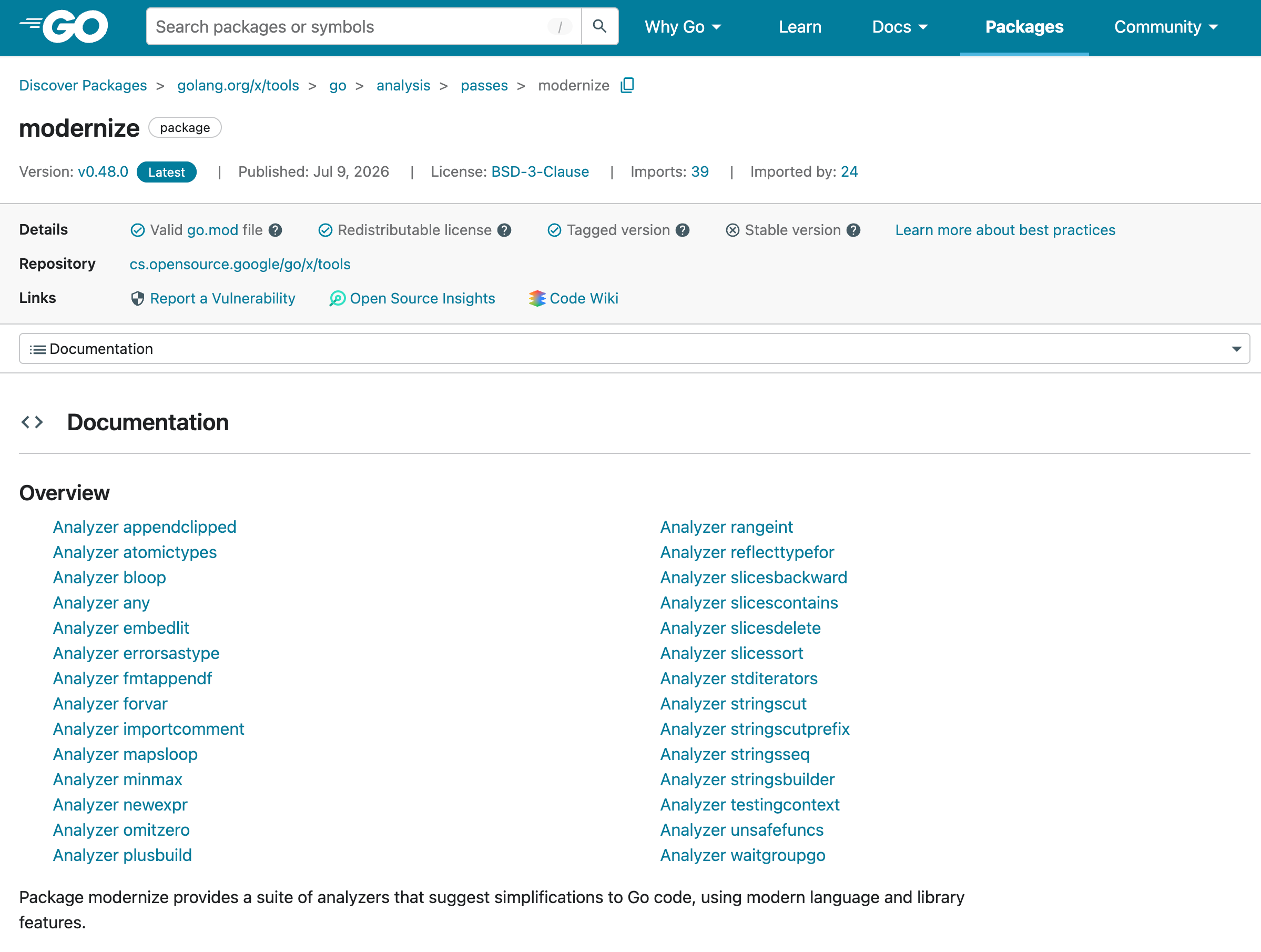
Dozens of pre-built modernizers keep your code uniform by deterministically updating older code patterns to the latest idioms and language features.
To combat architectural drift, Go provides built-in, deterministic tools designed to refactor and modernize codebases—and the entire Go ecosystem—at scale. This includes Go’s official language server, gopls, and the newly rebuilt go fix, which now includes the concept of modernizers. Modernizers keep your code uniform by deterministically updating older code patterns to the latest idioms and language features. At scale, this pulls forward not just your code, but the whole Go ecosystem, maintaining uniformity across libraries, open source projects, and other third-party codebases. And, because these tools are standardized and built directly into the Go platform, AI agents can leverage them to safely restructure packages, manage dependencies, and clean up technical debt without breaking the codebase.
Finally, Go ensures that this maintainability extends directly into the production environment through built-in observability and performance tuning tools. The Go runtime includes built-in profiling and execution tracing out of the box, giving developers deep visibility into application behavior under load. The compiler also natively supports profile-guided optimization, which uses real-world production profiles to compile highly optimized binaries informed by production usage. When combined with an AI-orchestrated deployment pipeline, this creates a highly sophisticated, closed-loop optimization cycle: production data can be automatically fed back into the compiler to rebuild and optimize the system.
As developers write less code, it might seem counterintuitive that their choice of programming language is actually more important than ever. Yet, when code generation is offloaded to AI, the primary bottleneck of software engineering shifts entirely from the speed of writing to the rigor of reviewing, verifying, and maintaining. Languages that historically prioritized loose prototyping and clever, implicit shortcuts now struggle to remain stable under the weight of fragmented, agentic output. Go, by contrast, was designed from day one to solve the challenges of large-scale, long-term collaboration. Its read-first clarity, production-readiness, and platform-wide consistency provide the exact deterministic guardrails required to absorb the high-velocity output of an AI teammate without sacrificing reliability, maintainability, or system integrity.
Ultimately, AI is your newest teammate—a hyper-productive contributor that requires strong guardrails to succeed. When you build on Go, you are not just writing code; you are establishing a robust, self-correcting platform where humans and AI together can safely work and iterate on production systems.
Ready to try it out? To get started:
此内容由惯性聚合(RSS阅读器)自动聚合整理,仅供阅读参考。 原文来自 — 版权归原作者所有。