








peshkov/iStock via Getty Images
During the first quarter, the fund lost 0.56% ¹ ((31/03/2026)). We do not have a stated benchmark in our Key Investor Information Document (KIID) and therefore cannot comment on relative performance. We leave it up to you to decide. We note the above number appears marginally better than European and global benchmarks. Our last reported NAV at quarter end was 19.51 ((31/03/2026)), -0.56% from the closest reported NAV at the fourth quarter end of 19.62 ((31/12/2025)). This brings our one-year NAV return to +9.4% ((31/03/2026 to 31/03/2025)). Our five-year compound annual return is 10.6% and our inception to quarter end NAV return is 95.3% or 10% compounded annual return. We are extremely optimistic about our portfolio's prospects and believe we will reach our compounded annual return aspiration over time. Our fund's composition is unlike any index, and we are unlikely to perform in a similar manner.
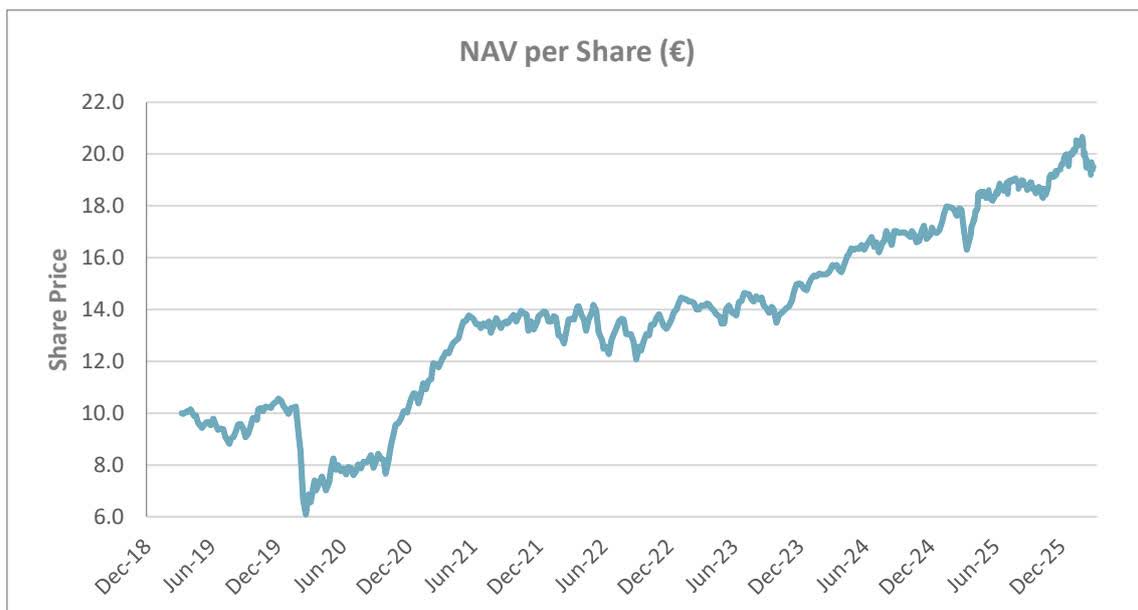
The fund performed well during the first two months of the quarter making new highs at the end of February. The market themes of the first two quarters were a rally in metals, particularly gold and copper, and a rotation in the AI theme, switching, at least momentarily, from those perceived as winners to those that are perceived as losers. The fund mostly sat out these two movements, with the exception of one or two positions. We had a modest exposure to copper with our investment in Atalaya Mining and we only had one possibly controversial AI loser, Universal Music Group via our holdings in Odet and Vivendi, in which we disagree with what some market participants are saying.
Of course, this all went out the window at the end of February where renewed political tensions – most notably the escalation of conflict in the Middle East – drove a sharp rally in energy and some commodities such as fertilizers and reintroduced inflationary risks in an otherwise moderating global disinflation trend. There was plenty of sharp, sentiment-driven volatility, where a single data point, policy hint, or even a well-timed social media post could rapidly shift market direction – triggering risk-off behavior one moment and sparking optimism the next. In such an environment, where even the most astute macro-observers struggle, we are happy to focus on the micro-economics of our businesses and try, to the best extent we can, to shut out the noise. We aren't simply putting our heads in the sand. We are happy to take advantage of the volatility to find even more undervalued rare gems. Rather, we think that it is important to maintain our long-term value discipline and stay the course, because we believe this is critical to capture long-term capital appreciation.
Our investment in Compagnie de l'Odet had positive news as its main asset, Bolloré SE, announced a sizable dividend of some €4.2 billion, or roughly 75% of its year end cash pile of €5.6 billion. Odet, which controls approximately 71% of Bolloré, announced that it would pay out some two-thirds of its share while retaining the rest. We find this interesting. Due to the Bolloré–Odet circular control structure, Bolloré will likely receive nearly €2.3 billion back. This will allow it to maintain flexibility of its balance sheet, while providing Odet the means to likely increase its stake (it has been buying shares of Bolloré aggressively) and perhaps eventually merge with Bolloré. It also allows cash to flow upstream to the parent companies providing them more flexibility to further consolidate the group with minimal tax-leakage. Bolloré's other main asset, Universal Music Group, performed poorly during the quarter with its 18% holding ending the first quarter valued at roughly €5.6 billion. We mentioned above some AI fears rocking parts of the market and we believe UMG's 25% sell off during the quarter might partly be explained by this. Following the quarter, Pershing Square introduced a proposal that was largely financial-engineering in nature rather than operational — but it nevertheless highlighted the depth of UMG's undervaluation. We expect interesting times at Odet, Bolloré and UMG in the coming quarters.
During the quarter we sold our position in Solvay, the soda ash producer, as we were concerned that ongoing expansion projects in Wyoming and China would mean more lower-cost capacity than Solvay's European synthetic product at a time when slow automotive and construction markets are impacting demand. Likewise, we sold our small position in Unilever (UL)'s spin-off Magnum's as the spin did not decline as much as we would have hoped. We also had better uses for the capital. We purchased a Portuguese logistics business and a Korean eyecare company hidden as a chemical distributor.
At quarter-end our portfolio had more than 110% upside to our estimated NAV and was trading at a weighted average P/E of 6.3x ((net of cash)), FCF/EV yield of 18% and a return on tangible capital of 28%.
Contributors Detractors Vitzrocell 136 bps Ibstock -74 bps Vår Energi 117 bps Esprinet -46 bps Danieli Savers 50 bps Converge -40 bps BW Offshore 46 bps Brightstar Lottery -39 bps LNA Santé 46 bps Vivendi -37 bps
The top contributor during the quarter was Vitzrocell (+95.5% +136 bps), the leading South Korean lithium primary batteries manufacturer. Whilst primary batteries are not rechargeable, they have a number of qualities that make them superior for some use cases. These include longer lifetime of over 10 years (vs less than two years for Alkaline or six months for secondary lithium batteries), higher energy density (3-5x Alkaline or secondary) and higher temperature ranges (-55C to +85C). This makes them ideal for extreme environments. Smart meters used in grids and pipelines are half of sales, primarily for utilities, but military and the oil and gas industry applications are both growing fast (with military and oil & gas estimated to be up 120% and 40% respectively in the last two years – now a combined approximately 35-40% of sales in 2025). Vitzrocell reported 15.3% growth in 2025 after delivering 19.6% and 28.3% in 2024 and 2023 respectively. Management is confident about their 2030 target of W600 billion which implies a further 87% growth over the next five years (or 23% CAGR).
The second largest contributor was Vår Energi (+67.5%, +117 bps), the Norwegian oil and gas operator. Vår Energi is the third-largest producer on the Norwegian Continental Shelf (NCS). The company holds equity stakes in approximately 50% of all producing assets on the NCS and is one of the largest exporters of Norwegian gas to Europe. In 2025, Vår delivered a transformational year by sanctioning 10 new development projects. This expanded its reserves and resource base to approximately 2.2 billion boe ² . The company currently has 14 projects in execution, targeting ~210 mmboe net 2P reserves with strong economics (average breakeven of ~$30/boe). In parallel, it is advancing around 30 early-phase projects with potential to add a further ~550 mmboe. This combination of growing production, low and declining costs, stable capex, and a low-risk operating environment on the NCS positions Vår for strong free cash flow generation going forward. Even before the recent escalation of the Iran conflict, Vår Energi reported strong Q4 2025 results in February 2026, exceeding consensus operating cash flow expectations by 39%. The quarter was driven by record-high production of 397 kboepd – up 7% quarter-on-quarter and 43% year-on-year – supported by new field ramp-ups, while unit production costs reached the targeted $10/boe. For the full year 2025, production averaged 332 kboepd, with operating costs of $11.1/boe, down from $12.8/boe in 2024. Strong free cash flow reduced net leverage to 0.8x, well below the 1.3x through-the-cycle target. The company maintained its quarterly dividend at $300 million, still delivering roughly 10% yield at quarter-end, and guided for similar quarterly dividends through 2026. For 2026, Vår expects production to rise to 390–410 kboepd while keeping costs around $10/boe. Notably, management stated the company should remain cash flow neutral at oil prices as low as $40/boe through 2032. With oil currently trading well above $100/boe, Vår is well positioned for substantial free cash flow and attractive shareholder returns.
The third significant contributor was Danieli & C Savers (+14.9%, +50 bps), the Italian steel plant maker and steel producer, introduced in our third quarter 2020 letter. Although sales declined 16% year-on-year due to project timing, EBITDA increased 17% exceeding expectations. The EBITDA was supported by the margin generated in the Plant Making division and by improved performance of the Steel Making division. Here, they expect to achieve solid profitability in the first half 2026, thanks to a more robust and receptive market. Moreover, the Plant Making order book increased by 10.9% to €5,967 millions and remained well diversified by geographical area and product line. The results of the two activities continue to offset each other through the ups and downs of economic cycles, while remaining consistently positive and growing overall. The clean cash (excluding advances) increased by €178 million to €929 million, covering 22% of market cap at quarter-end. Since the start of 2025, Danieli has appeared in four of our five top contributors' lists, generating a ~1.5x return. While the stock continues to look undervalued, we are taking partial profits, cognisant of rising energy and inflation risks.
The fourth largest contributor was BW Offshore (+25%, +46 bps), the Norwegian listed owner, operator and builder of FPSOs ³ . On 5th of December the company announced a strategic review of the business. We were bewildered by the muted share price reaction – as this was a meaningful trigger. We purchased shares and await the outcome of the review.
The fifth largest contributor was LNA Santé (+14.3% +46 bps), the French nursing home and healthcare facilities operator, which we introduced in our fourth quarter 2022 letter. LNA released its full results, confirming 7.6% organic growth, exceeding the upwardly revised guidance of 7% (originally 6%). This performance was primarily driven by a strong 12% organic increase in the Healthcare France segment, supported by higher volumes in home hospital care and day hospital stays. The nursing home business recorded 3.2% organic growth, entirely attributable to the regulated increase in accommodation rates. Reported occupancy rates remained below optimal levels, mainly due to the ramp-up of newly opened beds and the continued underperformance of five specific nursing homes. The operating EBITDA margin came in at 8.7%, down 30 basis points year-on-year, primarily due to tariff increases that lagged inflation. Management indicated that further updates on this front are expected in the coming months. For 2026, the company guided for 5% organic growth, margin stabilization, and additional asset disposals. Most notably, management provided guidance for €50 million in free cash flow (excluding changes in working capital and growth investments), offering greater visibility and confidence in the group's cash generation capacity and establishing a strong case for upside potential.
The top detractor was Ibstock (-27.9% -74 bps), the British brick and concrete product manufacturer, which we introduced in our third quarter 2019 letter. Group revenues rose 2%, driven by strong new-build activity in the first half, while Adjusted EBITDA fell 10% - in line with revised guidance. The margin pressure reflected ongoing cost inflation, an adverse product mix shift toward lower-margin new-build volumes, and elevated costs associated with reinstating capacity. Net debt edged slightly lower, aided by £30 million in proceeds from non-core divestments. The commissioning of the Atlas and Nostell facilities are now largely complete, which should reduce capex requirements and increase efficiency. Management expects residential new-build and repair & maintenance markets to remain subdued through the first half of 2026, with only modest volume recovery anticipated in the second half. In this environment, the key levers under the company's control are cost reduction and tight inventory management. On the cost side, approximately 80% of Ibstock's energy needs for 2026 are already secured, providing a degree of protection against the probability of another energy crisis. The timing and magnitude of recovery remains uncertain, but longer-term prospects are positive. The UK government has set an ambitious target of 300,000 annual home completions, yet delivered roughly 150,000 in 2025. Even a normalised run-rate closer to 200,000 completions should enable Ibstock to generate significant free cash flow. Owning a dominant, high-quality business through the current trough offers compelling upside potential once volumes recover toward more normalised levels.
The second largest detractor was Esprinet (-20.5%, -46 bps), the Italian electronics distributor, which we introduced in our fourth quarter 2019 letter. Esprinet reported 2025 results, with sales rising 3.6% to €4,292 million. Growth was driven by a strong performance in Iberia (+10% in Spain and +47% in Portugal), while Italy remained essentially flat. Gross margin held steady at ~5.5%, supported by lower factoring costs. The resulting increase in gross profit was offset by higher operating expenses, leaving adjusted EBITDA broadly stable at €70 million. The net debt increased more than expected due to higher working capital requirements, partly linked to opportunistic inventory builds ahead of anticipated price increases. What really caught the market off guard was the announcement that Alessandro Cattani, CEO (and significant shareholder) for over 25 years, will step down effective late April 2026. He plans to remain a major shareholder. At 63, Cattani cited reduced energy for leading the company forward as the main reason for his decision. Management acknowledged that the timing and communication of the retirement could have been handled more smoothly, noting that challenging macro conditions and uncertainty around memory pricing did not help market sentiment either. On the positive side, management provided an upbeat outlook for 2026, highlighting an expected recovery in Italy and continued strong momentum in Spain and Portugal. The Board proposed a final dividend of €0.35 per share, implying a payout ratio of 85%. Despite the messy quarterly reporting and the leadership transition, Esprinet continued to generate strong free cash flows which should justify a significantly higher valuation. We remain bullish on the share.
The third significant detractor was Converge (-19.2% -40 bps), the Philippines-based telecommunications company specializing in high-speed fiber-optic broadband internet, which we introduced in our fourth quarter 2025 letter. Converge ICT reported 10.6% year-on-year revenue growth for the fourth quarter 2025, driven by a strong 31.4% surge in the enterprise segment that more than offset the modest 6.6% growth in the residential business. Quarterly net subscriber additions slowed to 56,000 in the fourth quarter — well below the average of 121,000 over the previous three quarters. This brought the total residential user base to approximately 3 million, reflecting 16.4% year-on-year growth but only 2% quarter-on-quarter. Management attributed the slowdown to weather-related disruptions and outages, which particularly dampened demand in the prepaid segment. Looking ahead, the company expects consolidated revenue growth of 8-10% in the coming year — a slight moderation from the prior year's performance. EBITDA margins are projected to settle at 58-59%, implying a 140-240 basis point dilution. Meanwhile, capital expenditures are forecast to remain elevated at ₱18-23 billion, as Converge accelerates network expansion into the Visayas and Mindanao regions. We continue to see short-term operational challenges with room for normalisation while high capex masks true cash generation. If we are correct the upside remains significant.
The fourth detractor was Brightstar Lottery (-14.7%, -39 bps), the Italian-American lottery technology systems provider, which we introduced in our first quarter 2020 letter and updated in our first quarter 2024 letter. We have lost count of how many times we have commented on the performance of Brightstar (formerly [IGT]). Admittedly, it has been a volatile journey, but the position remains one of the biggest earners of the fund. With a 7% dividend yield and a defensive business model, it screams value, but we understand the long-duration characteristics of the equity story can sometimes detract from short term share price performance.
The fifth largest detractor was Vivendi (-24.9%, -37 bps), the French listed holding company with focus on content, media, and entertainment industries. Vivendi continues to face pressure, primarily due to its heavy exposure to Universal Music Group (UMG), which accounts for approximately 65% of the company's net asset value. Over the quarter, UMG's share price fell 35%, largely driven by investor concerns over future growth amid rising AI-related risks in the music industry. Although UMG's fourth quarter 2025 results beat consensus expectations — supported by several one-off items — subscription revenue growth (which represents around 40% of total sales) continued to decelerate. Cash generation remained flat, weighed down by elevated artist advances and increased catalogue investments, both of which form part of capital expenditure and are linked to the company's emerging markets growth strategy. These elevated investment levels are expected to persist into this year. We continue to regard UMG as a high-quality business that has de-rated from an elevated valuation. What we find particularly attractive now is the opportunity to gain exposure to the company at an even steeper discount through Vivendi.
Cirsa is a leading Spanish-based omni-channel gaming company with operations across Spain, Latin America and Italy. Cirsa manages 460 casinos and gaming halls, 80,000 slot machines and has a rapidly growing online gaming and betting division. The Company operates in 100% regulated markets and is the number one or two player within most markets it operates.
The company was founded in 1978 in Spain following the legalization of gaming in the country. In its early years, Cirsa focused on slot operations and manufacturing. In 1982 the group acquired its first casino in Spain, marking the beginning of its diversification strategy. During the 1990s, Cirsa expanded into Latin America, establishing a presence in countries such as Colombia, Panama and Mexico. In the 2000s, the company entered the Italian market through slot machine concessions. In 2007, Cirsa launched Sportium, a joint venture for sports betting, which later became a cornerstone of its online strategy. In a pivotal move for the company, Blackstone (BX) acquired a majority stake in 2018 from its founder Manuel Lao Hernández. Under Blackstone's ownership, Cirsa has focused on operational efficiency and a buy-to-build strategy, completing over 25 bolt-on acquisitions to consolidate its leadership in fragmented markets. The group has significantly pivoted toward an omnichannel model, acquiring a 100% stake in Sportium in 2019. Cirsa successfully completed its IPO in mid-2025. Since its creation some 50 years ago, Cirsa has built a well-balanced portfolio and is considered a leading global operator.
The company runs four business units. Casino segment (55% of 2025 EBITDA) is considered the Group's cash-cow and is focused on the low-wager mass-market customer profile. The Company operates 447 casinos across eight countries including Spain (268), Colombia (78), Panama (36) and Mexico (30). Other jurisdictions include Peru, Costa Rica, Dominican Republic and Morocco. Most licenses are either indefinite or generally automatically renewed. Slots Spain segment (30%) focuses on the operation of 25,500 slot machines in Spain where Cirsa is the clear market leader. The concession agreements consist of long-term exclusive contracts with hospitality venues (typically 5 to 10 years) and regional government licenses, which create high barriers to entry and provide predictable, recurring cash flows. The segment also includes the manufacturing of machines through its B2B division, which allows for product innovation and operational efficiency. Online Gaming and Betting (14%) operates primarily under the Sportium brand and is the fastest growing segment with EBITDA growing 5.7x since FY19. It is a critical part of Cirsa's omnichannel strategy leveraging its physical retail locations to acquire and cross-sell to online customers. Slots Italy (4%) manages 15,500 slot machines in Italy. The segment is not considered as core and management might be willing to divest at a right price.
Cirsa operates in a highly fragmented gaming landscape where it typically holds dominant market positions against mostly local, small-scale competitors. In the Casino segment, the group does not face major international competition, as its markets are primarily served by local family-owned companies. Its primary competitive risk in this area stems from the potential for regulators to issue new licenses rather than pressure from existing peers. In Slots Spain , Cirsa is the clear leader with 26% market share, identifying Codere as its most significant direct competitor in slot operations with 6-7% share. The Online Gaming & Betting division faces stronger competition from major international brands such as Bet365, Flutter (FLUT), Entain, and 888 Holdings. However, Cirsa (Sportium) is estimated to hold second position with an 11% market share, alongside Bet365. The Italian slot-machine market remains a challenge where CIRSA is an outsider (ranked #5) competing against much larger, established operators like Lottomatica and Snaitech (owned by Flutter).
Cirsa operates exclusively within fully regulated markets, a strategy that provides high barriers to entry but ties profitability closely to evolving government policies, such as fluctuating tax regimes and tightening advertising restrictions. While the business model depends on long-term government licenses and concessions, risk is mitigated by historically high renewal rates exceeding 90%. Geographically, the company generates 39% of its EBITDA from Latin America, exposing operations to regional political instability, currency devaluation, and macroeconomic volatility. Although the "low-wager" nature of its customer base typically renders the gaming sector recession-resilient, a severe economic downturn could still compress discretionary entertainment spending.
Prediction markets may pose a challenge for Cirsa. The regulatory response across its multi-jurisdictional operations could vary. Delays in regulating prediction markets could risk attracting bettors away from fixed-odds sportsbooks, pressuring GGR and margins. It is worth mentioning, Cirsa is responding proactively by launching its own prediction-style contracts in Spain later in 2026, creating an opportunity to engage younger, more analytical users. The company believes Spanish law prohibits these markets by non-regulated entities but time will tell how this will unfold.
We expect Cirsa to deliver solid growth in the coming years, primarily driven by the continued expansion of the online sports betting market, the ongoing rollout of the group's casino expansion strategy, and further consolidation opportunities in the fragmented markets where it operates. Short-term, margins may face some dilution as the faster-growing online segment — which currently operates at a lower margin profile of 19-20% — increases its weight relative to the group's overall average of 31-32%. However, over the longer term, as the online business scales and benefits from operating leverage, omnichannel synergies, and efficiency gains, we see no reason why Cirsa could not progressively narrow the gap toward group's average. All things considered, Cirsa is trading at a mid-teens free cash flow yield, which leaves ample room for price appreciation as the market recognizes its growth trajectory and improving profitability mix.
Post-IPO, Blackstone continues to hold a 72% stake in the company. While occasional share placements may exert temporary pressure on the stock price, we expect Blackstone to gradually release shares as the market increasingly recognizes the fundamental value of the equity.
Capital allocation is focused on consistent dividend distribution, approximately 35% of net profits, disciplined deleveraging, targeting 2-2.5x in the medium term and value-enhancing M&A. M&A is an integral part of Cirsa's growth story, which accounted for one-third of the group's historical growth.
For our Spanish investors, we are happy to report that the fund is now “traspasable” and the CNMV has been notified. We hope this makes investing an easier decision in Spain.
As previously mentioned, the fund changed to daily dealing at the end of April 2025. We have also launched an unhedged sterling share class in May of 2025 and an unhedged dollar share class in March of 2026. Given our current fund size, fund costs have dropped as a percentage of assets and we initiated a 50 bps (0.5%) management fee starting in May 2025 as we believe the total cost to the investor will be reasonable (<1%). The founder's class management fee is up to 1% of assets but we have no current plans to increase the management fee as we want to keep total costs low. We do not charge entry or exit commissions.
Our focus is and remains on the portfolio, but we do need to grow our assets to a sustainable level. Please feel free to share this letter with any potential investors.
We have a commercial agreement with Cobas Asset Management to distribute our fund in Spain . You can now open an account and place orders with them. For more information, please contact them via phone or email. In the future, we hope it will be possible via their website. You can reach the Cobas team at +34 91 755 68 00 or soporteinstitucional@cobasam.com
Our fund can be invested in through both European international central securities depositories: Euroclear and its FundSettle clearing platform and Clearstream through the Vestima fund clearing platform. Our fund is registered for distribution in the UK, Spain, Germany and Luxembourg including for retail distribution.
Other distributors in Spain where our fund is offered include: Renta 4, myinvestor, Ironia, Lombard Odier, Creand as well as many other institutions working through the main platforms in which the fund is available upon request: Allfunds Bank and Inversis.
In the UK we are offered on the AJ Bell low-cost platform ajbell.co.uk and can be part of an ISA or pension. Interactive Broker (IBKR)'s UK website now allows for a dealing account and ISA. We can also be found on TransAct, Interactive Investor, Quilter and Aegon.
Our fund is also available on Interactive Brokers where you can open an account in almost any jurisdiction (fund not available in the US). SwissQuote also offers almost world-wide access where virtually any nationality (ex-USA) can open an account without local Swiss taxes being an issue.
If you have any issues finding our fund or wish to get more information about us and our process, please contact us at IR@palmharbourcapital.com
Our fund is being offered as part of a Spanish pension value-orientated fund of funds. Please follow this link to find out more.
Stefan Weiss, a long ago colleague of Peter's past evil German banking days, joins the team to redeem his sins. He will contribute on both the analysis and investor relations front (or wherever else he can).
We thank you for your ongoing support. We continue to believe this is a great time to be a value investor and are very excited about the medium-term prospects for the portfolio.
Yours faithfully,
Palm Harbour Capital
This information is being communicated by Palm Harbour Capital LLP which is authorized and regulated by the Financial Conduct Authority. This material is for information only and does not constitute an offer or recommendation to buy or sell any investment or subscribe to any investment management or advisory service. In relation to the United Kingdom, this information is only directed at, and may only be distributed to, persons who are “investment professionals” (being persons having professional experience in matters relating to investments) defined under Articles 19 & 49 of Financial Services and Markets Act 2000 (Financial Promotion) Order 2001 & Articles 14 & 22 of the Financial Services and Markets Act 2000 (Promotion of Collective Investment Schemes) (Exemption) Order 2001 and/or such other persons as are permitted to receive this document under The Financial Services and Markets Act 2000. Any investment, and investment activity or controlled activity to which this information relates is available only to such persons and will be engaged in only with such persons. Persons that do not have professional experience should not rely or act upon this information unless they are persons to whom any of paragraphs (2)(a) to (D) of article 49 apply to whom distribution of this information may otherwise lawfully be made. With investment, your capital is at risk and the value of an investment and the income from it can go up as well as down, it may be affected by exchange rate variations, and you may not get back the amount invested. Past performance is not necessarily a guide to future performance and where past performance is quoted gross then investment management charges as well as transaction charges should be taken into consideration, as these will affect your returns. Any tax allowances or thresholds mentioned are based on personal circumstances and current legislation, which is subject to change. We do not represent that this information, including any third-party information, is accurate or complete and it should not be relied upon as such. Opinions expressed herein reflect the opinion of Palm Harbour Capital LLP and are subject to change without notice. No part of this document may be reproduced in any manner without the written permission of Palm Harbour Capital LLP; however, recipients may pass on this document but only to others falling within this category. This information should be read in conjunction with the relevant fund documentation which may include the fund’s prospectus, simplified prospectus or supplement documentation and if you are unsure if any of the products and portfolios featured are the right choice for you, please seek independent financial advice provided by regulated third parties.
Editor's Note: The summary bullets for this article were chosen by Seeking Alpha editors.
此内容由惯性聚合(RSS阅读器)自动聚合整理,仅供阅读参考。 原文来自 — 版权归原作者所有。