







To gauge growth, look at the share of the population pursuing careers rather than just trying to make ends meet.

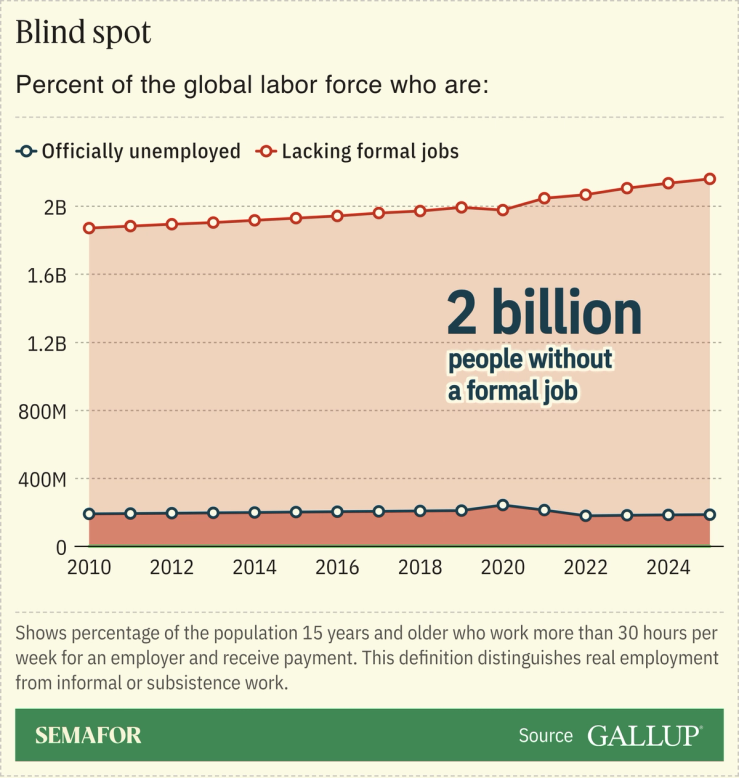
Current global jobs numbers peg unemployment at only 5%, suggesting that almost everyone who wants work has it. But that figure includes people who are just scraping by with informal jobs, “gig work,” and other ways of earning money.
Gallup strips out the roughly 2 billion people worldwide who are informally employed. Measuring the percentage of people over age 15 working at least 30 hours a week in full-time, formal jobs puts that global unemployment number closer to 50%. Focusing on what Gallup calls “gross domestic payroll to population,” or GDP2P, reveals a workforce actually pursuing careers and striving for upward mobility.
Core finding: The growth in formal employment in the US, China, and western Europe has flattened, while the share of rewarding work in emerging economies in Asia, the Gulf, and eastern Europe is improving.
The US has hit a ceiling. For nearly two decades, the percentage of people 15 or older working full time for an employer has been stuck in a loop, bouncing between 42% and 46%. The old economic engine of “more people equals more output” has stalled, squeezed by a triple whammy — an immigration crackdown, a falling birth rate, and a manufacturing job boom that never arrived.
Even US Federal Reserve Chair Jerome Powell admitted this March that the country is facing something unprecedented: a labor force that simply isn’t growing. While official job numbers show most Americans working, Gallup’s data shows half the population without formal employment.
The percentage of people with formal employment in China soared from 25% in 2011 to a 42% peak in 2022, when the country’s post-pandemic economic engine roared back to life and state-sponsored enterprises kept payrolls full to ensure social stability. But as the economy has slowed, the property crisis has wiped out jobs, and formal employment among China’s younger generation has slipped, that number has dropped to 37%.
India faced a similar roller coaster ride, surging to 30% in 2018, then plunged to 17% following the shocks of demonetization and the pandemic. The rate clawed back up to 26% last year — but cracks in the growth narrative persist in the world’s largest democracy.
Europe is split. Job growth is flat (or down) across western Europe, but rising among eastern European countries. In the UK, waves of Brits are going abroad in search of better careers. Traditional powerhouses like Germany, France, and Italy are reckoning with rising energy and housing costs, declining manufacturing, and an aging workforce.
Jobs are growing in Poland, Croatia, and other eastern European countries that have benefited from a post-pandemic, tariff-fueled shift from China to nearshore manufacturing, logistics, and business services closer to home.
Vietnam is the standout performer in the new global economy, nimble enough to navigate a fractured global order, strong enough to resist superpower coercion, and open enough to capture the immense opportunities from growing South-to-South trade flows. Manufacturers are flocking to the country, escaping geopolitical uncertainty with a China +1 strategy. Vietnam’s experience underscores how growth in real jobs can translate into a positive outlook on the future.
Likewise, Saudi Arabia’s diversification has produced dramatic results: The percentage of Saudis with formal employment soared from 27% to 51% in a decade.
此内容由惯性聚合(RSS阅读器)自动聚合整理,仅供阅读参考。 原文来自 — 版权归原作者所有。