



惯性聚合 高效追踪和阅读你感兴趣的博客、新闻、科技资讯
阅读原文 在惯性聚合中打开

推荐订阅源

博客园 - 【当耐特】
云风的 BLOG
云风的 BLOG
罗磊的独立博客
C
Check Point Blog
奇客Solidot–传递最新科技情报
奇客Solidot–传递最新科技情报
Blog — PlanetScale
Blog — PlanetScale
freeCodeCamp Programming Tutorials: Python, JavaScript, Git & More
月光博客
月光博客
大猫的无限游戏
大猫的无限游戏
Google DeepMind News
Engineering at Meta
Engineering at Meta
N
Netflix TechBlog - Medium
宝玉的分享
宝玉的分享
Recent Announcements
酷 壳 – CoolShell
酷 壳 – CoolShell
博客园_首页
J
Java Code Geeks
Apple Machine Learning Research
人人都是产品经理
人人都是产品经理
爱范儿
爱范儿
I
InfoQ
Hugging Face - Blog
Hugging Face - Blog
T
Tailwind CSS Blog
B
Blog RSS Feed

Semafor

US inflation jumps, though long-term war impact yet to be seen Hospitals consider replacing some radiologists with AI Amazon takes a jab at Nvidia over chips shift VCs step in to fund university upstarts Exclusive: Anthropic is gaining on OpenAI’s revenue, but hasn’t yet eclipsed it Exclusive: AI powerhouses threaten data processing firms A South African artist is changing the way viewers understand Picasso’s Guernica Airbnb faces familiar battle in Cape Town First look at war-related inflation sparks political jostling View: China’s state businesses are reshaping markets in Africa US issues Nigeria travel warning over terrorism, kidnapping FirstRand exits UK business after regulatory hit Afreximbank’s $800M answer to Fitch Exclusive: Navy takes nuclear-powered sub offline after $800 million cost run-up Cuba leader says he will not step down Fed, Treasury summon Wall Street chiefs over AI fears How Bluesky earned its reputation — and why it could be the way of the future China eyes stronger Taiwan influence Orbán slams Hungary’s opposition as he trails in polls Iran war reshapes air travel, perhaps for the long term Tehran residents embrace calm amid tenuous truce Countries lack fiscal capacity to handle war fallout Higher producer prices ease China deflation fears Trump ‘optimistic’ on Iran peace talks Inside the five-year succession plan at a $130B warehouse giant Georges Elhedery on HSBC’s big bets on the Gulf and Asia Warsh’s Fed hearing slips past next week Moore takes on the Sun’s ‘MAGA billionaire’ and more Debatable: AI titans influencing regulation Americans still think taxes are too high, poll finds
View: Ghana’s president offers insights on life after USAID
Alexis Akwagyiram · 2026-06-05 · via Semafor

Ghana’s president gave a rare insight this week into what it is like to lead an African government hit by the shuttering of Washington’s international aid agency.

Accra factored an average of $154 million a year from USAID into government budgets, of which nearly half went into “critical areas” of its health system, President John Dramani Mahama revealed at London’s Chatham House think tank. He tapped a government health fund to release $300 million but pointed out that other nations have been left reeling.
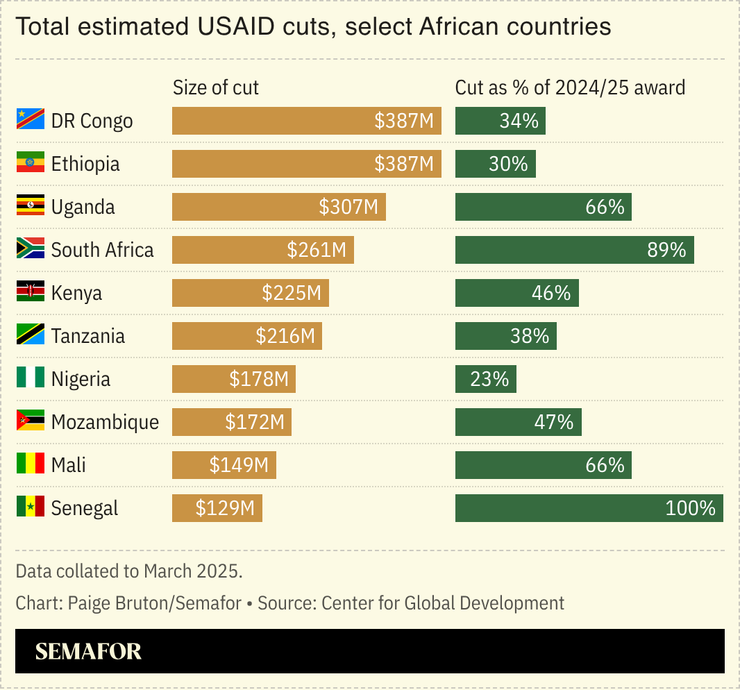
A chart showing the total estimated USAID cuts in select African countries.

That glimpse into policymaking in an increasingly turbulent world highlights the challenges faced by smaller nations and so-called middle powers in an era of dwindling multilateralism.

Washington’s transactional approach to foreign policy is probably clearest in its global health policies, where the ​​Trump administration’s America First Global Health Strategy asks countries to share health data about their citizens as a condition of receiving funding. Some African nations — including Ghana, Zambia, and Zimbabwe — have rejected the agreements. But US Secretary of State Marco Rubio, addressing a Senate committee this week, said 32 countries had signed the health compacts, including a number of African nations.

Rubio said the strategy was an improvement on traditional donor-NGO relationships that created dependency and weakened local capacity. But critics warn the impact of US development cuts is already playing out through the Ebola outbreak in DR Congo, where the US was reportedly the largest donor, financing around 70% of humanitarian work. Nicholas Kristof of The New York Times recounted how health experts told him the sudden withdrawal of aid workers removed early warning systems that meant the Bundibugyo strain of Ebola, for which there is no vaccine yet, may have circulated, undetected, for weeks.

At a time of shrinking aid budgets across Western countries and the shift to increased defense spending, it’s clear that African countries need to adapt to a new world. Mahama stressed the need for African governments to cut waste and improve governance as a buttress against increasingly frequent international shocks because a return to the old system of global support is very unlikely. His message was simple: “We must take our destinies into our own hands.”