

惯性聚合 高效追踪和阅读你感兴趣的博客、新闻、科技资讯
阅读原文 在惯性聚合中打开

推荐订阅源

T
The Blog of Author Tim Ferriss
Hugging Face - Blog
Hugging Face - Blog
F
Fortinet All Blogs
B
Blog
Cyber Security Advisories - MS-ISAC
Microsoft Security Blog
Blog — PlanetScale
Blog — PlanetScale
月光博客
月光博客
腾讯CDC
小众软件
小众软件
G
Google Developers Blog
V
Visual Studio Blog
罗磊的独立博客
GbyAI
GbyAI
V
V2EX
大猫的无限游戏
大猫的无限游戏
H
Help Net Security
L
LangChain Blog
Engineering at Meta
Engineering at Meta
量子位
The GitHub Blog
The GitHub Blog
博客园 - 司徒正美
WordPress大学
WordPress大学
B
Blog RSS Feed

Latest from Tom's Hardware

Our experts review your astonishing PC builds and setups in Rig Rundown — from wall-mounted setups to a system… News outlets are blocking Wayback Machine from archiving their pages — 23 outlets concerned AI companies might abuse fair use and use it to train their models Mark Zuckerberg reportedly working on AI clone of himself — Meta insiders claim 3D photoreal animated Zuck will be able to engage with employees on his behalf Score a massive $700 off this 4K-ready Lenovo gaming PC with an RTX 5070 Ti, now just $1,899 — epic Legion Tower 5i pre-built ships with a 20-core Intel CPU, 32GB DDR5 and a 2TB SSD Pay $1,349.99 for Gigabyte's Aero X16 laptop and save $300 on this 32GB beast with RTX 5070 graphics —… Veteran Windows dev shows off AI running on 47-year-old PDP11 with 6 MHz CPU and 64KB of RAM — 'gloriously absurd' project runs transformer model written in PDP-11 assembly language Half of all US employees now use artificial intelligence at work, crossing landmark threshold for first time — Gallup data shows daily and weekly usage hitting all-time high of 28% in Q1 2026, with 65% feeling positive about its impact on productivity China has spent 3.6 times more than the US on chipmaking subsidies over the past decade — $142 billion and counting, easily outweighs CHIPS Act FAA approves military use of drone-killing laser weapons in US airspace — decision comes after it was decided ‘systems do not present an increased risk to the flying public’ Nvidia says AI cuts 10-month, eight-engineer GPU design task to overnight job — company is still 'a long way' from AI designing chips without human input Small Missouri town ousts half its city council after $6 billion AI data center approval — petition calls for mayor's removal as frustration (and violence) over AI data centers mounts New tech can see a CPU's transistors in action — terahertz radiation can potentially steal data as a chip is… Intel's Nova Lake CPUs gear up to seize AMD’s 3D V-Cache gaming throne — early leak points to up to 52 cores, blazing DDR5-8000 support, and massive 175W TDP Acer Predator GX850 SFX power supply review: Solid electrical performance with good efficiency NZXT to cough up $3.45 million over 'predatory' Flex PC rental scheme in RICO class-action settlement — in-debt customers to get up to $5,000 of relief, eligible renters to be granted ownership Bulbous 15x fan PC case side panel dubbed the ‘Superdome’ lowers temps by 20 degrees —  $600 worth of Noctua fans arrayed in 3D-printed structure Approvals for Nvidia and AMD AI chip exports to China stall under government bottleneck —  20% staff turnover… Espresso Lite 15 Review: An entry-level portable monitor with a splash of color Save a massive $700 on this 4K-ready HP gaming PC with a 9800X3D and RTX 5070 Ti, now just $2,499 — discounted HP Omen 35L pre-built powerhouse ships with 32GB DDR5 RAM and a 1TB SSD 'CopprLink' destroys every eGPU standard in new test, achieves near-native-level performance with an RTX 5090 — setup requires $2,300 worth of additional hardware Website backup crippled by 1.6MB Friends GIF that was replicated 246,173 times, breaking Linux's EXT4 filesystem limit — Jennifer Aniston's 'happy dance' animation ate up 377 gigabytes of data due to security policy Why we spent 50+ hours retesting Intel’s Core Ultra 270K Plus and 250K Plus Just $284.99 for 32GB of Team T-Create Classic DDR5-6000 RAM is the cheapest going right now — this double-dipping… Grab MSI’s RTX 5080 gaming laptop for just over $2,000 — offers fast 240 Hz QHD+ display, dual storage slots, and expandable DDR5 memory Lenovo hikes Legion Go 2 handheld gaming PC to almost $3,000 for 2 TB model — Handheld now costs more than AMD's Strix Halo devices despite relatively weaker Z2 Extreme chip Iran's forced nationwide internet blackout becomes second-longest on record as it passes 1,000 hours offline — possessing Starlink terminals punishable by death, country using 'military-grade jamming' against service Tiny 3-inch cube PCs bring a splash of color to the passive PC market with red, orange, green and blue options — Intel Twin Lake-powered Kubb Mini PCs start at $500 Veteran Microsoft engineer says original Task Manager was only 80KB so it could run smoothly on 90s computers — original utility used a smart technique to determine whether it was the only running instance Tech enthusiast gets Doom to run on a 40-year-old printer controller — ancient Agfa Compugraphic 9000PS came with a Motorola 68020 onboard for fast processing Keychron Q6 Ultra 8K Review: 660 hours of battery life at 8 KHz
Palantir co-founder Peter Thiel backs $140M wave-powered ...
Etiido Uko · 2026-05-05 · via Latest from Tom's Hardware
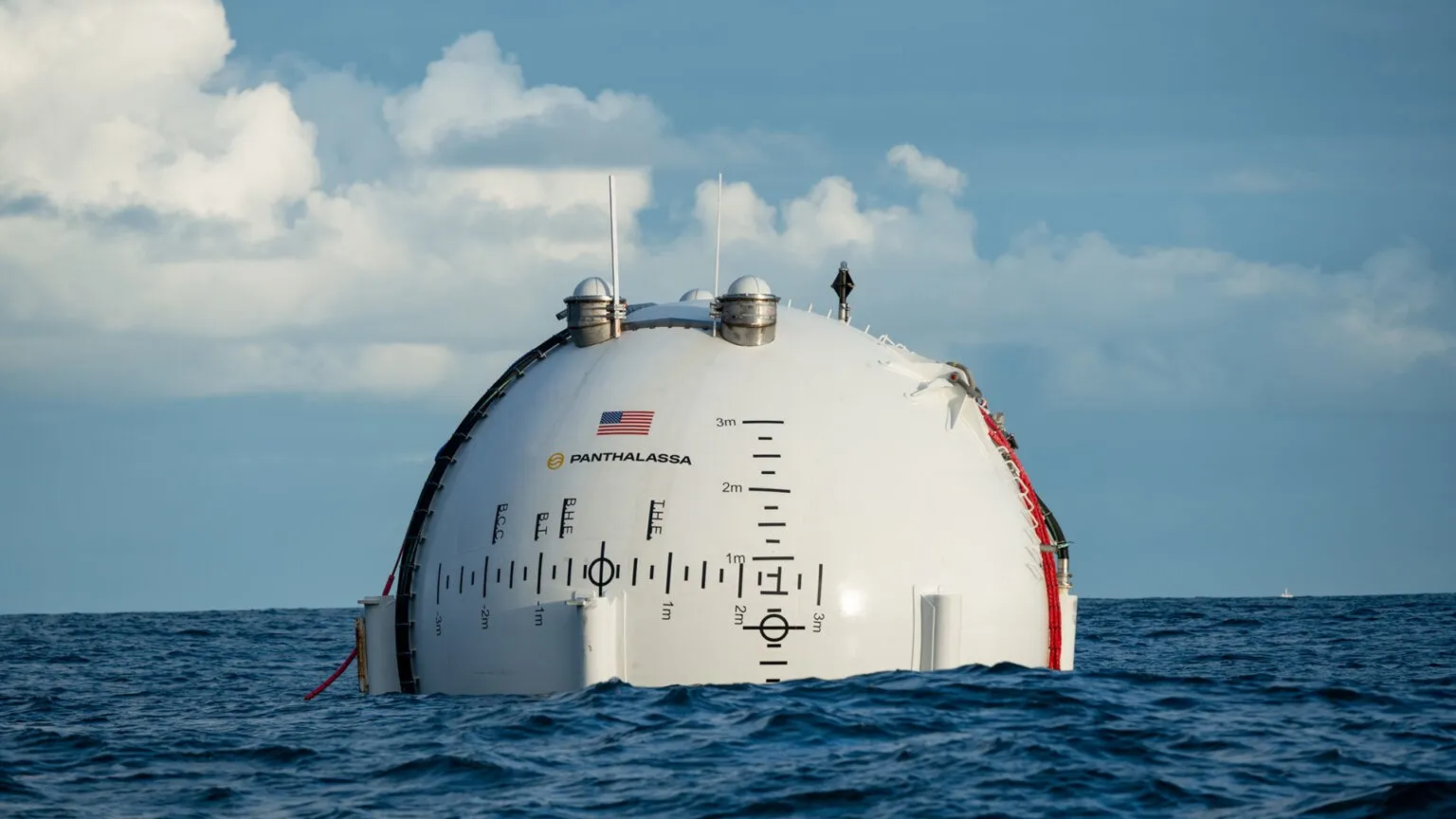
Pathanlassa floating data center
(Image credit: Pathanlassa)

An official press release yesterday confirmed a $140 million investment to power AI data centers at sea. The funding goes to Pathanlassa — a renewable energy and ocean technology company — and was raised in a Series B financing led by avid investor and former PayPal CEO and Palantir co-founder Peter Thiel, alongside several other investors.

The Portland-based start-up said it would use the funding to complete its pilot manufacturing facility in Oregon for its Ocean-3 series nodes — an autonomous platform that will house and power data centers for AI inference computing at sea, using electricity generated from ocean waves.

“There are three sources of energy on the planet with tens of terawatts of new capacity potential: solar, nuclear, and the open ocean,” said Garth Sheldon-Coulson, Co-Founder and CEO of Panthalassa. “We’ve built a technology platform that operates in the planet’s most energy-dense wave regions, far from shore, and turns that resource into reliable, clean power. We’re now ready to build factories, deploy fleets, and provide a sustainable new source of energy for humanity.”

Panthalassa’s solution is an autonomous, fully integrated system called a node that houses both AI infrastructure and power-generating hardware in a single offshore unit. Each lollipop-shaped node consists of a buoyant spherical head connected to a long, submerged vertical tube and structural frame.

As ocean waves pass, the node bobs up and down, but, crucially, the surrounding water moves only in small orbital paths. This relative motion between the structure and the water column induces oscillations within the tube, effectively driving seawater up and down through the system.

That oscillating flow is channeled into the spherical chamber through a high-pressure jet, where it is converted into usable mechanical energy. The water then passes through internal turbines, generating electricity before recirculating back into the tube to repeat the cycle. The system is designed as a closed hydraulic loop that continuously extracts energy from wave-induced motion.

As the ocean never stops moving, the system generates power around the clock. That power runs the onboard payloads. For truly autonomous operation, the system transmits data back to shore via satellite, eliminating the need for tethering. Another noteworthy benefit of the system is that the surrounding ocean provides free supercooling, solving one of the biggest engineering challenges in land-based data centers.

Get Tom's Hardware's best news and in-depth reviews, straight to your inbox.

Each node also incorporates propulsion and station-keeping systems, allowing it to maintain optimal positioning or operate as part of a distributed offshore network, effectively coupling renewable energy generation directly with modular AI compute at sea.

After decades of research and development, and several preceding versions, Panthalassa says it plans to “deploy its Ocean-3 pilot node series in the northern Pacific Ocean, demonstrating AI inference capabilities and refining its manufacturing process in preparation for commercial deployments in 2027.”

AI’s electricity demand is rising much faster than conventional power infrastructure can keep up with. In many regions, grid operators are already struggling to keep up, while communities are increasingly pushing back against new builds over concerns about land use, noise, and energy diversion. In response, companies are scrambling for alternatives, and the solutions are becoming increasingly unconventional. “The future demands more compute than we can imagine,” said Peter Thiel. “Extra-terrestrial solutions are no longer science fiction. Panthalassa has opened the ocean frontier.”

Panthalassa’s wave-powered offshore compute nodes are the latest in a growing line of radical bets on how to power AI sustainably. Last month, we reported that Meta had signed a partnership with an energy start-up to beam solar energy from space to enable continuous, 24/7 power. Other startups are exploring the idea of moving data centers entirely off-planet. These are just a few of the many other initiatives to meet AI’s seemingly impossible electricity demands.

Google Preferred Source

Follow Tom's Hardware on Google News, or add us as a preferred source, to get our latest news, analysis, & reviews in your feeds.

Etiido Uko is a news contributor for Tom's Hardware covering the latest updates in big tech and the PC industry. He is a mechanical engineer and senior technical writer with over nine years of experience in documentation and reporting. He is deeply passionate about all things engineering and technology, and is an expert in gadgets, manufacturing, robotics, automotive, and aerospace.