





惯性聚合 高效追踪和阅读你感兴趣的博客、新闻、科技资讯
阅读原文 在惯性聚合中打开

推荐订阅源

P
Privacy International News Feed
Martin Fowler
Martin Fowler
D
Docker
Y
Y Combinator Blog
云风的 BLOG
云风的 BLOG
U
Unit 42
T
Tailwind CSS Blog
J
Java Code Geeks
G
Google Developers Blog
MongoDB | Blog
MongoDB | Blog
阮一峰的网络日志
阮一峰的网络日志
WordPress大学
WordPress大学
月光博客
月光博客
大猫的无限游戏
大猫的无限游戏
美团技术团队
F
Fortinet All Blogs
N
News and Events Feed by Topic
Exploit-DB.com RSS Feed
Hacker News - Newest:
Hacker News - Newest: "LLM"
The GitHub Blog
The GitHub Blog
cs.AI updates on arXiv.org
Recorded Future
Recorded Future
N
Netflix TechBlog - Medium
Google DeepMind News
Hacker News: Ask HN
Hacker News: Ask HN
L
LINUX DO - 最新话题
Microsoft Security Blog
N
News and Events Feed by Topic
I
Intezer
TaoSecurity Blog
TaoSecurity Blog
NISL@THU
NISL@THU
小众软件
小众软件
博客园 - 聂微东
博客园 - Franky
有赞技术团队
有赞技术团队
P
Palo Alto Networks Blog
爱范儿
爱范儿
H
Hacker News: Front Page
C
Cyber Attacks, Cyber Crime and Cyber Security
C
Cisco Blogs
P
Proofpoint News Feed
I
InfoQ
Google DeepMind News
OSCHINA 社区最新新闻
OSCHINA 社区最新新闻
Vercel News
Vercel News
H
Heimdal Security Blog
C
Cybersecurity and Infrastructure Security Agency CISA
Application and Cybersecurity Blog
Threat Intelligence Blog | Flashpoint
量子位

The Guardian

Rory McIlroy surges into six-shot Masters lead with stunning second-round flourish ‘That’ll be the end’: actor Sam Neill joins fight to stop controversial goldmine near his New Zealand vineyard Roberto De Zerbi targets ‘Ange-ball’ revival to save Spurs from relegation Bath hit back to reach semi-final after stunning Northampton in 11-try epic Secret Garden to Outcome: the week in rave reviews Zebras, wealth and power: Hungary’s election tests Orbán’s grip on power ‘TikTok effect’ brings sellout crowds and younger fans to Grand National meeting The war over Omagh’s gold: the £21bn mine plan tearing a community apart Britain’s shadow workforce is paid as little as 65p an hour. Who cares for the carers? From You, Me & Tuscany to Euphoria: your complete entertainment guide to the week ahead Six great reads: the man who let snakes bite him, masked heavy metal and the brutal reality for foreign students in the UK American Classic review – I defy you not to fall in love with Kevin Kline and Laura Linney’s tender comedy Cuba’s doctors were a lifeline for the world. Now the Caribbean is shamefully complicit in the US drive to expel them An environmental disaster in Moldova has Russia’s fingerprints all over it RMIT drops misconduct case against student who accused university of being ‘complicit in Gaza genocide’ Ichiro Suzuki statue unveiling goes awry as bronze bat snaps during ceremony Survivors of Epstein’s abuse accuse Melania Trump of ‘shifting burden’ on to victims European football: Real Madrid held at home by Girona to extend winless run Arne Slot insists he is ‘aligned’ with Liverpool board and fans as squad is rebuilt Kamala Harris ‘thinking about’ running for president again in 2028 JD Vance warns Iran against trying to ‘play’ the US in peace talks West Ham double up twice to thrash Wolves and put Spurs in relegation zone Trump administration releases new renderings of so-called ‘Arc de Trump’ Crispin Odey drops £79m libel claim against FT over sexual misconduct allegations Bafta apologises for events surrounding John Davidson’s Tourette’s outburst Cocktail of the week: Bar Shrimp’s la rosita – recipe New drug may extend survival in aggressive ovarian cancer, trial shows One dead and 27 injured after bus with British passengers crashes in Canary Islands Pope adds to Smith’s mass of Surrey runs with England woes a world away OpenAI CEO Sam Altman’s home targeted with molotov cocktail Reform UK local election candidate was twice disciplined by Tories over ‘racist comments’ Remaining in Nato is in best interests of US, says Keir Starmer Prince Harry sued for defamation by charity he co-founded Anthropic’s new AI tool has implications for us all – whether we can use it or not Concerns raised about motorbike tourist trail after death of British teenager in Vietnam The Guardian view on Trump’s civilisational threats: the words that fuel war must be condemned The Guardian view on dystopias for our times: the American nightmare Doctors’ leader claims new reduced pay offer killed chances of ending strikes in England Netanyahu-ism has achieved nothing for Israelis – and come at a monstrously high price Deborah Levy: ‘CS Lewis’s White Witch terrified me – but I wanted to meet her’ How I Shop with Michelle Ogundehin: ‘We grownups have enough stuff already’ Trump’s war and Melania’s Epstein statement, with US editor Betsy Reed – The Latest We have to stop killer motorists on Britain’s roads UK starts crackdown on EU citizens’ post-Brexit rights Londoners aren’t unfriendly – but don’t compare us to New Yorkers The religious right and the perversion of faith Artemis II images reignite moon mission memories Orbán and Magyar trade accusations in last days of Hungary election campaign Reckonwrong: How Long Has It Been? review | Safi Bugel's experimental album of the month Martin Rowson on Middle East peace talks – cartoon Masters magic, the Grand National and Premier League drama – follow with us Fears of UK and EU flight cancellations as airports warn of jet fuel shortages Reform’s petulance over slavery reparations shows it just doesn’t grasp Britain’s place in the modern world Peers vote to ban pornography depicting sex acts between stepfamily members Starbucks’s retail arm gets £13.7m tax credit even as sales increase Flyby review – interstellar musical is a voyage of epic strangeness Grand National preview: Jagwar can deny Irish cohort in Aintree classic Week in wildlife: an ostrich on the lam, a tortoise crossing a road and surfing seals Anger as swifts’ nesting holes in Derbyshire rail viaduct ‘blocked up’ Peter Mandelson faces fixed-penalty notice for urinating in public ‘There’s no shortage of terrifying technology’: how AI became TV drama’s new go-to villain ‘Fresher than anything in a shop’: the best recipe boxes and meal kits for time-poor foodies, tested Who was Hilma? Af Klint exhibition to highlight exclusion of women from abstract art Critics assemble! Here’s my list of the greatest superhero movies of all time US inflation soars in March as war on Iran drives economy into uncertainty Amazon to finally launch Leo satellite internet in ‘mid-2026’, says CEO Grand National 2026: horse-by-horse guide to all the runners Pete Hegseth’s holy war: the militant Christian theology animating the US attack on Iran Add to playlist: the beautifully dazed, countrified indie-rock of Tracey Nelson and the week’s best new tracks Not just about Gaza: the Muslim voters turning from Labour to the Greens ‘I’m worried there’s too much of me,’ says a birch: inside the interspecies council giving nature a voice Why is anyone surprised by the US and Israel’s latest war? It’s only what the world allowed them to do in Gaza Tori Amos review – fans hang on every note of this dramatic deep dive into her back catalogue Coachella 2026: Justin Bieber launches a major comeback in the desert Super Mario what?! The seven best obscure Mario games ‘An abomination’: the Lancashire town kicking up a stink over reopened landfill Pillion to Roofman: the seven best films to watch on TV this week Holly Humberstone: Cruel World review – Taylor Swift fave trades gothic melancholy for pop glow-up Thrash review – cursed shark thriller sinks like a stone on Netflix Gulf states rethink security in light of US-Israel war on Iran Go Gentle by Maria Semple review – a joyfully clever New York romcom Welcome to Y’all Street: bullish Dallas aims to steal New York’s financial crown Margo’s Got Money Troubles to Beef: the seven best shows to stream this week I baulked at the idea of ‘friction-maxxing’. But there’s more to it than meets the eye Reich: The Sextets album review – Colin Currie celebrates the minimalist master’s joy of six Benjamina Ebuehi’s sweet and salty chocolate chip cookies recipe Experience: my house was taken over by 70,000 bees Malcolm in the Middle: Life’s Still Unfair review – the TV magic they’ve created here is absolutely miraculous Lava bursts forth as Hawaii’s Kilauea volcano erupts Sonos review: Are these the best portable speakers that money can buy? I tested to find out Buy bread in the evening, hit the sales on a Tuesday: retail workers’ top tips to cut your shopping bill The best water flossers in the UK, tested for that dentist-clean feeling Where to start with: Muriel Spark You be the judge: should my girlfriend stop mixing gold and silver jewellery? The best carry-on luggage in the UK, tested on an assault course How games capture the awe and terror of cosmic isolation I never text back – and it’s ruining my relationships The pet I’ll never forget: Beau, the labrador who saved my life Life Is Strange: Reunion review – a decade-long story comes to an impassioned close Why is gaming becoming so expensive? The answer is found in AI
‘At a crossroads’: will piling-up crises force Europe to put brakes on US-style car culture?
Ajit Niranja · 2026-05-07 · via The Guardian

On a brisk winter’s evening in Europe’s automotive heartland, a cyclist who had pushed for safer streets went out on his bike for a final time. Andreas Mandalka had documented dangerous driving and shoddy cycling infrastructure for years, measuring the margins at which cars zipped past him and posting videos of blatant violations. While quick to remind readers that only a small proportion of drivers behaved badly, the 44-year-old blogger in Baden-Württemberg, Germany, had grown frustrated with authorities for failing to act. He felt they viewed him as a nuisance.

As he cycled down a straight stretch of renovated road that runs parallel to a forest path he had flagged for poor quality, lights bright on his bike and helmet firm on his head, he was fatally struck from behind by a car.

“I went to bed that evening, took a quick look at my phone and saw a police report of an accident in our area,” said Siegfried Schüle, a friend of Mandalka’s from a cycling organisation in Pforzheim. “I immediately had a very strange feeling. I reposted this tweet from the police, with typos and everything, and just wrote: ‘Andreas, how are you?’ That was my last message to him.”

Mandalka was one of 19,934 people killed in 2024 on EU roads, which are among the safest in the world. Traffic collisions cause 1.19m deaths around the world each year.

As carmakers flood the market with bigger and more harmful models, the added pressures of air pollution, climate breakdown and volatile petrol and diesel prices are fuelling renewed efforts to break the societal dependence on automobiles.

“It’s not about taking anything away from anyone,” said Schüle, a startup founder. “It’s just about giving everyone the same freedom – even if they don’t have a driver’s licence – to move safely.”

Public health experts struggle to convey the risks that cars pose to people without sounding alarmist. Loud machines in steel cages, the vast majority of which burn fuels that foul the air and heat the planet, zoom past schools, homes and hospitals. Rubber tyres kick road dust and microplastics into the air. The outsized infrastructure deprives cities of cycle paths, forcing commuters to drive more and exercise less, while limiting space for parks to socialise and enjoy nature. Paving over greenery leads to hotter heatwaves, heavier flash floods and higher stress levels.

“The list goes on,” said Dr Audrey de Nazelle, an environmental epidemiologist at Imperial College London. Yet it is partly the diffuse nature of the dangers that hinders efforts to reduce car use, she said, with policymakers pursuing isolated fixes such as electric vehicles to avert climate damages and added safety features to cut crash deaths.

“In governance, there’s a separate solution for everything but no way to embrace all the benefits – and that’s what hinders change,” De Nazelle said.
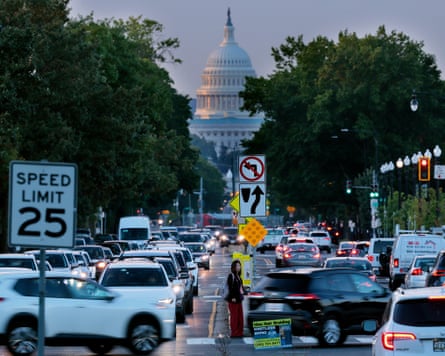
Washington DC at a standstill as morning traffic moves slowly along North Capitol Street Northwest
Even in the car-centric US, almost one in five vehicle-owning adults in cities and suburbs are ‘strongly interested’ in living car-free. Photograph: Chip Somodevilla/Getty Images

Signs of frustration have begun to emerge. Mayors around the world have felt emboldened to reallocate road space in their pursuit of clean air, and many drivers – motivated by money, comfort, health or the environment – want to get out from behind the wheel. In Europe, an Ipsos poll found more people than not report more walking and public transport use in the last five years, while personal car use has fallen slightly out of favour. Even in the car-centric US, almost one in five vehicle-owning adults in cities and suburbs are “strongly interested” in living car-free, a study found in February, with two in five open to the idea.

Surprisingly, the latest pleas to get off the road have come from energy experts rather than doctors or environmentalists. In March, the International Energy Agency (IEA) encouraged carsharing, driving slower and working from home to cushion the shock from soaring fuel prices caused by the Iran war. It cautioned countries against fighting high prices at the petrol pump with blanket subsidies – as many did during the last energy crisis – and advised targeting financial support to vulnerable groups instead.

Average footprint of vehicle models sold in the US by vehicle category

Yet even as the reasons to limit car dependence mount, the vehicles themselves keep growing in size. Like for like, bigger cars waste more fuel, spew more pollution, take up more space and pack more punch in a crash. In Europe, where most new cars sold are SUVs, the average vehicle mass has risen since 2010 by 9% for combustion engine cars and by 70% for battery electric ones, according to data from the International Council on Clean Transportation, an nonprofit research organisation. On top of the direct harms, the supersizing of electric vehicles may also have slowed the transition away from fuel-burning ones by pricing people out of clean alternatives.

“Europe is at a crossroads,” said Lucien Mathieu, the director of cars at Transport and Environment (T&E), a nonprofit in Brussels. He said the choice ahead was to manufacture the “compact affordable electric vehicles” that China has begun to popularise across the developing world or to embrace the expensive “mega SUVs and monster trucks” that the US has championed. More than 80% of cars sold in the US are now an SUV, van or pickup truck, official data shows.
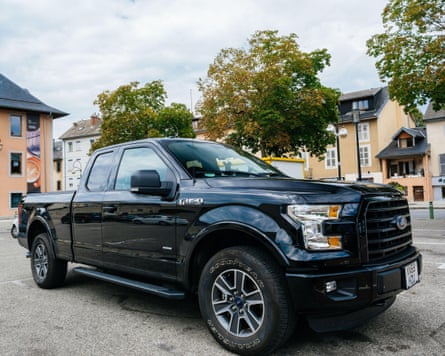
Front view of new F-150 Ford pickup truck in a European square
Thousands of pickup trucks such as the Ford F-150 are on European streets, evading EU safety standards through an import loophole. Photograph: ifeelstock/Alamy

For now, the SUVs clogging European roads are fairly dainty by North American standards, with the additional threat to human health coming more from higher bumper heights rather than the added pollution that extra weight entails. But even bigger vehicles are revving their engines around the corner. Thousands of pickup trucks such as the Dodge Ram 1500 and Ford F-150 have been driven on to European streets in recent years, evading EU safety standards through a backdoor process that allows individual vehicles to be imported under less stringent conditions. Efforts to close the loophole have been complicated by a US-EU trade deal last year that calls for “mutual recognition to each other’s standards” on automobiles.

The agreement, which to the frustration of Donald Trump has been signed but not ratified, is helping carmaker efforts to get big vehicles into Europe. In December, the American Automotive Policy Council (AAPC) wrote to Howard Lutnick, the US commerce secretary, to protest against planned changes to the EU’s import approval process. Last month, in a follow-up seen by the Guardian, the lobby group claimed the latest draft proposal constituted “a significant trade barrier” that ran counter to the agreement. Among its objections were requirements to test vehicles to European emissions standards, fit them with gas particulate filters and equip them with pedestrian protection sooner than the AAPC deems feasible.

Average weight of vehicle models sold in the US by vehicle category

Carmakers in North America and Europe have sought to justify the shift to bigger cars by saying they are meeting consumer demand for spacious vehicles. Even amid a cost of living crisis, customers have been willing to pay premiums for vehicles that are more expensive to buy and run, with an increase in drivers defaulting on automobile loans ringing alarm bells on Wall Street. Critics complain that the automotive industry is obscuring the role its adverts play in generating demand while it chases the higher profit margins that SUVs offer.
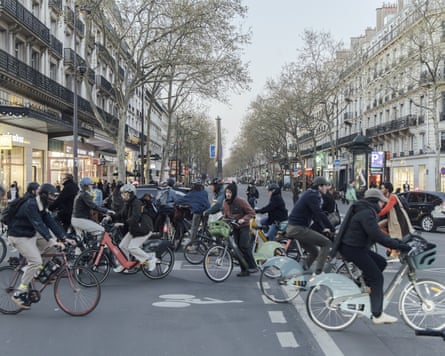
A multitude of cyclists on Boulevard Sebastopol in Paris in March
Paris and London have only in recent years taken steps to bolster public transport systems, share road space with cyclists and restrict motorists. Photograph: Bloomberg/Getty Images

Is Europe doomed to follow North American car bloat? There are some signs that the rise of SUVs may be spurring resistance to car culture more broadly. A handful of European cities began the process of reducing car dependency decades ago, such as the Dutch and Danish cities that removed urban motorways and built bike lanes after the oil crises in the 1970s, but other frontrunners such as London and Paris have only recently taken transformative steps. Their efforts to bolster public transport systems, share road space with cyclists and restrict motorists are being cited across the continent as proof that a shift away from cars is feasible and desirable.

Yet even places of progress show mixed support. In London, the introduction of an ultra-low emissions zone generated so much backlash that it became the face of a widespread conspiracy theory that painted “15-minute cities” as a globalist plot of government control. In Paris, whose transformation under the city’s former mayor Anne Hidalgo was celebrated around the world, public referendums on pedestrianising school streets and charging big cars more to park were won with tepid, single-digit percentage turnout – even though recent municipal elections showed little appetite for backsliding.

Even the IEA’s fuel-saving call has been largely ignored outside of Asia, where shortages are hitting hardest. The EU has relegated demand-cutting measures to an annexe of “good national practices” in the emergency response package it released last month. In the US, the failure to provide public transport and build walkable neighbourhoods means few even have the luxury of alternatives to the automobile.

At the heart of the problem, some transport researchers and campaigners say, is that measures that restrict motorists are portrayed as an attack on civil liberties and lower-income households – while the costs of car culture are ignored outright.

“If someone buys a new SUV and puts it on the street, the space is gone,” Schüle said. “We don’t have a problem as a society with putting that private property in the public space – that’s completely OK and accepted. But the moment someone explicitly says ‘hey, we’d like to build a cycle path here’, the uproar is huge.”