







To paraphrase the musical Rent, 131,487,300 minutes – how do you measure, measure 250 years? Especially in a country navigating an election year fraught with divisions and disagreements over basic facts?
That is the challenge facing the Smithsonian National Museum of American History in Washington DC as it marks the semiquincentennial of US independence.
Its answer is with 250 objects that tell the American story, ranging from a revolutionary war-era gunboat to gloves worn by a “Miracle on Ice” hockey player, from Thomas Jefferson’s desk to a Donald Trump fan’s “Make America great again” hat.
“How do you structure a commemoration, celebration and time for reflection?” asks Anthea Hartig, the museum’s director. “What we landed on were those moments where individuals or communities had fought for recognition and advocated for their own sense of identity and self in their role in creating and becoming a part of the United States. But we also wanted to do the playful.”
Hartig describes the US as “amazing, beautiful, complicated”, and cites the African American writer James Baldwin’s celebrated observation: “American history is longer, larger, more various, more beautiful, and more terrible than anything anyone has ever said about it.”
Opening on 14 May, In Pursuit of Life, Liberty & Happiness will display 250 objects encompassing 250,000 sq ft across all three floors of the museum. They range from old to new, from big to small and from sublime to mundane.
Seventy-six of them – many rarely or never seen by the public – will be concentrated in cases lining the entry halls, while the remainder will be embedded throughout the museum’s existing galleries, connected by a “ribbon” design to guide visitors on a historical treasure hunt. Each is paired with an action verb to underscore Hartig’s view of democracy as a “highly participatory sport”.
She adds: “We believe that this anniversary is so important not only to the nation but the world, and that our past 250 years are filled with so much history that it takes an entire museum to do it justice.”
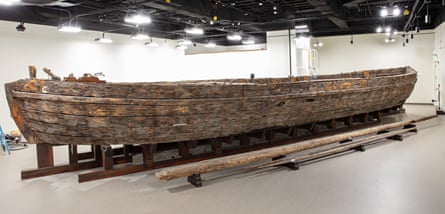
Among the star attractions is the Philadelphia, a 53ft, flat-bottomed wooden gunboat constructed in the chaotic, sweltering summer of 1776. On a recent preview tour, the Guardian stepped into a climate-controlled enclosure at the museum where the air was thick with the scent of 100% acetone.
Behind viewing windows that allow the public to see the work in progress, two conservators clad in headlamps and respirators were meticulously wielding soft and stiff bristle brushes, dental picks and wooden dowel rods to strip away decades of accumulated lacquer from a rusted iron cannon and its surrounding timber.
Hastily built in Skenesborough, New York, by a scrappy workforce of free and enslaved people under the command of Benedict Arnold, the Philadelphia was part of a desperate attempt to stall British forces on Lake Champlain. It did not last long. During the Battle of Valcour Island, the Philadelphia was struck by a 24lb British cannonball near its bow and sank to the frigid depths of the lake.
The wreck languished there for 159 years before Lorenzo Hagglund, an experienced salvage engineer and amateur historian, dragged the bay and hoisted it to the surface in 1935, fully intact with its armament and hundreds of artifacts scattered across its deck. Today, this 16,000lb relic is the only surviving US-built boat from the revolutionary period.
Peter Fix of Texas A&M University, the lead conservator on the gunboat preservation project, notes that the original wooden planks are now only three-quarters of their original thickness, having been eroded by centuries of underwater bacteria. The bacteria ate away at the wood around the boat’s iron fasteners, leaving hollow ovals in the timber. Yet, thanks to groundbreaking engineering science, Fix believes the preserved material will now last “at least another thousand years”.
The boat also continually surrenders new secrets that complicate the historical record. When the Philadelphia was raised, it was discovered that one of its cannon had a bar shot hanging from its lip and two more shots ready to fire. Jennifer Jones, the project director, says: “This was like a triple shot on one cannon so it sounded like they were desperate to get these shots off quickly.”
The crew list notes 44 men were assigned to the boat, a claustrophobic reality that historians are still trying to model. Yet on payday after the battle, only 33 men showed up. The fate of the other 11 remains a mystery.
Jones adds: “There’s about 600 to 800 items that came up with the boat. That includes things like the cannon, the carriages, the wheels, the trucks for the carriages. We have a stew pot as well as a melting pot for pitch. There was a patch full of pitch and a pitch brush. We have buckles from shoes – some shoe leather and some formed shoes came up; buttons from regimental coats. The team did find, when they were cleaning out, a leather button, which was probably from someone’s breeches.”
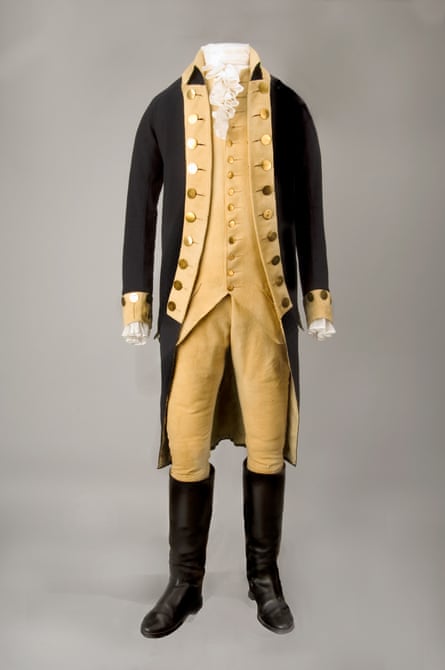
Nearby, a new virtual reality experience promises to transport visitors back to the boat’s construction 250 years ago. Elsewhere in the museum, visitors can see the portable desk on which Thomas Jefferson drafted the Declaration of Independence, the Star-Spangled Banner that inspired the national anthem, and George Washington’s military uniform.
But placed on equal footing are items that capture the eccentricities, innovations and intimate realities of daily life. There is a faux-pearl necklace worn by Abigail Adams in the mid-18th century. The “pearls” are actually blown glass meticulously covered in fish scales to simulate the iridescent sheen of the real thing.
Hartig says: “I love the thought of John [Adams] not being able to afford pearls but somehow also being in that revolutionary moment where they are simultaneously identifying as quite British but yet they’re still searching for a new identity and new way to govern themselves as free people – John freer than Abigail.”
The exhibition leans joyfully into American weirdness and ingenuity, including an unreasonably heavy wooden surfboard used by the Native Hawaiian athlete Duke Kahanamoku in 1928. There is a 1970 Earth Day flag, gloves worn by Phil Verchota during the “Miracle on Ice” Olympic hockey victory in 1980 and a steelworker’s hard hat recovered from the wreckage of the terrorist attacks on 9/11. A Nintendo console will be a sobering reminder to an entire generation that their childhood is now officially museum history.
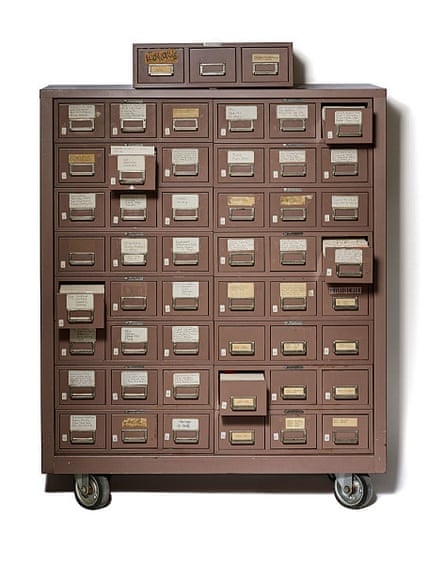
There is also a massive filing cabinet that once belonged to the trailblazing comedian Phyllis Diller. Megan Howell Smith, the museum’s head of experience development, says: “It contains over 52,000 handwritten jokes, each on a different note card. She noted when she used it, what the date was, how it was received, if there are any changes she made to it – some of them are scratched out. To have her whole career in a humdrum file cabinet is pretty amazing.”
Then there is the Coney Island hotdog cooker from 1904, which has six vertical glass cylinders and used an electric current that surged between electrodes at each end of an upright dog. Howell Smith laughs: “It represents the ways that our freedoms have helped encourage technological progress and it represents people trying to get a good hotdog. Now, whether a hotdog coming out of there would be good is for someone else to decide.”
Yet the exhibition does not shy away from often brutal chapters of the American story. The curation includes the Greensboro lunch counter, a site of 1960 civil rights sit-ins. Visitors will find a deck of playing cards painstakingly crafted from scrap paper by Joan Trumpauer Mulholland, a white teenage Freedom Rider who was detained in Mississippi’s notoriously brutal Parchman prison.
Howell Smith comments: “You would come across those and, if you didn’t know what they were, you’d be like: ‘Oh, it’s some scraps of paper.’ But they are loaded with such meaning and so much history.”
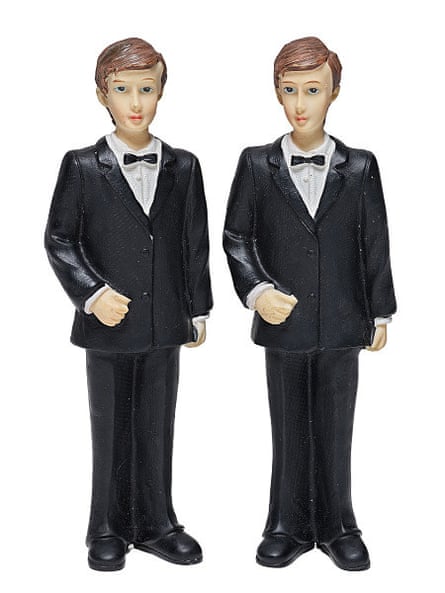
The curators have also intentionally placed objects in conversation with one another to illustrate the push and pull of social progress. In one striking display, two wedding cake toppers sit side-by-side: a traditional man and woman from 1957, and two men from 2008.
Asked about the inclusion of a Maga hat, Howell Smith explains: “We’re trying to show all things, all sides. We take very seriously that all people need to feel themselves represented here. People are still pursuing life, liberty and happiness in all kinds of different ways.”
Since returning to office, Trump has accused the Smithsonian Institution of presenting an unduly negative version of US history and demanded a review of its exhibits. He has also sought to hijack the country’s 250th birthday to present a flag-waving celebration of heroic founders and American exceptionalism.
The museum has been working closely with America 250, the congressional commission planning the 250th anniversary, and the White House. Hartig maintains that the Smithsonian has insulated itself through rigorous, unassailable scholarship.
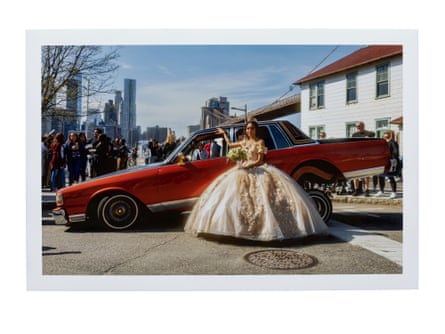
“We put ourselves through our paces internally,” she says. “It doesn’t mean our work can’t be interesting and provocative and inclusive; it just also then has to be scholarly grounded and so I feel very comfortable about that. We have something for everybody. That’s the beauty of the museum and the 250 objects. The breadth is exciting.”
Hartig, the first female director of the museum, likens American history to origami. “It’ll sometimes fold in on each other and you’ll feel like the sides are touching in terms of echoes of the past. Our job is to unfold that origami bird or frog or whatever we’ve made – maybe it’s an eagle – and to see how all of those folds come together, but also to know that we can learn from that and be sustained by it and not necessarily bound by it as we together imagine a new future.
“It’s an awe-inspiring and awesome responsibility that we’re incredibly grateful to serve and this will be a big year of service for the whole Smithsonian. I’m confident and hopeful that we’ll look back on it and feel that we gave our all to help people both domestically, but also from around the world, reflect and celebrate and commemorate.”
-
In Pursuit of Life, Liberty & Happiness opens at the Smithsonian’s National Museum of American History in Washington DC on 14 May